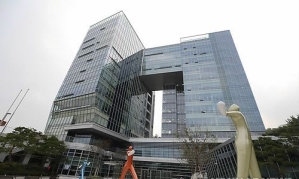
Policy and Land Committee Hold Forum
With the June 3 local elections approaching next year, the broader ruling bloc has been continuously criticizing Seoul Mayor Oh Sehoon. The Democratic Party of Korea has even established the Oh Sehoon Administration Failure Normalization Task Force (hereafter referred to as the Oh Sehoon TF).
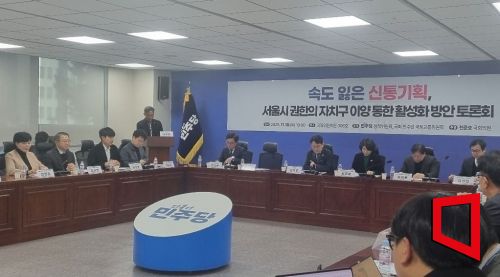 Members of the Democratic Party Policy Committee and Chun Junho, a member of the Democratic Party of Korea, along with ruling party members of the National Assembly Land, Infrastructure and Transport Committee, held a forum on the 18th at the National Assembly titled "Revitalization Measures for the New Town Planning Losing Momentum through the Transfer of Seoul City Authority to Autonomous Districts." Photo by Moon Hyewon
On the 18th, members of the Democratic Party Policy Committee and ruling party members of the National Assembly Land, Infrastructure and Transport Committee held a forum at the National Assembly under the theme "Revitalization Plan for the New Town Project Losing Momentum through the Transfer of Seoul City Authority to Autonomous Districts," specifically targeting Mayor Oh's flagship project, the "Fast-Track Integrated Planning" (hereafter referred to as Integrated Planning).
Cheon Junho, a member of the Land, Infrastructure and Transport Committee and head of the Oh Sehoon TF within the Democratic Party, directly criticized, "Seoul City has promoted Integrated Planning as its key initiative, pledging to drastically shorten the redevelopment project period and accelerate housing supply, but in reality, the process is not fast but rather stagnating on the ground."
Integrated Planning is a system introduced after Mayor Oh Sehoon took office in 2021, designed to improve the complex procedures and regulations of the existing redevelopment process. In May 2021, the city announced six major deregulation measures for redevelopment, including the abolition of the residential maintenance index system and the introduction of public planning.
Regarding this, Assemblyman Cheon pointed out, "Out of 224 residential maintenance project zones, only two have actually commenced construction, and even these are for office supply, not housing, meaning there have been no housing starts at all. The authority to designate maintenance zones and conduct integrated reviews of project implementation plans is concentrated in Seoul City, which has led to increased conflicts among residents and administrative bottlenecks during the review stage, causing redevelopment projects to come to a standstill."
He further emphasized, "The stagnation in housing supply stems from excessive concentration of administrative authority and inefficiency in conflict management. Contrary to its name, 'fast-track,' the administration is actually hindering supply."
Han Jeongae, Chair of the Democratic Party Policy Committee, who attended the forum, stated, "During Mayor Oh's 4 years and 3 months in office, the number of permits and housing starts decreased by 84,549 units and 135,500 units, respectively, compared to the same period under the previous mayor. On the ground, hundreds of projects are piling up for review by Seoul City, creating bottlenecks, and once delayed, projects are pushed back by one to two years due to structural problems."
She added, "We are not trying to place all the blame on Seoul City. What matters is finding a solution. We are not suggesting transferring all projects, but rather selectively transferring maintenance projects below a certain scale and working together to minimize any side effects."
© The Asia Business Daily(www.asiae.co.kr). All rights reserved.