Trump's "F-35 Sale to Saudi Arabia" Sparks Controversy
Israel Protests, Demanding Preservation of Military Superiority
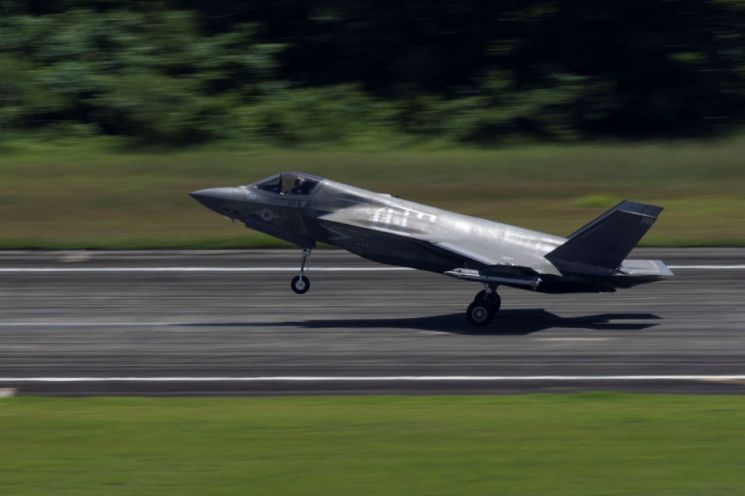 An F-35 fighter jet belonging to the US Marine Corps taking off from Roosevelt Roads Naval Base in Puerto Rico. Photo by Reuters Yonhap News
As U.S. President Donald Trump announced plans to sell the state-of-the-art stealth fighter jet F-35 to Saudi Arabia, concerns are mounting that the balance of power in the Middle East could be shaken. Although the Israeli government is protesting, demanding that its military superiority in the region be maintained, there is a possibility that the Trump administration may eventually approve F-35 purchases not only for Saudi Arabia but also for other Arab countries such as the United Arab Emirates (UAE) and Qatar.
Trump: "F-35 Sale to Saudi Arabia"... Israel Protests, Demanding Adherence to 'QME Principle'
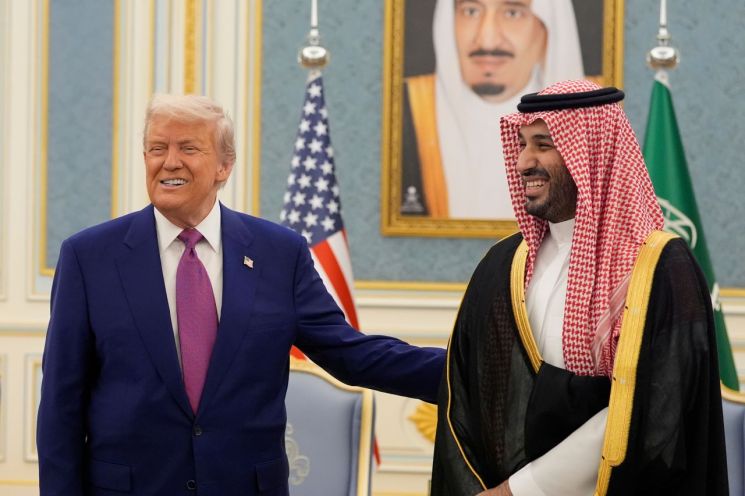 In May, Donald Trump, President of the United States (left), exchanged greetings with Mohammed bin Salman, Crown Prince of Saudi Arabia (right), during a state visit to Riyadh, the capital of Saudi Arabia. Photo by AP
On the 17th (local time), President Trump stated at a press conference at the White House, "Saudi Arabia wants to buy the F-35. We will sell the F-35 to them, as they are a great ally," adding, "Saudi Arabia was also satisfied with the U.S. airstrikes on Iran's nuclear program in June." He made this announcement ahead of a summit meeting with Saudi Crown Prince Mohammed bin Salman, signaling his approval for the sale of F-35 fighter jets.
The F-35, the U.S. military's advanced stealth fighter, is currently only possessed by Israel in the Middle East, with the Israeli Air Force operating 36 units. The F-35 can evade air defense systems and carry out airstrikes, and Israel has actively used it in real combat situations, such as strikes against Hamas and Iran. Saudi Arabia is reportedly seeking to purchase 48 F-35 fighter jets, which is more than Israel currently owns.
The Israeli government opposes selling the F-35 to Saudi Arabia without its approval. Axios, citing an Israeli government official, reported, "We conveyed to the Trump administration that we would only support the supply of F-35s if relations between Saudi Arabia and Israel are normalized." While Saudi Arabia and Israel have not engaged in direct conflict since the Middle East wars, they remain at odds over the Palestinian issue and have not established diplomatic relations.
Within Israel, there is backlash against the Trump administration potentially pushing ahead with the F-35 sale to Saudi Arabia despite Israeli opposition, as it would violate the 'Qualitative Military Edge (QME)' principle established through U.S.-Israel arms supply agreements. The QME, a principle set after the outbreak of the Fourth Middle East War in 1973, stipulates that only Israel should receive advanced weapons from the U.S. to ensure its military superiority in the region.
Will the Balance of Power in the Middle East Shift... Concerns Over Technology Leaks to China
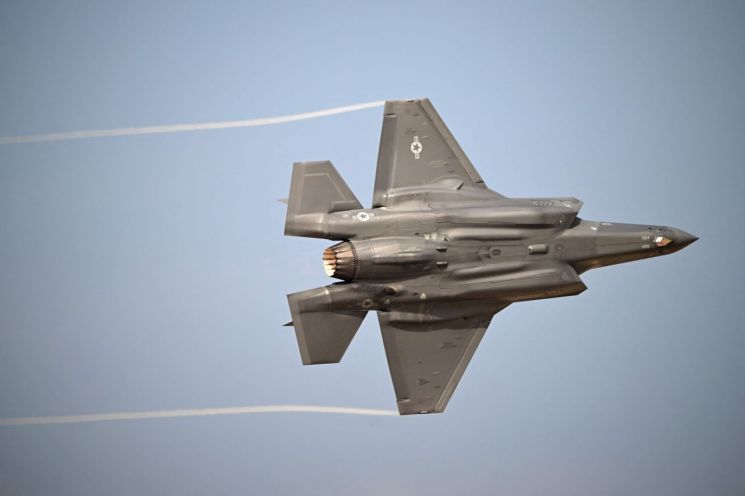 On the 17th (local time), an F-35 fighter jet performed a demonstration flight at the airshow held in Dubai, United Arab Emirates (UAE). Photo by AFP Yonhap News
Israel is concerned that if F-35 exports to Saudi Arabia are approved, similar sales to other Middle Eastern countries such as the UAE and Qatar could follow. If Saudi Arabia and most other Arab countries acquire F-35 capabilities, Israel's military superiority could be significantly undermined, potentially altering the balance of power in the Middle East.
The U.S. defense media outlet The Defense Post reported, "The Israeli government is worried that, just as Iran, once a pro-U.S. country, turned hostile after its revolution, other Middle Eastern countries could also become adversaries after acquiring the F-35." The report also noted that when the UAE expressed interest in purchasing the F-35 in 2020, the Israeli government strongly opposed the sale, leading the U.S. government to withdraw the offer.
Some experts warn that selling the F-35 to Saudi Arabia and other Middle Eastern countries with close ties to China could result in U.S. advanced fighter jet technology leaking to China. Given the ongoing security cooperation between Saudi Arabia and China, critics argue that selling advanced weaponry to these nations should be avoided.
The New York Times (NYT), citing U.S. Department of Defense officials, reported, "There are concerns that after the F-35 deal, Chinese espionage or security cooperation between China and Saudi Arabia could result in F-35 manufacturing technology being transferred to China." The report also noted, "Saudi Arabia has purchased short-range ballistic missiles from China over the past several years and continues to buy missiles from China even now."
© The Asia Business Daily(www.asiae.co.kr). All rights reserved.
![Clutching a Stolen Dior Bag, Saying "I Hate Being Poor but Real"... The Grotesque Con of a "Human Knockoff" [Slate]](https://cwcontent.asiae.co.kr/asiaresize/183/2026021902243444107_1771435474.jpg)

















