"Not Just 'Ten Seoul National University-Level Schools'
But 'World-Class Universities in Diverse Fields'"
"Just as Arizona State University (ASU), considered the most innovative university in the United States, was cautious about 'Harvardization'-that is, simply copying Harvard-the plan to create '10 Seoul National Universities' should also focus on developing each university by nurturing its unique characteristics." (Bae Sanghoon, Professor of Education and Dean of Academic Affairs at Sungkyunkwan University)
"World-class universities such as the Massachusetts Institute of Technology (MIT), ETH Zurich, Nanyang Technological University in Singapore, and Aalto University in Finland did not grow by imitation, but rather within their own distinctive ecosystems. The goal of creating '10 Seoul National Universities' should not be to produce 'Seoul National University-level' institutions, but to foster ten different world-class universities, each with its own strengths." (Park Jaemin, Professor at Konkuk University and Vice President of the Korea Association of University Technology Holding Companies)
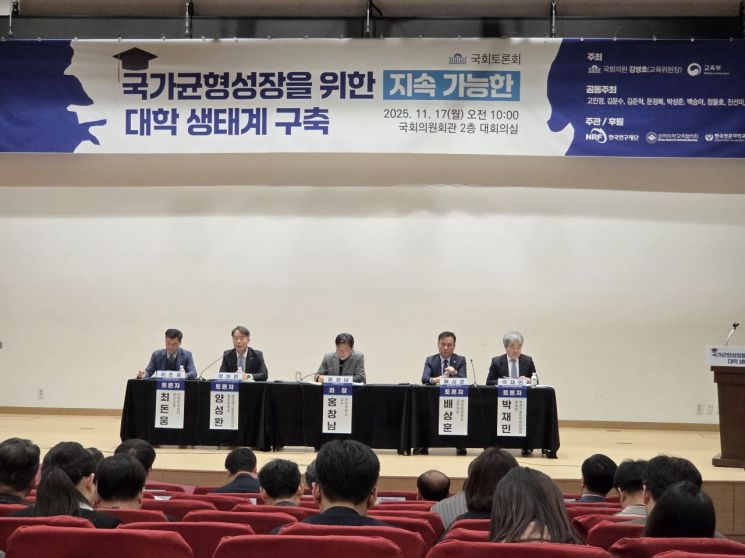 On the 17th, a National Assembly forum titled "Establishing a Sustainable University Ecosystem for National Balanced Growth" was held at the National Assembly Members' Office Building. Participants unanimously agreed that the government's plan to create "10 Seoul National Universities" should focus not simply on "copying Seoul National University" but on fostering world-class universities each with distinct strengths. Photo by Juyoun Oh
At the National Assembly forum titled "Establishing a Sustainable University Ecosystem for National Balanced Growth" held on the 17th at the National Assembly Members' Office Building, participants engaged in a heated debate over the government's plan to create "10 Seoul National Universities." They agreed that the initiative would not succeed if it simply involved regional flagship national universities "copying Seoul National University or rebranding themselves." Instead, they emphasized the need to help each university grow into a specialized institution by leveraging its distinctive features.
The forum was co-hosted by the Ministry of Education and the Chair of the National Assembly's Education Committee, Assemblyman Kim Youngho. The underlying view was that, to achieve the government's "Five Core Regions and Three Specialized Zones for National Balanced Growth," it is essential to establish a sustainable cooperation system among local governments, industries, universities, and research institutes centered on each region's flagship national university. The "10 Seoul National Universities" initiative is a higher education policy aimed at developing regional flagship national universities to the level of Seoul National University. Participants stressed that the policy should not remain a slogan but should focus on making these universities truly desirable destinations for students.
In her congratulatory remarks, National Assembly Education Committee ruling party secretary Koh Minjung said, "Universities should be able to answer the question, 'Is this a university my child truly wants to attend?'" She argued that the regional flagship national universities selected for the "10 Seoul National Universities" initiative should become the best in Korea in at least one specific field.
While the specialization of each university is important, some participants also argued that "enhancing regional competitiveness" must be achieved simultaneously. After the discussion, Chungbuk National University President Ko Changsub noted, "There is a very strong preference for the Seoul metropolitan area in Korea," and added, "It may be a chicken-and-egg question, but it is necessary to strengthen regional competitiveness." He explained that even if local universities attract talented students, if there are no jobs in the region after graduation, graduates will inevitably move to the Seoul metropolitan area, creating a vicious cycle in which talent does not remain in the region.
Feelings of marginalization among local private universities under the "10 Seoul National Universities" policy were also voiced. The head of the RISE project group at Sangji University in Wonju, Gangwon Province, said, "Local private universities feel like small fry in the grand narrative of creating 10 Seoul National Universities," and added, "As local private universities are on the front lines of population decline and dwindling freshman enrollment, they are being hit much harder than local national universities. I hope the education authorities will provide more concrete policies in this regard."
Hong Changnam, Professor at Pusan National University and chair of the session, who previously served as Head of the Social Affairs Division 2 of the Presidential Committee on State Affairs Planning, said, "I have often been asked whether Seoul National University should really be the model that all universities in Korea should follow." He explained, "The name '10 Seoul National Universities' was retained to help the public easily understand the policy, but a more appropriate name will be introduced in future government agendas."
On the same day, Minister of Education Choi Gyojin stated, "We will create a 'Five Core Regions and Three Specialized Zones Industry-Academia Innovation Belt' and support field-oriented innovative education and research platforms that enable regional universities to grow together through joint research institutes and shared campuses in each region." He added, "We will also work with the Regional Era Committee, the Ministry of Trade, Industry and Energy, and the Ministry of Land, Infrastructure and Transport to create youth jobs and improve living conditions in the regions."
The Ministry of Education plans to develop a "Regional University Development Plan for National Balanced Growth" in December, based on the cases and policy proposals discussed at this forum.
© The Asia Business Daily(www.asiae.co.kr). All rights reserved.