Samsung and SK Strengthen AI Semiconductor Production Capabilities
Hyundai Motor Builds Mother Factory Linked with Robotics
Securing Manufacturing Leadership, Preventing Industrial Hollowing-Out
The intention behind Samsung, SK, Hyundai Motor, and LG Group investing 800 trillion won over the next five years is to prevent industrial hollowing-out while building 'super-gap factories.' Their strategy is to design the pinnacle of the manufacturing transformation-spanning artificial intelligence (AI), semiconductors, batteries, and robotics-within Korea, thereby staying ahead of China's technological advances.
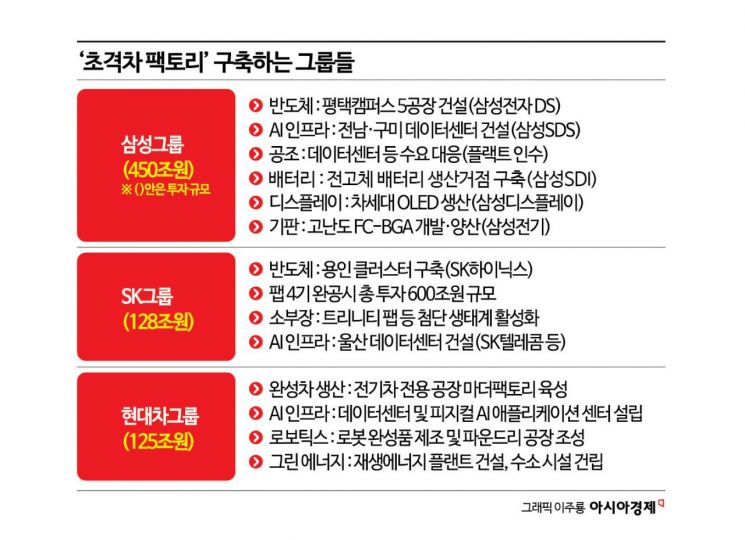
According to the business community on November 17, Samsung plans to invest 450 trillion won by 2030, Hyundai Motor 125 trillion won, LG 100 trillion won, and SK is set to spend over 128 trillion won by 2028. This investment announcement was made after the conclusion of the Korea-US tariff negotiations, as a measure to prevent industrial hollowing-out. With a determination to secure future growth engines domestically, massive investments are expected not only in the Seoul metropolitan area but also across various regions.
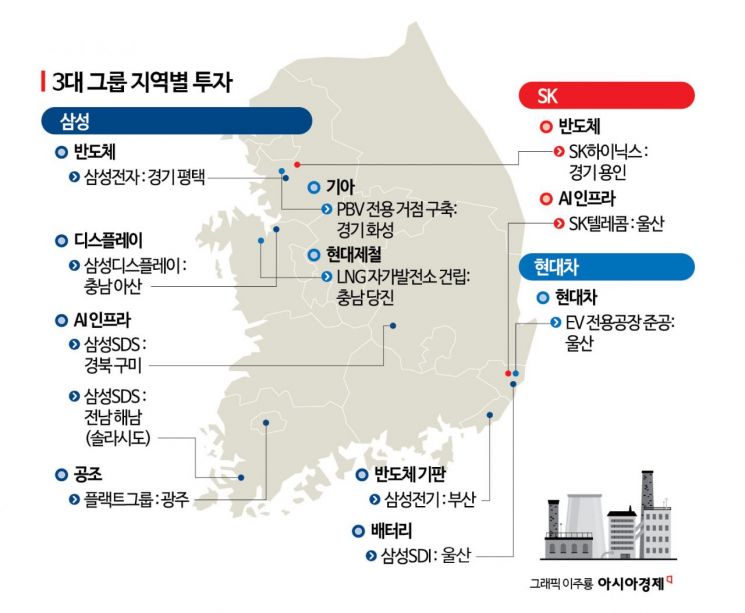
Given that the fact sheet outlining the results of the Korea-US negotiations is clearly intended to keep China in check, analysts believe the goal goes beyond merely addressing domestic production hollowing-out. Industry insiders view this as a structural choice to establish 'super-gap K-factories,' which China would find difficult to replicate in the short term, thereby securing manufacturing competitiveness.
The decision by Samsung Electronics and SK Hynix to make large-scale investments in domestic semiconductor production facilities follows the same logic. According to a report released the same day by the Federation of Korean Industries titled "Competitiveness Status and Outlook of Korea, the US, Japan, and China," Korea's semiconductor technology is projected to be caught up by China in five years. The fifth plant at Samsung's Pyeongtaek Campus, which Samsung announced it would expand, will produce high-bandwidth memory (HBM) and server DRAM-core memory for AI training and inference. As these are fields where process complexity is high and the accumulation of production technology is crucial, it is assessed that proactive expansion alone can partially fend off competitors. Solid-state batteries, next-generation organic light-emitting diodes (OLEDs), and high-value package substrates are also considered future core technologies, and Samsung's strategy is to reinforce its technological edge in these areas.
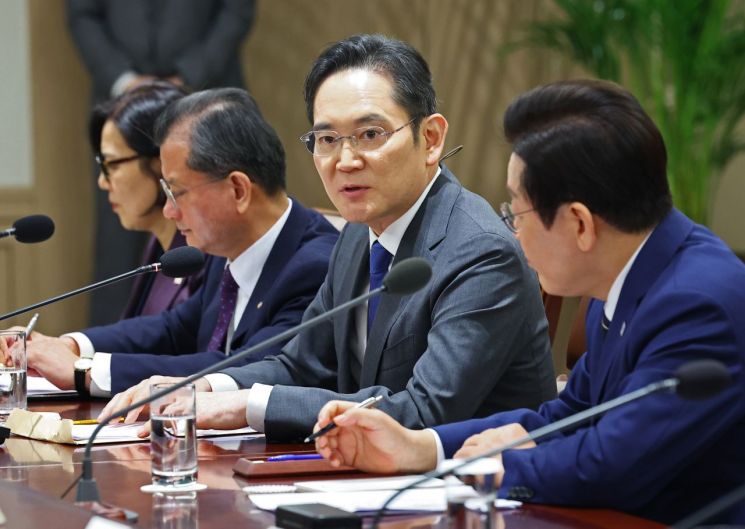 Samsung Electronics Chairman Jay Y. Lee is speaking at the follow-up public-private joint meeting on Korea-US tariff negotiations held at the Yongsan Presidential Office on the 16th. Photo by Yonhap News
SK Group's investment will also focus on establishing a de facto 'HBM-specialized manufacturing zone' centered around the Yongin semiconductor cluster. If all four fabs are built, the total investment is estimated to reach 600 trillion won. The 'Trinity Fab' project, promoted by SK Hynix in cooperation with the government, will support the ecosystem of semiconductor materials, components, and equipment.
Hyundai Motor is directly challenging China's dominance in robotics. Under its goal to reorganize domestic plants into AI- and electrification-centered 'mother factories,' the company plans to directly connect in-vehicle AI, software-defined vehicles (SDVs), autonomous driving, and robotics technologies with its manufacturing system. AI data centers, physical AI verification centers, and robot foundries designed in Korea are expected to become the foundation of Hyundai's competitiveness in finished vehicles. The company is also pursuing a strategy to stabilize its entire production process by advancing electrification platforms and battery technologies.
LG Group, which will invest 100 trillion won over the next five years, aims to strengthen its capabilities in batteries, automotive electronics, next-generation displays, and semiconductor materials, components, and equipment.
Many experts agree that the scale of investment will determine the future gap in competitiveness. Quantitative investment is necessary to translate Korea's technological assets into competitiveness and growth speed.
Lee Jonghwan, Professor of System Semiconductor Engineering at Sangmyung University, stated, "For Samsung's semiconductor business, this is the so-called 'right time.' Large-scale investments in memory and foundry sectors could enable a significant leap forward." Kim Yongseok, Distinguished Professor at Gachon University, said, "A robust semiconductor belt has been established in southern Gyeonggi Province, including Yongin and Pyeongtaek. If investments are concentrated there, Korea can build the world's most powerful production base."
Lee Taekyu, Senior Research Fellow at the Korea Economic Research Institute, commented, "The fact that companies can continue to make large-scale domestic investments is a positive sign for industrial competitiveness. Investments outside the capital area will not only facilitate power supply but also help prevent industrial hollowing-out and reduce concerns about regional extinction."
© The Asia Business Daily(www.asiae.co.kr). All rights reserved.