"Restoring Water Quality and Ecology,
Improving Spatial Infrastructure"
On November 14, Jeonju City in North Jeolla Province announced that Deokjin Park is gradually transforming into a stay-type cultural park, focusing on water quality and ecological restoration as well as improvements to spatial infrastructure.
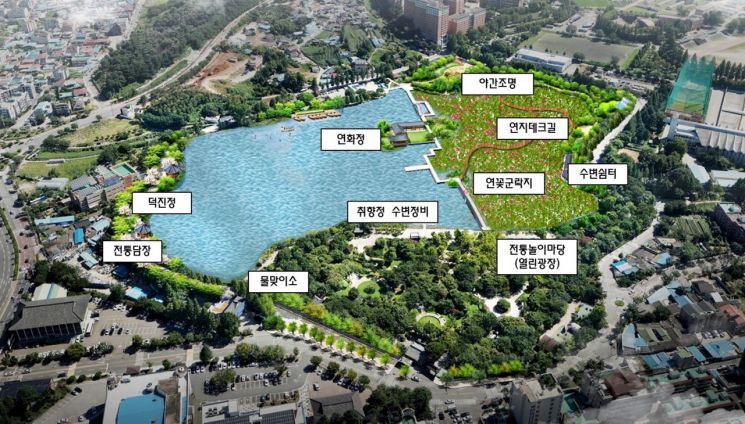
The city has been working to improve the water quality of Deokjin Lake, where external water inflow is limited and water circulation is stagnant, by simultaneously carrying out several initiatives: dredging sediment from the west side of Yeonhwa Bridge, securing two additional groundwater sources (500 tons per day) through well investigation and development, and implementing photocatalyst-based water purification.
As a result, improvements have been observed in water quality, including reduced turbidity, suppression of algal blooms, and stabilization of eutrophication indicators. The ecosystem is also visibly recovering, as evidenced by the confirmed presence of the Eurasian otter (a first-grade endangered wild animal) and the Black-faced Spoonbill (a second-grade endangered species).
The city is also making efforts to protect and restore the habitat of the Chinese pond turtle, a natural monument found in Deokjin Lake. Specifically, by the end of this year, the city plans to complete the creation of a habitat for the Chinese pond turtle and the removal of invasive turtle species in cooperation with the Korea Association for the Protection of the Chinese Pond Turtle.
In addition, since last year, the city has been promoting comprehensive improvements to the visitor environment in the Deokjin Park area, including enhancements to nighttime landscape lighting, reconstruction of the Samtaegeuk Yeonjigyo Bridge, creation of waterfront rest areas, development of a hydrangea path along a traditional wall, and installation of media fa?ades at Yeonhwajeong Pavilion and Byeokjin Waterfall.
Notably, with the recent completion of the "Deokjin Park Open Plaza Project" this year, an open plaza has been established where citizens can freely gather. The open plaza features a large lawn and a circular plaza, with the floor of the circular plaza decorated with a design inspired by the "Cheonsang Yeolcha Bunyajido" (an ancient Korean star map) and equipped with nighttime lighting to enhance its usability both day and night.
Furthermore, the open plaza includes a traditional play area, making it a venue for traditional cultural experiences and small-scale cultural events, such as the Dano Festival Ssireum (Korean wrestling) competition, which is one of Jeonju's representative seasonal events.
To preserve the historical value and traditional culture of Deokjin Park, the city is redeveloping "Changpowon" as a traditional waterfront space. Changpowon will reinterpret the old custom of washing hair with sweet flag water on Dano Day into a modern experience space that combines tradition and relaxation, with construction scheduled for completion within the year.
Next year, the city plans to gradually renovate some sections of the aging walking trails within Deokjin Park to further improve the safety and convenience of visitors, as well as address slope and drainage issues to provide a more pleasant park experience for citizens.
The city will continue to develop and operate a variety of programs and related tourism content so that Deokjin Park can be established as a representative urban cultural park where citizens and tourists can stay and enjoy themselves.
A city official stated, "We will complete Deokjin Park as a 'stay-type park' by steadily adding content while restoring its water quality, ecology, and space," adding, "We will strive to ensure that both citizens and tourists can always enjoy a clean and bright lakeside park."
© The Asia Business Daily(www.asiae.co.kr). All rights reserved.
![Clutching a Stolen Dior Bag, Saying "I Hate Being Poor but Real"... The Grotesque Con of a "Human Knockoff" [Slate]](https://cwcontent.asiae.co.kr/asiaresize/183/2026021902243444107_1771435474.jpg)















