Overhauling the Basic Research Ecosystem
with a Long-Term and Stable Support System
The government will overhaul the entire basic research ecosystem through the 2026 Basic Research Project. The 2026 Basic Research for Life will be restored to a scale of 115 billion won, and the research period will be extended from the previous short-term focus of 1 to 3 years to a maximum of 5 years.
The Ministry of Science and ICT announced on the 12th at the 'Basic Research Project Steering Committee' that it had finalized the implementation plan for next year and, starting from the 13th, began accepting applications for new projects. The total project budget has increased by 17.1% year-on-year to 2.7362 trillion won, and the number of supported projects will expand to approximately 15,800. Of these, about 7,000 will be new projects, signaling a full-fledged expansion of the basic research base.
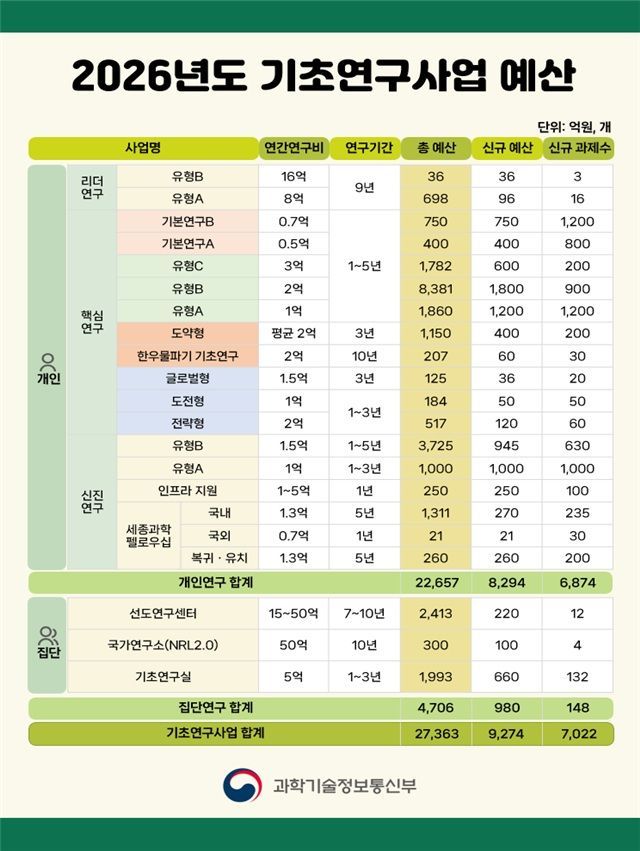
The core of this reform is the revival of 'Basic Research.' To address the research gap created after the suspension of new selections for the Basic Research for Life in 2024 and its conclusion in 2025, the government has brought back the basic research program. With a total budget of 115 billion won, about 2,000 new projects will be supported. The government plans to actively prioritize researchers with vulnerable research foundations, such as first-time researchers, those who have experienced career interruptions, and researchers based in regional areas, to restore a stable research ecosystem.
The research period will also be significantly extended. Both the Basic Research and Core Research Type A (formerly Creative Research) will see their maximum duration increased from 3 years to 5 years, and New Researcher Type A (formerly Seed Research) will be extended from a one-year short-term project to up to 3 years. Projects with outstanding results will be eligible for up to two follow-up studies (Leap-type), allowing for long-term research of up to 11 years. The government explained, "This fundamentally addresses the structural limitations that made long-term achievements difficult due to short project cycles."
Efforts to attract outstanding overseas researchers will also be strengthened. A return and recruitment track will be newly established within the Sejong Science Fellowship, providing 130 million won annually for five years. To help foreign researchers settle in Korea, the government will fully implement the submission of research proposals in English. The previously limited 'New Researcher Infrastructure Support Project' for foreign nationals will also be expanded.
Investment in outstanding researchers and large-scale research teams has also been significantly strengthened. The number of new Leader Research projects will increase from 6 this year to 19 next year, and a new 'Top-Tier' type has been established to support world-class research, offering large-scale support of up to 1.6 billion won per year. The research budgets for leading research centers such as the Science Research Center and Engineering Research Center have also been raised to 1.8 billion won and 2.2 billion won, respectively. To strengthen regional research capabilities, four new National Research Laboratories (NRL 2.0) have been selected, with two of them assigned to the regional track.
The evaluation system has also been reformed to be more researcher-centric. Most stage evaluations will be abolished for new projects, and the evaluation cycle will be extended to five years. For Leader Research, the number of stage evaluations will be reduced from two to one, and the multi-stage evaluation process, previously centered on discussion and presentation, will be streamlined into a single procedure. Administrative burdens will be eased by reducing the length and format requirements of research proposals, and the professionalism and fairness of evaluations will be enhanced by expanding the size of expert evaluation panels and review boards (RB).
To improve researchers' understanding, the Ministry of Science and ICT will hold an online project briefing session on the 19th, followed by a series of regional sessions in the Seoul metropolitan area, Honam, Chungcheong, and Yeongnam regions. First Vice Minister Koo Hyukchae stated, "We hope this will be a turning point for the complete restoration and qualitative growth of the basic research ecosystem by establishing a predictable long-term research environment."
© The Asia Business Daily(www.asiae.co.kr). All rights reserved.