Waiting for the Fog to Clear Amid Many Uncertainties Behind the Weak Won
Overseas Investment Flows by Residents and Stable Foreign Currency Debt Levels... No Major Concerns
Lee Changyong, Governor of the Bank of Korea, stated that the central bank is maintaining its accommodative monetary policy stance despite signs of improvement in gross domestic product (GDP) in the second half of the year, as the economy still remains below its potential growth rate. However, he indicated that there is a possibility of upward revisions to this year's and next year's economic growth rates in the revised economic outlook to be announced on November 27, and that decisions regarding the magnitude, timing, and direction of a rate cut will be made after reviewing the relevant data.
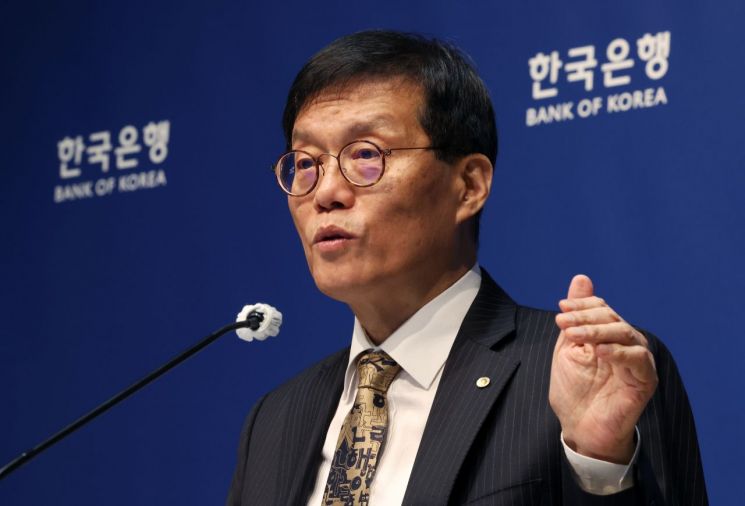 Lee Changyong, Governor of the Bank of Korea, is speaking at a press briefing following the Monetary Policy Committee meeting on monetary policy direction held at the Bank of Korea in Jung-gu, Seoul, on the 23rd of last month. Photo by Yonhap News Agency Joint Coverage Team
GDP Remains Below Potential Growth Rate... Rate Cut Cycle Maintained
Governor Lee made these remarks in an interview with Bloomberg in Singapore on the 12th, where he was attending a fintech (finance + technology) event. When asked why the possibility of a rate cut remains despite higher-than-expected third-quarter GDP and robust exports, he pointed to concerns about an economic growth rate (1.8-2.0%) that still falls short of the potential growth rate. He emphasized that the 0.9% growth rate forecast for Korea this year in the August economic outlook was much lower than the potential growth rate.
Governor Lee said, "We plan to announce new projections in two weeks (on November 27), and there is a possibility of an upward revision. We need to see how much the figures will be revised, and then decide how to adjust monetary policy." He reiterated that while the accommodative monetary policy stance will be maintained, a comprehensive review-including the magnitude, timing, and potential change of direction of a rate cut-will be made after examining future data.
Governor Lee explained, "Since August, the rate of increase in housing prices in the Seoul metropolitan area has been much higher than expected, which has been a major concern. Now, we need to reassess the upside factors for economic activity, particularly after the introduction of new government policies and negotiations with the United States on tariffs and investment." He added, "Monetary policy alone cannot control rising housing prices, but we are being cautious to ensure that excessive liquidity from a rate cut does not overheat the real estate market." He further stated, "It will be difficult for prices to fall sharply in the short term, but I hope the sharp rise in housing prices in the Seoul metropolitan area will subside."
"Korean Won Weakness, Many Uncertainties-Need to Wait for the Fog to Clear... Market Reactions Excessively Sensitive"
Regarding tariff negotiations with the United States, he assessed, "It is positive that the two leaders have reached an agreement on a trade and investment package, which has resolved much of the tariff-related uncertainty." He said that moving forward, it will be important for both countries to identify mutually beneficial joint projects that are commercially viable. Specifically, he stressed that joint projects combining the United States' strengths in basic science with Korea's strengths in applied and manufacturing technologies would be highly desirable.
When asked about the 350 billion dollar Korea-to-U.S. investment fund being cited as a cause of the Korean won's weakness, he explained, "Over the past two to three months, there have been numerous factors affecting the exchange rate, including volatility in U.S. artificial intelligence (AI) stocks, data gaps caused by the U.S. government shutdown, policy uncertainty from the Federal Reserve, dollar strength, and the new Japanese government's macroeconomic policy direction. Additionally, issues discussed at the Asia-Pacific Economic Cooperation (APEC) summit, such as U.S.-China trade relations and Korea-U.S. trade and investment agreements, have also played a role." He added, "With so many uncertainties, we need to wait for the 'fog to clear' before the direction becomes clear." However, he also noted that the market is reacting excessively sensitively to these uncertainties.
When asked whether the weakness of the Korean won is excessive, he said, "It is difficult to judge, as there are many factors at play," but added that he is not significantly concerned from a financial stability perspective. Governor Lee pointed out, "Recent fluctuations in the Korean won have been driven mostly by overseas investment flows from domestic residents. Foreign currency debt levels remain stable, and other indicators also reflect the soundness of the market." However, he acknowledged that exchange rate volatility could increase due to resident portfolio shifts.
KOSPI Surge Not Excessively Overvalued... Semiconductor Volatility Expected to Continue
Regarding the sharp rise in the domestic stock market this year, he said, "It is difficult to see this as excessive overvaluation." He emphasized, "Looking at the price-earnings ratio (PER) and price-to-book ratio (PBR), even after the recent rise, the PBR is still at about 1.1, which is lower than in other countries." However, he noted that the recent stock price increases have been concentrated in advanced industries such as semiconductors, and that Korean semiconductor stocks are not completely immune to trends in U.S. technology stocks, so volatility is expected to continue.
On concerns about a potential "AI bubble," he said, "At last week's Bank for International Settlements (BIS) meeting, there was much discussion about whether tech stocks have risen excessively, but I am relatively optimistic." He diagnosed, "Korea has strengths in both hardware and software in the AI sector. Demand for hardware such as semiconductors is expected to continue for the time being."
Meanwhile, Governor Lee's comments were interpreted as hawkish (favoring monetary tightening), causing turbulence in the bond market. The yield on three-year government bonds closed at 2.923% per annum, up 9.2 basis points (1bp = 0.01 percentage point) from the previous trading day. The yield on ten-year bonds jumped 8.1 basis points to 3.282% per annum.
© The Asia Business Daily(www.asiae.co.kr). All rights reserved.
![Clutching a Stolen Dior Bag, Saying "I Hate Being Poor but Real"... The Grotesque Con of a "Human Knockoff" [Slate]](https://cwcontent.asiae.co.kr/asiaresize/183/2026021902243444107_1771435474.jpg)















