Paju City Achieves Success with "Special 100 Days of Traffic Safety"... Challenge for Zero Fatalities
Building a "People-First Traffic System" Year-Round... 59% Reduction in Fatalities Over Five Years
Laying the Foundation for Field-Oriented Traffic Safety Policies Led by the "Zero Traffic Accident Task Force"
From PM Safety to Smart Crosswalk Systems... Advancing Customized Traffic Safety Policies
Paju City in Gyeonggi Province has solidified its status as a "leading city in traffic safety" by successfully completing the "Special 100 Days of Traffic Safety Project," which aimed to reduce traffic accident fatalities by 30% over a 100-day period from July 23 to October 31. This intensive management initiative, launched ahead of the high-risk autumn travel season, is being recognized as an innovative model for establishing a sustainable traffic safety ecosystem that goes beyond one-off crackdowns by combining citizen participation campaigns with advanced technology.
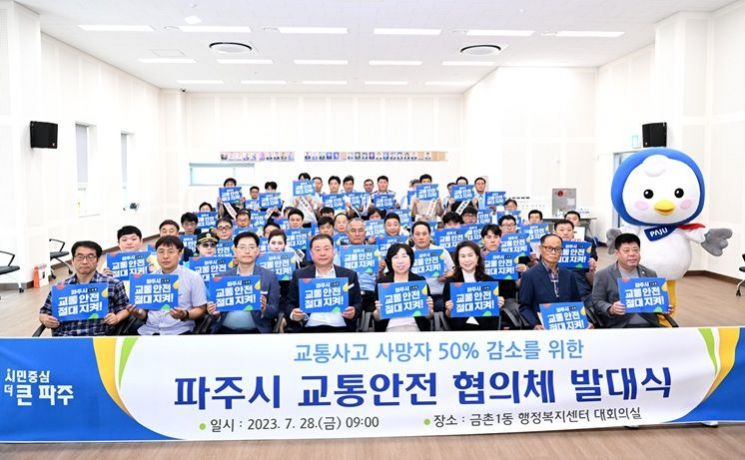
100 Days of Intensive Management: The Challenge for Zero Traffic Fatalities
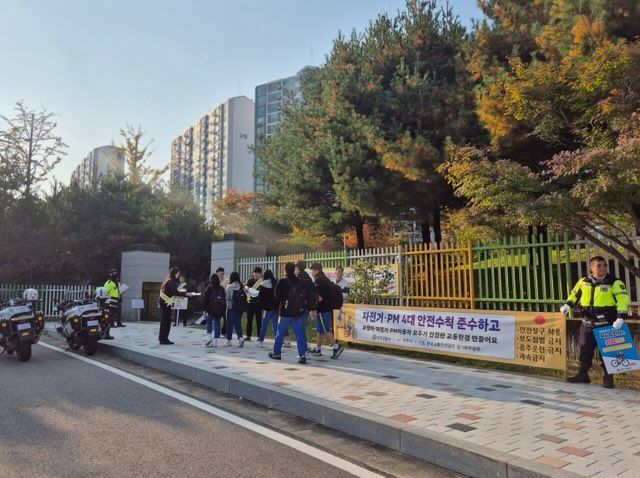
According to Paju City on November 12, the "100-Day Project," which began at the end of July, was an intensive campaign conducted in collaboration with citizens to prepare for the autumn travel season, when the highest number of traffic fatalities typically occurs each year. The campaign focused on major intersections, school routes, areas with heavy use of personal mobility devices (PM), and school zones throughout Paju.
The "100-Day Project" brought together over 100 participants from various organizations and groups, including Paju City, Paju Police Station, Korea Transportation Safety Authority, Paju Office of Education, Model Drivers Association, Saemaul Transportation Volunteer Corps, Green Mothers Association, and transportation companies.
During the hot summer months of July and August, the campaign promoted traffic safety through various channels such as social media and apartment bulletin boards. Starting with an event at Geumchon Station Square on September 10, five on-site campaigns were held at Dayul Intersection on October 1, in front of Homeplus on October 15, Geumchon Rotary on October 22, and Unjeong Lake Intersection on October 29. These campaigns focused on promoting specific practices: regular use of turn signals, eradicating drunk driving, prohibiting smartphone use while walking, obeying pedestrian crosswalk signals, and following the five key safety rules for personal mobility devices.
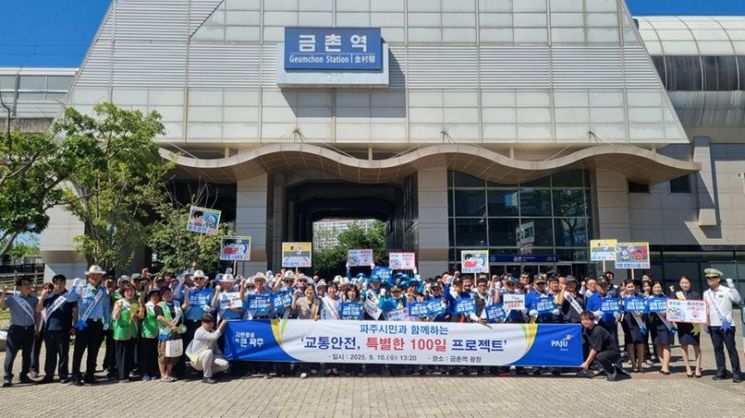 Paju City held the "Special 100 Days for Traffic Safety" event at Geumchon Station on September 10, challenging to achieve zero traffic accident fatalities during the 100-day project. Provided by Paju City
City Traffic Safety Policy: Field-Oriented Traffic Safety Infrastructure Improvements
To ensure that traffic safety policies are not one-off measures, Paju City has established the "Paju City Comprehensive Traffic Safety Plan" annually since 2023, in connection with the basic traffic safety plan. This plan incorporates detailed, data-driven strategies tailored by age group, region, and time period.
In addition, to foster communication with citizens and develop optimal policies for diverse groups, the city formed a "Traffic Safety Council" that includes seven agencies, eight organizations, and nine transportation companies.
In September last year, the existing "Traffic Safety Council" was expanded to include university professors, researchers, and other traffic experts, forming the "Zero Traffic Accident Task Force" under the direct supervision of the mayor. Through inter-agency collaboration, the city has been developing and gradually implementing a variety of field-oriented safety measures.
In 2023, Paju City achieved an A grade (ranked first in Gyeonggi Province) in the Ministry of Land, Infrastructure and Transport's Traffic Culture Index Survey of 229 cities, counties, and districts nationwide. The city has also achieved tangible results, reducing the number of traffic fatalities by 59% over the past five years, further solidifying its reputation as a leader in traffic safety. The number of fatalities decreased significantly from 34 in 2020 to 28 in 2021, 27 in 2022, 22 in 2023, and 14 in 2024.
Alongside various traffic safety policy initiatives, Paju City has also focused on improving safety facilities. Last year, to prevent pedestrian accidents involving children and the elderly and to create a safer walking environment, the city implemented traffic safety facility improvement projects at 21 school zones. Starting in the second half of this year, the city will enhance traffic safety facilities around 32 additional school zones to reduce accident risks. Planned improvements include unmanned traffic enforcement equipment, raised crosswalks, anti-slip facilities, illuminated signs, and colored safety barriers.
Furthermore, in response to the global trend of integrating artificial intelligence with traffic infrastructure, Paju City has expanded its intelligent transportation system (ITS) to improve road traffic flow and citizen safety. The city has installed 24 smart crosswalk systems for vulnerable pedestrians, which automatically extend green lights by up to 10 seconds, and plans to add five more locations this year to further protect vulnerable road users.
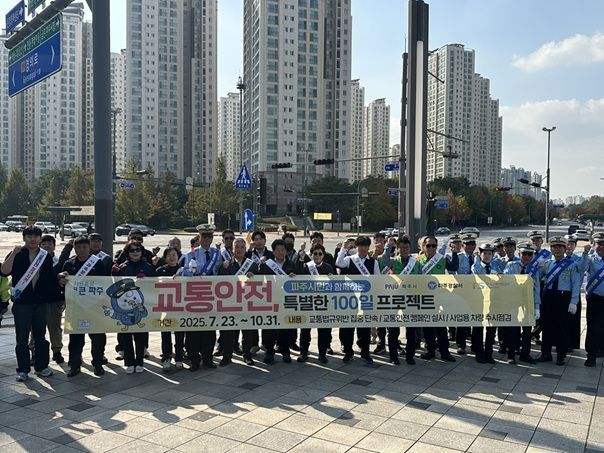 Paju City held the "Special 100 Days of Traffic Safety" project event challenging to achieve zero traffic accident fatalities over 100 days at Unjeong Lake Intersection on October 29. Provided by Paju City
Personal Mobility Device (PM) Safety: A Fundamental of Transportation
This January, Paju City demonstrated its commitment to building an advanced transportation city by establishing a "Mobility Team" and utilizing various new technologies, including artificial intelligence.
Recently, with the rapid increase in the use of personal mobility devices such as electric scooters, urban safety accidents have emerged as a social issue, making the management of these devices an urgent task. In response, the city signed a memorandum of understanding (MOU) with the Korea Transportation Safety Authority (TS) for traffic safety education and conducted "on-site safety education" for students at 11 middle and high schools. The city also established a cooperative system with private platform companies and held regular meetings to promote proper usage culture for personal mobility devices. Administrative measures have been strengthened for devices left on sidewalks or roads, including immediate towing and the designation of "Red Zones" (no-return areas) for personal mobility devices. The city is also working to create a safer environment for shared mobility devices by expanding the number of dedicated parking zones to 13 locations.
Looking beyond the 100-day period, the city aims to become a "365-day Traffic Safety City, Paju" by institutionalizing the "100-Day Project" as an annual initiative and establishing and implementing annual traffic safety action plans to foster a safe and pleasant traffic culture for Paju citizens.
Next year, through the annually established "Paju City Comprehensive Traffic Safety Plan," the city will actively reflect citizens' demands for traffic safety and propose practical solutions. Additionally, Paju City will develop a five-year statutory "Paju City Basic Traffic Safety Plan" to diagnose overall traffic safety issues and submit step-by-step, efficient implementation plans for government approval.
Mayor Kim Kyoungil of Paju emphasized, "Traffic safety is a fundamental right directly linked to citizens' lives, and in that sense, this 'Special 100 Days of Traffic Safety Project' is not just a promotional activity but an experiment and innovation to change the city's traffic culture together with citizens."
Paju City has pledged to use this "100-Day Project" as a springboard to become a "traffic safety city that puts people first." The core of this initiative is to move away from enforcement- and campaign-centered approaches and to build a sustainable traffic safety ecosystem with direct citizen participation. If Paju City successfully completes this model, it is expected to become a benchmark case for traffic safety policy among local governments nationwide.
© The Asia Business Daily(www.asiae.co.kr). All rights reserved.
![Clutching a Stolen Dior Bag, Saying "I Hate Being Poor but Real"... The Grotesque Con of a "Human Knockoff" [Slate]](https://cwcontent.asiae.co.kr/asiaresize/183/2026021902243444107_1771435474.jpg)

















