KITA Analyzes Performance of Over 1,000 Startups
Participating in Support Programs Over the Past Three Years
More Than Half of Analyzed Companies See Increases in Investment, Employment, and Sales Growth
Despite a global economic slowdown and weakening investment sentiment leading to a 16.8% decrease in global startup investment this year, systematic institutional support is breathing new life into the startup ecosystem.
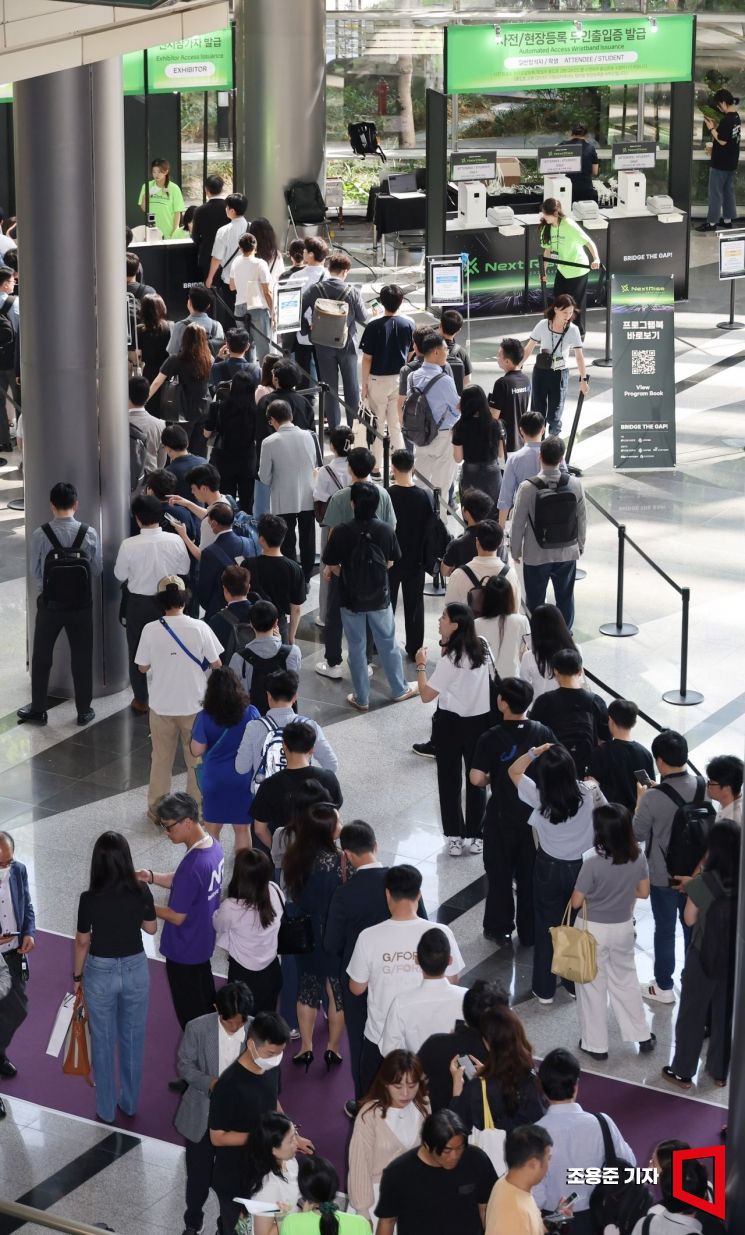 Many visitors are waiting to enter the NextRise 2024 Export Startup Fair held on June 13 last year at COEX in Samseong-dong, Seoul. NextRise is the largest single venture and startup event in Korea, serving as a festival where participants network and showcase innovation. Photo by Yongjun Cho jun21@
On November 12, the Korea International Trade Association published a report titled "Performance Analysis and Future Directions of Startup Support Programs." The report quantitatively evaluated the business performance of companies that participated in the association's startup support programs over the past three years (2022-2024). According to the findings, among approximately 1,200 companies that disclosed investment information, 54.2% succeeded in attracting investment. Of the 813 companies that disclosed employment information, 55.6% saw an increase in employment. Additionally, among 1,053 companies that disclosed financial statements, 61.7% recorded steady sales growth over the past three years.
There were also tangible results in collaboration with large corporations. In a survey conducted to qualitatively evaluate the support programs, 26.5% of respondent companies reported signing non-disclosure agreements (NDAs) or memorandums of understanding (MOUs) with large or mid-sized companies, while 25.5% participated in joint projects such as proof of concept (PoC) or pilot initiatives. For example, Ninewatt, which participated in the "2022 Korea International Trade Association-LS Electric Open Innovation" program, completed a PoC with LS Electric and then jointly developed a digital energy platform called "Enable," moving into the commercialization stage. The company also succeeded in attracting investment of approximately 3 billion won from corporate venture capital (CVC) firms, including LS Electric.
Some startups have also found new pathways to enter overseas markets. Lab&People, a microneedle patch company, expanded its network in Japan through a one-on-one meetup with Shiseido and the "2023 Korea-Japan Open Innovation Summit," ultimately succeeding in launching its products at Don Quijote retail stores. Recently, the company has entered Walgreens, a major U.S. drugstore chain, and is now actively targeting the Japanese beauty market in partnership with Paltec, Japan's largest cosmetics distributor.
Robigos, a logistics artificial intelligence (AI) company, participated in a testbed project through an MOU between the Korea International Trade Association and Malaysia’s Lion Group in 2022. The company demonstrated its AI and cloud-based integrated inventory management system at Parkson Department Store, a Lion Group affiliate, and subsequently signed a formal supply contract. Robigos established a local subsidiary in Malaysia, achieved sales of 4 billion won this year, and recently began construction on a 66,000-square-meter smart logistics center, launching a project valued at approximately 66 billion won.
Lee Myungja, Head of Overseas Marketing at the Korea International Trade Association, stated, "For the startup ecosystem to continue growing, institutional support must underpin the market even when private investment is subdued. As an 'industrial innovation hub' connecting the innovation needs of large and mid-sized domestic and international companies with startups, our association will continue to strengthen its efforts to expand networks, discover overseas testbeds, and support global open innovation."
© The Asia Business Daily(www.asiae.co.kr). All rights reserved.
![Clutching a Stolen Dior Bag, Saying "I Hate Being Poor but Real"... The Grotesque Con of a "Human Knockoff" [Slate]](https://cwcontent.asiae.co.kr/asiaresize/183/2026021902243444107_1771435474.jpg)















