Focus on Four Key Strategies: Livelihood, Growth, Care, and Climate
Budget Includes Support for Small Businesses, Youth, and Advanced Industries
"Continued Investment for the Future Despite Fiscal Challenges"
Gwangju City has finalized its budget for next year at 7.6823 trillion won. This represents an increase of 78 billion won (1.0%) compared to this year. Despite challenging fiscal conditions, the city stated that it focused on stabilizing livelihoods and laying the foundation for future growth.
On November 11, Gwangju City submitted its 2026 main budget proposal to the city council, totaling 7.6823 trillion won. This is a 1.0% increase from the previous year’s 7.6043 trillion won. While the city’s own revenues, such as local taxes and non-tax income, decreased by 3.9%, dependent resources like national subsidies increased by 7.4%.
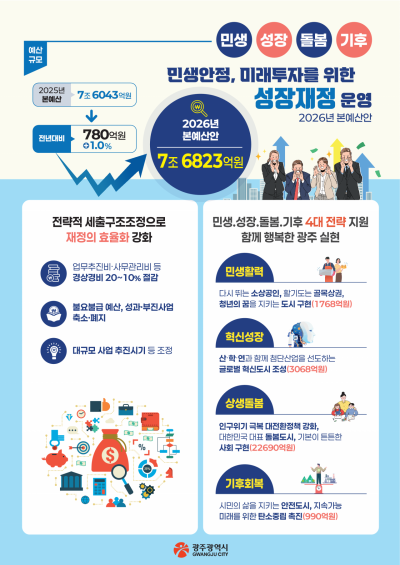
The general account was set at 6.2725 trillion won, up 0.2% from this year, while the special account was set at 1.4098 trillion won, a 5.0% increase. Gwangju City explained, “We focused on efficient fiscal management to promote key regional projects linked to national policy tasks, sustainable urban growth, and improving the quality of life for citizens.”
Under the direction of “Four Strategies for Livelihood, Growth, Care, and Climate: A Happier Gwangju Together,” the city identified four core strategies: revitalizing livelihoods, innovative growth, inclusive care, and climate recovery.
The budget includes funds to boost local businesses, such as 7.55 billion won for special guarantee funds for small business owners, 41 billion won to support the issuance of mutual growth cards, and 1.22 billion won for traditional market support. For young people, the city will continue monthly rent assistance (7.96 billion won), job search allowances (5 billion won), and the Work Experience Dream Project (7.7 billion won).
In the innovative growth sector, the budget allocates 7.3 billion won to establish the second phase of the AI AX Demonstration Valley, 600 million won for developing core electronic parts for future vehicles, and 4.19 billion won for creating a Green Startup Town. It also includes 87.94 billion won to establish the Regional Innovation-Centered University (RISE) and 33.8 billion won to foster glocal universities.
In the inclusive care sector, the budget includes 2 billion won for mutual growth cards for families with newborns, 160 million won for multiple birth celebration grants, and 7.43 billion won to establish an integrated care system, all aimed at addressing low birth rates. The city will also promote the construction of Gwangju-style lifelong housing (12.29 billion won).
For climate recovery, the budget allocates 7.7 billion won for the “G-Pass” public transportation fare reimbursement service, 5.5 billion won for installing stormwater retention facilities, and 6.47 billion won for improving housing in vulnerable areas, all as part of its safety and climate response initiatives.
Prior to drafting this budget, Gwangju City held a fiscal strategy meeting to pursue spending restructuring. The city reduced routine expenses such as business promotion and office management costs, as well as event and festival-related expenses, and adjusted unnecessary and non-urgent budget items.
Lee Byungcheol, Director of Planning and Coordination, said, “Although the fiscal environment is difficult due to the slowdown in economic recovery, the city’s finances must serve as a catalyst for the local economy’s rebound. We will continue investing in innovative growth sectors such as artificial intelligence, mobility, and new renewable energy.”
© The Asia Business Daily(www.asiae.co.kr). All rights reserved.
![Clutching a Stolen Dior Bag, Saying "I Hate Being Poor but Real"... The Grotesque Con of a "Human Knockoff" [Slate]](https://cwcontent.asiae.co.kr/asiaresize/183/2026021902243444107_1771435474.jpg)















