Four of Six Board Members to Be Replaced by 2027
Vice President de Guindos’s Term Ends in May Next Year
Vice Presidential Selection Seen as Crucial Turning Point in Presidential Succession
As the terms of a significant number of European Central Bank (ECB) executives are set to end by late 2027, competition has begun over the succession of key positions, including that of President Christine Lagarde. In particular, the nationality and monetary policy stance of the next Vice President are expected to directly influence the lineup for Lagarde's successor, drawing the attention of member states in the eurozone (the 20 countries using the euro) to who will take over the baton.
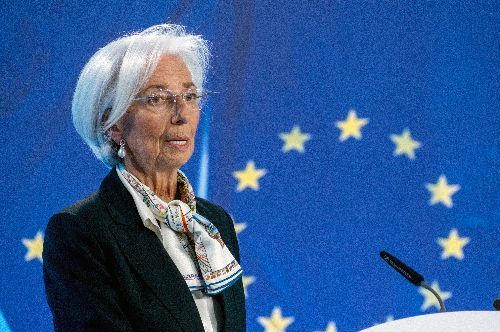
According to the Financial Times (FT) on November 10 (local time), the terms of four out of the six members of the ECB Executive Board will end by late 2027. The term of Vice President Luis de Guindos will end in May next year, while the terms of President Lagarde, Chief Economist Philip Lane, and Executive Board Member Isabel Schnabel will all end in 2027. As a result, the FT reports that fierce competition is underway in the capitals of eurozone countries to secure positions that will determine the direction of monetary policy.
Notably, the race to appoint the next Vice President coincides with the end of Jerome Powell's term as Chair of the U.S. Federal Reserve. The succession process for Powell, who has been at odds with U.S. President Donald Trump, and the ECB leadership transition will happen simultaneously. The ECB is expected to formally request the European Union (EU) Commission to begin the process of replacing Vice President de Guindos as early as this week, and eurozone finance ministers are reportedly set to begin related discussions this week.
Behind the scenes, the race to succeed President Lagarde has already begun. Klaas Knot, President of the Dutch Central Bank (and ECB Governing Council member), Joachim Nagel, President of the German Bundesbank, and Pablo Hernandez de Cos, former Governor of the Bank of Spain and current Secretary General of the Bank for International Settlements, are being mentioned as strong candidates for the next president.
Amid this, President Lagarde's attention appears to be focused on President Knot. Last month, during an appearance on the Dutch podcast "College Leaders in Finance," President Lagarde praised Knot, saying, "President Knot possesses both intelligence and stamina, as well as an exceptional ability to embrace people. These are rare and very necessary qualities." She added, "Knot is not the only one, but he certainly has those abilities."
The selection of the next Vice President is expected to be a turning point in shaping the succession structure for President Lagarde. This is because the Vice President's appointment can effectively signal the likely region of origin for the next president. Traditionally, if the Vice Presidency goes to someone from Southern Europe, the Presidency is likely to go to someone from the opposing bloc, such as Northern Europe. This is due to the internal personnel structure and balance of power within the ECB. As a supranational institution jointly operated by the central banks of its 21 member countries, even a single personnel change at the ECB represents a realignment of power among member states, rather than a simple appointment.
Meanwhile, there is an unwritten rule at the ECB that no country can hold two seats on the Executive Board. As a result, governments are carefully considering how to balance hawks and doves, aiming to maintain checks and balances so that the ECB’s monetary policy does not tilt toward any particular camp. Gender is also a consideration. According to the FT, the ECB Executive Board has historically been male-dominated, with women accounting for only 19% of the 26 board members since 1998.
© The Asia Business Daily(www.asiae.co.kr). All rights reserved.
![Clutching a Stolen Dior Bag, Saying "I Hate Being Poor but Real"... The Grotesque Con of a "Human Knockoff" [Slate]](https://cwcontent.asiae.co.kr/asiaresize/183/2026021902243444107_1771435474.jpg)















