53-61% Reduction Target Compared to 2018
Higher Than Previous Industry Demands
2.15 Trillion Won Invested in Equipment Rationalization Over Five Years
Billions Required Despite Prolonged Construction Slump
Potential Ripple Effects Acro
The government has announced a new greenhouse gas reduction target that is much more stringent than the initial demands of the industrial sector, heightening concerns and anxiety within the cement industry. This comes at a time when the business environment has already deteriorated to unprecedented levels due to the prolonged slump in the construction market.
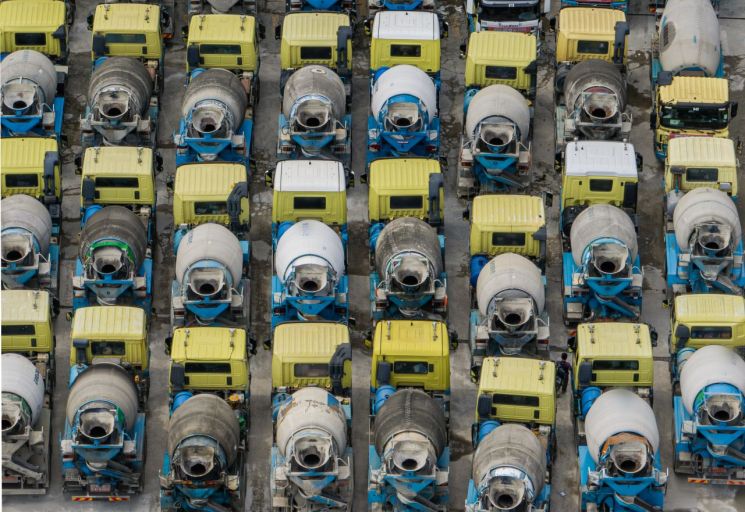 Ready-mix concrete trucks are parked at a cement factory in Anyang, Gyeonggi Province. Photo by Yonhap News
According to industry sources on November 10, the seven major cement companies (Sampyo Cement, Ssangyong C&E, Hanil Cement, Asia Cement, Sungshin Cement, and others) are currently discussing internal response measures immediately after the government unveiled the "2035 National Greenhouse Gas Reduction Target (2035 NDC)." Due to the nature of cement manufacturing, which involves chemical reactions at high temperatures, it is inevitable that large amounts of carbon and carbon dioxide are emitted. There is a sense of crisis that extraordinary measures will be required to meet the government’s targets. Initially, the industrial sector had requested that the lower limit for the NDC be set at 48% or less.
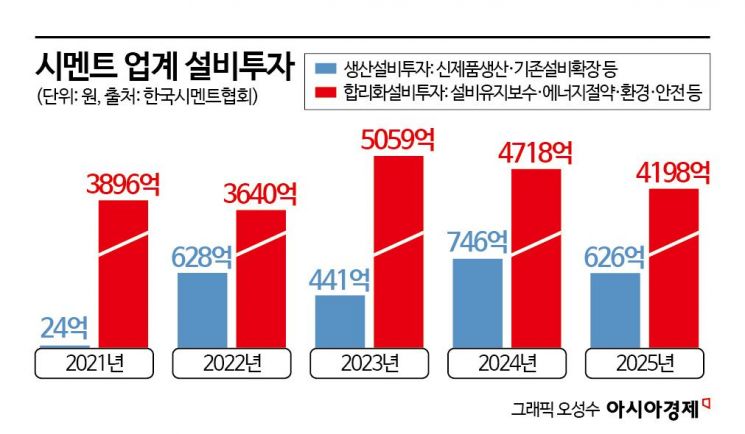
There is growing concern within the cement industry that investment costs resulting from government environmental regulations may exceed manageable levels. According to the Korea Cement Association, the seven major cement companies spent approximately 2.1511 trillion won over the past five years solely on "facility rationalization investments" to comply with environmental regulations and reduce costs. This amount is equivalent to about 40% of last year’s industry sales (5.5267 trillion won) and roughly 4.3 times the industry’s net profit (499 billion won). In contrast, investments in production facilities, such as new product manufacturing and expansion of existing facilities, amounted to only 246.5 billion won, accounting for just 9.7% of the total. While the industry has tightened its belt on investments aimed at strengthening competitiveness due to the sluggish construction market, it has poured massive resources into environmental facilities.
An official from the cement industry stated, "Even the initial demands from the industrial sector represented a tremendous burden for carbon-intensive industries like ours, but the government has announced even higher targets. There is growing sentiment that there is no option but to develop carbon reduction technologies or introduce new facilities. We are facing a crisis that could even lead to production shutdowns."
There are also projections that the newly proposed measures could affect not just the cement industry, but the construction sector as a whole. Cement prices have increased by about 42% from 2021 to this year due to the economic downturn and the rise in investments for environmental facilities. If the upwardly revised greenhouse gas reduction targets further increase pressure on cement prices, it could result in higher manufacturing costs for ready-mix concrete companies and, ultimately, increased construction costs overall.
Song Changyoung, Professor of Architecture at Gwangju University, commented, "Cement is a core component of construction costs, so if its price rises, the additional costs could be passed on beyond ready-mix concrete to overall construction expenses. If the government does not simultaneously support facility investments and technology development, there is a risk that the cost structure of the entire industry could be destabilized."
© The Asia Business Daily(www.asiae.co.kr). All rights reserved.