Impact Spreads Beyond Southeast and East Asia to Australia
"Chinese Companies Also Supplying Methamphetamine Precursors"
There have been claims that the background of the 'methamphetamine (meth) tsunami' sweeping across Asia lies in Chinese companies exporting chemical substances used as precursors for methamphetamine.
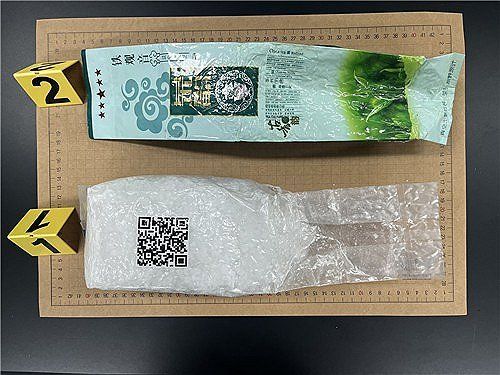 On the 4th, a fisherman discovered a suspicious drug object disguised as a car bag on the rocky shore in Jocheon-eup, Jeju City, and reported it to the police. Jeju Regional Coast Guard Headquarters
On November 8 (local time), The Washington Post (WP) reported, based on documents from the United States and various Southeast Asian governments as well as interviews with over 40 related parties, that Chinese companies are increasingly exporting chemicals that can be used as methamphetamine precursors to Myanmar, the world's largest producer of methamphetamine.
According to a report by the United Nations Office on Drugs and Crime (UNODC), the amount of methamphetamine seized in Southeast and East Asia last year reached 236 tons, a 24% surge from the previous year, marking an all-time high. The UNODC stated, "An unprecedented scale of methamphetamine is being produced and trafficked in the Golden Triangle (the border area of Myanmar, Laos, and Thailand), especially in Myanmar's Shan State."
This methamphetamine, pouring out from the 'lawless zone' of Myanmar, is spreading its reach not only across Southeast and East Asia but also to the Indo-Pacific region and other parts of the world. In Australia, methamphetamine use increased by 21% between 2023 and last year, reaching epidemic levels. In South Korea, the number of drug users was also estimated to have surged by more than 60% in five years, surpassing 400,000 last year.
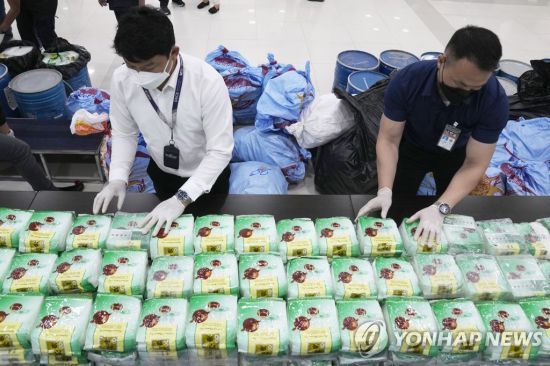
Brandon Yoder, former Deputy Assistant Secretary of State at the U.S. Department of State, told WP, "The precursor chemicals from Chinese companies have directly triggered the (methamphetamine tsunami)." In July 2020, Goldlink Industry, a subsidiary of a Chinese state-owned enterprise, attempted to send 72 tons of propionyl chloride-a methamphetamine precursor-from Laos to Shan State, Myanmar, but was caught by Laotian customs. The Thai government also conducted 12 crackdowns last year alone, including the seizure of a total of 800 tons of chemicals such as sodium hydroxide, toluene, and acetone needed for methamphetamine production in the border area with Myanmar in October.
However, a senior official at Thailand’s Office of the Narcotics Control Board (ONCB) explained that there is little way to stop this, as it is extremely difficult to prove that Myanmar’s importers are transporting these substances for drug production if they claim to be importing them for 'legitimate purposes.'
Furthermore, U.S. law enforcement authorities have identified dozens of Chinese companies openly selling substances such as ephedrine and pseudoephedrine-which are cold medicine ingredients but can be processed into methamphetamine precursors-online. According to the UNODC, in 2023, Wuhan-based Wingroup Pharmaceutical sold chemicals on Alibaba, along with instructions on how to synthesize them into drug precursors. The company not only offered to disguise shipments as soap or wax, but also accepted payment in cryptocurrencies such as Bitcoin.
Wingroup was also found to have directly sold fentanyl (a narcotic analgesic) precursors to the United States, Canada, and Mexico. In February of this year, two Chinese sales managers from Wingroup were convicted in a U.S. court.
Despite these circumstances, the Chinese government still imposes only limited regulations on drug precursors. Experts believe that precursor substances are being traded openly within China.
Two years ago, under pressure from the United Nations and the International Narcotics Control Board (INCB), China strengthened controls on the export of drug precursor substances from Yunnan Province in the southwest, which borders Myanmar's Shan State. However, UN investigators emphasized that the export of drug precursor substances has not decreased; rather, alternative distribution routes from China through Laos and Thailand to Myanmar have expanded.
Meanwhile, following the resumption of international flights after COVID-19, there has been a nationwide increase in cases of international drug smuggling organizations bringing drugs into the country, along with continued cases of drugs being smuggled via Jeju International Airport. On October 24, a Chinese man in his 30s was caught by police while attempting to secretly bring in enough methamphetamine for 40,000 doses and distribute it domestically. The Chinese man secretly brought 1.2 kilograms of methamphetamine disguised as tea bags through Jeju International Airport, concealed in his suitcase, and posted high-paying part-time job ads on social media to recruit a Korean courier to deliver the goods to Seoul. However, the Korean man in his 20s who received the package from the Chinese man for a daily wage of 300,000 won suspected it contained explosives and reported it to the nearby Hamdeok Police Station, leading to the discovery of the crime.
© The Asia Business Daily(www.asiae.co.kr). All rights reserved.