As the Central Accident Response Headquarters decided to dismantle boiler towers 4 and 6 adjacent to the collapsed tower 5 at Ulsan Thermal Power Plant for a swift resolution of the accident, preliminary blasting work for towers 4 and 6 began in earnest on the afternoon of November 9.
First, following a situation assessment meeting held in the morning, the fire authorities recovered the body of Mr. Kim (44), who had been trapped and found dead at the collapse site. The decision to expedite the recovery was made because, once the preliminary weakening work on tower 6 began in the afternoon, there would be a risk of further collapse, making it impossible for firefighters to enter the site for rescue or search activities.
From the afternoon, with all fire personnel withdrawn from the site, the 'preliminary weakening' work on tower 6 proceeded. This process involves pre-cutting columns and steel structures so that the large tower can be demolished more easily in a single blast. At that point, about 75% of the weakening work on tower 6 had been completed. Tower 4's weakening work was fully completed, leaving its structural stability compromised, while tower 5 collapsed while about 90% of the work was underway.
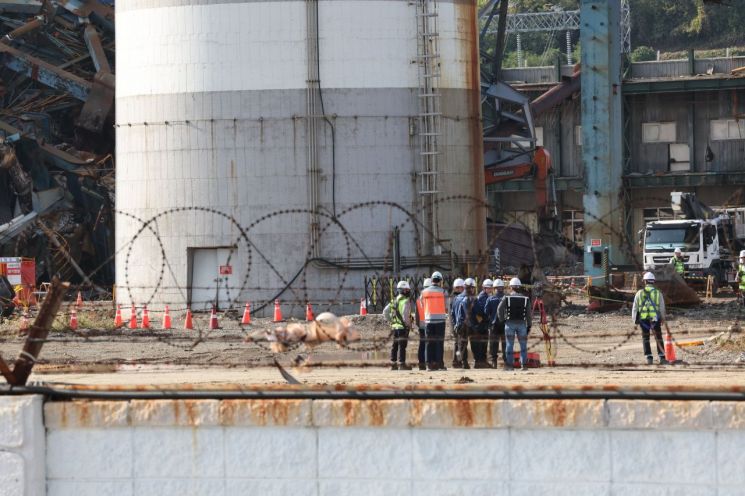 On the afternoon of the 9th, the fourth day since the collapse of the boiler tower at Ulsan Thermal Power Plant, officials inside the plant are discussing the preliminary blasting work for boiler towers 4 and 6. Photo by Yonhap News
Once the weakening work is completed, the process for blasting will begin immediately, with explosives installed at specific points on the weakened columns and structures. The blasting, expected to take place as early as the beginning of next week, will use a 'directional blasting' method to ensure the collapse occurs in the intended direction. This is to prevent towers 4 and 6 from falling toward the already collapsed tower 5 or the large smokestack.
The collapse that occurred on November 6 trapped a total of seven people, three of whom have been recovered. Two are presumed dead, and two remain missing. Once space or passageways are secured by fixing, cutting, and removing debris using small cranes and excavators, it is expected that the search and rescue of those still trapped or unaccounted for will accelerate.
The Central Accident Response Headquarters plans to prevent damage by simulating the potential for debris to fall from various angles during the blasting design stage. Additionally, the families of the missing will participate in meetings, and all procedures and schedules will be shared to ensure transparency throughout the process.
© The Asia Business Daily(www.asiae.co.kr). All rights reserved.