Research Commissioned by City Council Explores Public Use of Closed Schools
86.1% Support Commercial Utilization of Urban Closed Schools
There is a growing consensus that closed schools should be repurposed as spaces that generate economic value beyond education. As the number of closed schools increases even in urban areas due to the declining school-age population, there is a call for a broader discussion on how these spaces can be utilized.
According to the "Research on Public Utilization Plans in Response to the Increasing Number of Closed Schools in Seoul," which the Seoul Metropolitan Council decided to pursue on November 7, a survey conducted from July 31 to August 11 among 366 Seoul residents showed that 86.1% responded positively to the idea of using closed schools in urban areas for commercial purposes. Specifically, 53.0% answered "very positive," while 33.1% said "somewhat positive." The survey respondents included students, self-employed individuals, office workers, and public officials.
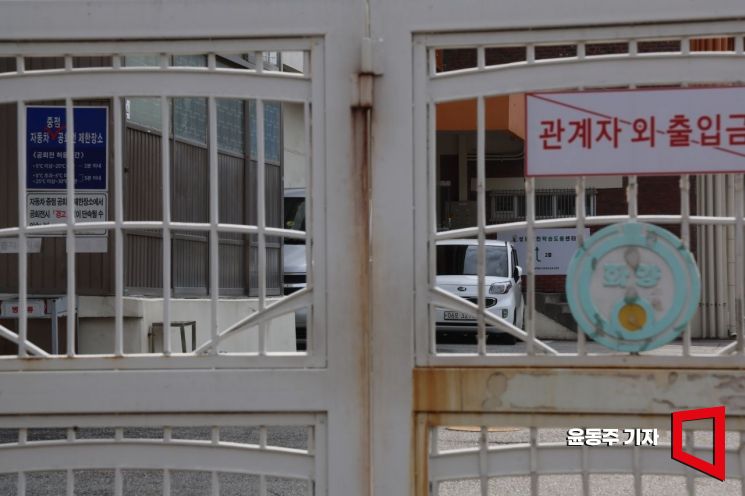 The entrance gate of Huayang Elementary School, which was closed in 2023, is firmly shut. 2025.04.16 Photo by Dongju Yoon
When asked about the most desirable model for utilizing closed schools, there was a high demand for spaces that facilitate economic activities. "Startup and job support spaces" were cited as the most desirable by 22.4% of respondents, while "commercial and private use spaces" accounted for 22.1%. These options followed closely behind cultural and arts spaces, which had the highest demand at 30.6%.
This trend became even more pronounced when respondents were asked about their own neighborhoods. The need for startup and job support spaces was cited by 80.0%, while commercial and private use spaces were mentioned by 76.0%. These figures were significantly higher than those for cultural and arts spaces (59.3%) and eco-friendly green spaces (45.0%).
Currently, there are six closed schools in Seoul: Gongjin Middle School, Yeomgang Elementary School, Hwayang Elementary School, Dobong High School, Deoksoo High School, and Seongsu Technical High School. Seongjin School, a public special education school, is scheduled to be established on the site of Seongsu Technical High School. While Gongjin Middle School is planned to be used as an ecological and environmental education park, most of the other sites are either being used temporarily or have remained vacant for an extended period.
When a school closes, it not only means the disappearance of an educational institution but can also lead to the fragmentation of local communities and a weakening of the public character of urban spaces. The longer these sites are left idle, the greater the negative impact. This is why there is increasing demand for various models to utilize closed schools that reflect local needs, beyond just educational purposes. The research team stated, "The results of this survey suggest that residents expect closed schools to be repurposed not only as cultural and educational spaces but also as venues connected to economic and industrial functions."
© The Asia Business Daily(www.asiae.co.kr). All rights reserved.
![Clutching a Stolen Dior Bag, Saying "I Hate Being Poor but Real"... The Grotesque Con of a "Human Knockoff" [Slate]](https://cwcontent.asiae.co.kr/asiaresize/183/2026021902243444107_1771435474.jpg)















