Option 1: 50-60%, Option 2: 53-60%
Final Plan to Be Decided at Today's Public Hearing
The government has decided to set the 2035 National Greenhouse Gas Reduction Target (NDC) as a 'range-based target' with upper and lower limits, instead of a single target value as initially expected. This decision reflects the need to consider both social acceptability and policy feasibility, given the ongoing gap between the positions of the industrial and environmental sectors regarding the level of reduction. The government plans to finalize the target after collecting final opinions through a public hearing on November 6, 2025.
According to the '2035 NDC' released by the Ministry of Climate, Energy and Environment on the same day, the government presented two options for the reduction target, both based on the greenhouse gas emissions in the base year of 2018 (742.3 million tons). The first option sets the reduction range at a minimum of 50% and a maximum of 60% by 2035, while the second option sets the minimum at 53% and the maximum at 60%. In both cases, the maximum reduction target is 60%, but the minimum differs, allowing for a range in reduction intensity.
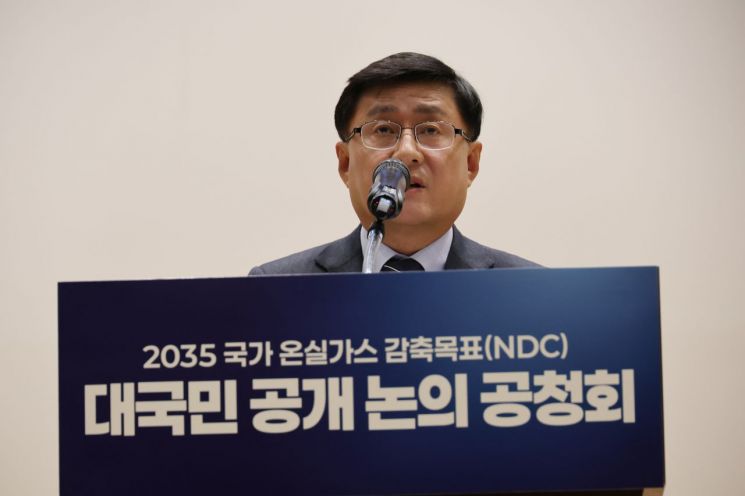 2035 National Greenhouse Gas Reduction Target (2035 NDC) Public Hearing
(Seoul=Yonhap News) Photo by Dongju Park - On November 6, Kim Sung-hwan, Minister of Climate, Energy and Environment, delivered a welcoming speech at the 2035 National Greenhouse Gas Reduction Target (2035 NDC) public discussion hearing held at the National Assembly Members' Office Building in Yeouido, Seoul. 2025.11.6
pdj6635@yna.co.kr (End)
The government initially considered presenting a single numerical reduction target, but after internal discussions, it shifted to setting a range with upper and lower limits, judging that ensuring flexibility in the target is more appropriate given the characteristics of the industrial structure, technological conditions, pace of energy transition, and economic variables.
In particular, this decision was influenced by repeated concerns raised by domestic industries regarding the limited reduction capacity of high-emission sectors such as steel and petrochemicals, as well as growing voices within the government emphasizing the need to consider practical constraints, such as the gap between the pace of renewable energy adoption and the expansion of the power grid.
The government emphasized that this reduction target is not merely a declaration of a reduction figure, but serves as a core pillar of the 'Green Transformation (GX)' policy, which encompasses growth strategies and industrial transition strategies. For the power sector, the government identified expanding renewable energy and reducing fossil fuel-based power generation as key measures. In the industrial sector, electrification of processes and decarbonization of fuels were highlighted, while in the transportation sector, accelerating the transition to electric and hydrogen vehicles was emphasized. For the building sector, expanding electrification of heating and thermal supply was proposed as a major reduction measure.
Additionally, in the agriculture, fisheries, and waste sectors, as well as carbon sinks, the government plans to promote measures such as expanding the use of renewable fuels, improving livestock manure treatment, and creating new carbon sinks. It also intends to implement a 'just transition' policy to mitigate potential damages to specific regions and industries during the process of industrial and energy structural transformation.
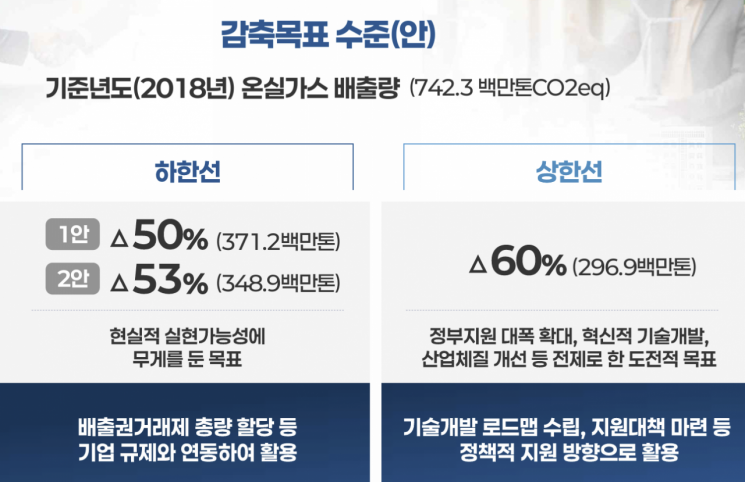
However, responses from various sectors remain divided. The industrial sector has called for a target focused on the lower limit, arguing that simply raising the reduction target without adequate renewable energy infrastructure and power grid development could significantly undermine international competitiveness and increase the risk of production disruptions. In contrast, environmental groups have criticized the 50%-range reduction as insufficient by international standards aimed at limiting global temperature rise to within 1.5 degrees Celsius, demanding that a reduction of at least 60% be made mandatory.
The government stated that it will finalize the plan after the public hearing and expert reviews. The public hearing will discuss sector-specific reduction potentials, technology roadmaps, and alignment with power supply plans. After the hearing, the government will prepare its final proposal, which will be reviewed and approved by the 2050 Carbon Neutrality and Green Growth Committee and the Cabinet early this month. The finalized 2035 NDC will then be announced at the 30th Conference of the Parties to the United Nations Framework Convention on Climate Change (COP30), to be held in Belem, Brazil, from November 10 to 21.
Kim Sung-hwan, Minister of Climate, Energy and Environment, stated, "The process of establishing this greenhouse gas reduction target is a new model of public discourse created together with the people," adding, "Through a target that balances feasibility and international responsibility, Korea will leap forward as a leading nation in green transformation."
© The Asia Business Daily(www.asiae.co.kr). All rights reserved.
![Clutching a Stolen Dior Bag, Saying "I Hate Being Poor but Real"... The Grotesque Con of a "Human Knockoff" [Slate]](https://cwcontent.asiae.co.kr/asiaresize/183/2026021902243444107_1771435474.jpg)
















