The government has launched efforts to develop next-generation wildfire suppression vehicles to effectively respond to increasingly frequent large-scale wildfires.
On the 6th, the Korea Forest Service announced that, in collaboration with the Ministry of Science and ICT and the Ministry of the Interior and Safety, it has begun developing domestically produced "large-scale wildfire suppression vehicles."
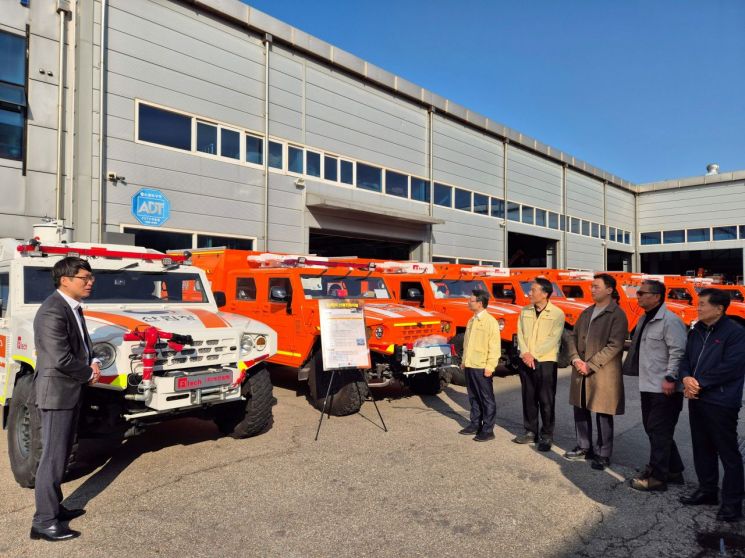 A representative from the research and development institution responsible for the 'Multipurpose Wildfire Suppression Vehicle,' an outcome of the National Life Safety Emergency Response Research Phase 1 (2022?2024), is introducing the manufacturing process. Provided by the Korea Forest Service
The three agencies jointly held an on-site kickoff briefing for the "large-scale wildfire suppression vehicle" emergency response research the previous day at a research institution located in Bio Valley, Hwaseong, Gyeonggi Province.
The emergency response research is a project jointly organized by the Ministry of the Interior and Safety and the Ministry of Science and ICT, aimed at identifying solutions to disaster and safety issues that threaten the daily lives of citizens. Previously, through Phase 1 (2022-2024) of the emergency response research project, the Korea Forest Service developed a "medium-sized multipurpose wildfire suppression vehicle" and will deploy a total of 64 medium-sized wildfire suppression vehicles in the field by the end of this year.
The subsequent Phase 2 research and development (R&D) aims to complete a suppression vehicle suitable for responding to large-scale wildfires.
Through Phase 2 R&D, the government plans to develop a suppression vehicle equipped with a water tank capable of holding 6,000 liters-twice the capacity of the main wildfire suppression helicopter, the KA-32 (Kamov).
In addition, the government intends to develop water supply technology that enables simultaneous relay water supply to multiple wildfire suppression vehicles, and to enhance long-distance water spraying systems capable of reaching over 50 meters, thereby strengthening ground-based wildfire suppression capabilities.
Notably, the Phase 2 R&D process will directly involve professional wildfire suppression personnel to incorporate field feedback, applying a Living Lab approach that allows for on-site validation and improvement. Through this, the government aims to dramatically enhance the completeness of the large-scale wildfire suppression vehicle.
Lee Woojin, Acting Director of the Public Convergence Research Policy Division at the Ministry of Science and ICT, stated, "We will continue to support emergency response research based on inter-ministerial collaboration to resolve urgent disaster and safety issues such as wildfires through science and technology."
Seo Namgyo, Director General of the Social Disaster Policy Bureau at the Ministry of the Interior and Safety, said, "We will strive to ensure that practical research and development, which actively reflects field feedback, is carried out to protect the safety of the public from various disasters."
Park Eunsik, Director General of the Forest Industry Policy Bureau at the Korea Forest Service, commented, "As the agency responsible for wildfires in this era of climate disasters, the Korea Forest Service will focus its resources on wildfire prevention and initial response," adding, "To this end, we will also actively pursue tailored forest science and technology R&D."
© The Asia Business Daily(www.asiae.co.kr). All rights reserved.
![Clutching a Stolen Dior Bag, Saying "I Hate Being Poor but Real"... The Grotesque Con of a "Human Knockoff" [Slate]](https://cwcontent.asiae.co.kr/asiaresize/183/2026021902243444107_1771435474.jpg)















