"2026 Budget Bill Debate" Held at the National Assembly on the 3rd
Ruling and Opposition Secretaries of the Special Committee on Budget and Accounts Outline Their Review Directions
At the 2026 budget bill debate, the ruling and opposition party secretaries of the National Assembly Special Committee on Budget and Accounts confronted each other, each advocating for opposing directions in budget review. The ruling party stated that it would thoroughly scrutinize unnecessary budget items while also considering areas that may require increased funding. In contrast, the opposition party argued that further expenditure restructuring is necessary.
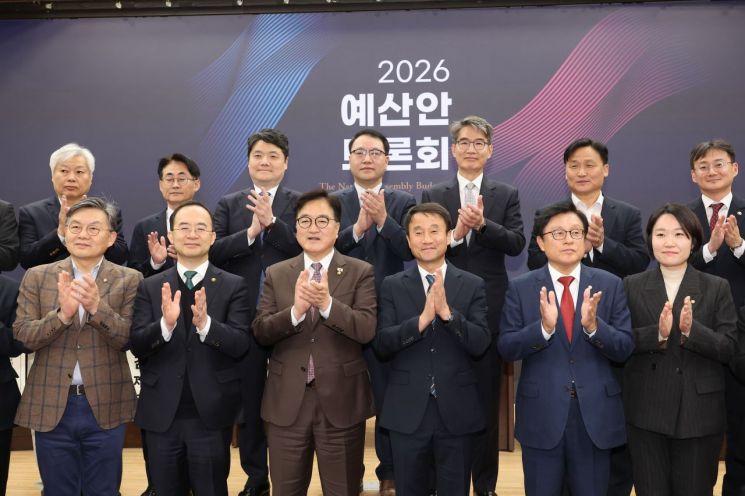
At the "2026 Budget Bill Debate" held at the National Assembly Members' Office Building in Yeouido on the 3rd, Lee Soyoung, the secretary of the ruling party for the Special Committee on Budget and Accounts and a member of the Democratic Party of Korea, commented on the direction of the budget review, saying, "This is the first budget bill of the government elected by the people," and added, "It is significant in that it designs the finances to faithfully implement national policy tasks, and I will ensure that this intent is well reflected during the review."
The budget bill for next year amounts to 728 trillion won, an 8.1% increase compared to the previous year. National debt is expected to reach 1,415.2 trillion won, representing 51.6% of the gross domestic product (GDP). Yoo Byungseo, Director of the Budget Office at the Ministry of Economy and Finance, stated during his presentation, "We have carried out expenditure restructuring amounting to approximately 27 trillion won," and added, "This is a more intensive adjustment than in previous years' budget bills."
Lee pointed out, "The most notable aspect of the budget bill is the significant increase in total expenditure compared to the previous year, and this is by no means a small amount." She continued, "However, I agree with the government's judgment that a substantial increase in spending is necessary under the current circumstances." Lee attributed the need for increased spending to the mismanagement of the Yoon Suk Yeol administration, stating, "Restoring what has collapsed and correcting what has been disrupted inevitably requires greater energy."
Lee emphasized, "Above all, the National Assembly's role is to meticulously review the budget to prevent waste," and added, "We will carefully examine whether there are any unnecessary or non-urgent budget items to ensure that the benefits are fully delivered to the people."
She also mentioned the need for budget increases. Lee stated, "We plan to actively identify budget items that ensure the sustainability of the Republic of Korea," and continued, "We will actively seek out budgets for addressing local extinction, balanced regional development, climate and demographic crises, support for vulnerable groups and youth, and fostering future core industries." She further added, "We will also reflect budgets for resource decentralization and redundancy following the national data center fire, drought contingency funds, and additional demands related to customs negotiations."
Lee explained, "Because the parliamentary audit started a week late due to Chuseok, the budget review is also under tight deadlines," but assured, "Nevertheless, we will conduct the review efficiently to meet the statutory deadline." The legal deadline for the National Assembly to process the budget bill in a plenary session is December 2.
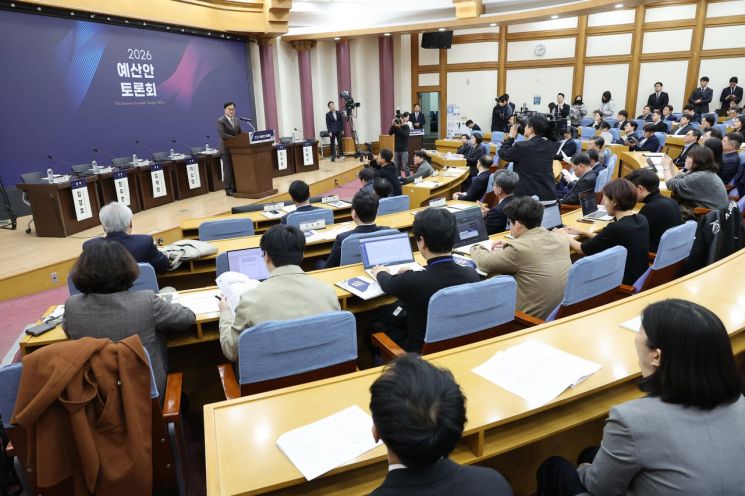
On the other hand, the People Power Party pointed to the increased national debt and insisted on the need for further expenditure restructuring. Park Hyungsoo, the opposition party secretary for the Special Committee on Budget and Accounts and a member of the People Power Party, stated, "We will approach the review with the aim of minimizing unnecessary tax and national debt burdens on the people and overcoming difficulties to prepare for future uncertainties," and added, "We will examine the budget to eliminate cash handout programs and reduce the costs of issuing government bonds."
Park remarked, "Recently, S&P downgraded France's credit rating by one notch. The reason was that the French government decided to shelve pension reform aimed at reducing fiscal spending," and continued, "Countries that neglect fiscal soundness are all facing difficulties." He further argued, "Although this is said to be the most drastic expenditure restructuring ever, it is not very high compared to total expenditure. It is almost at the same level as in 2023," and insisted, "We need to pursue further expenditure restructuring."
He also mentioned local gift certificates and Onnuri gift certificates, saying, "Rather than being a fundamental solution for the people's livelihood and economy, aren't these just aiming for a temporary economic stimulus effect?" and added, "We need to fundamentally consider how long we will continue injecting fiscal resources and issuing local currencies."
Park argued that the National Growth Fund and the parent fund for fostering the venture business ecosystem also require review. Regarding the National Growth Fund, Park stated, "They say they will raise 150 trillion won over five years. While I agree with the necessity, there is a lack of detailed explanation about how the fund will be created, where it will be invested, and how it will generate results."
Regarding the parent fund, he pointed out, "The private investment matching ratio was in the 80% range in 2016, but it has continued to decline and now remains in the 60% range," and added, "I am concerned that instead of stimulating robust private investment, the parent fund may be fostering a structure where entities rely on it, so we need to examine the actual operational status."
Park refuted Lee's attribution of responsibility for increased budget spending to the Yoon Suk Yeol administration, stating, "While the imposition of martial law was wrong, it does not mean that every policy of the government that imposed martial law was also wrong," and added, "The reasons why economic policies had to be managed in such a manner during the Yoon Suk Yeol administration were due to a combination of factors, including the Ukraine and Israel-Middle East wars, which led to rising raw material prices." Park emphasized, "I hope people do not believe that these issues arose solely because of flawed economic policies."
Meanwhile, National Assembly Speaker Woo Wonshik, in his remarks of encouragement, stated, "This is the second such review since the 22nd National Assembly convened," and added, "As this is the first budget formulated by the new government and is now under review, I urge both the ruling and opposition parties to cooperate so that a budget bill that meets the public's expectations can be passed within the statutory deadline." President Lee is scheduled to deliver a policy speech on next year's government budget bill at the National Assembly on November 4.
© The Asia Business Daily(www.asiae.co.kr). All rights reserved.
![Clutching a Stolen Dior Bag, Saying "I Hate Being Poor but Real"... The Grotesque Con of a "Human Knockoff" [Slate]](https://cwcontent.asiae.co.kr/asiaresize/183/2026021902243444107_1771435474.jpg)
















