'Policy Improvement Measures for SSM Franchise Stores' Seminar at the National Assembly
Nearly Half (47%) of SSMs Operated by Small Business Owners
"Only SSM Franchises Face Regulations Among Franchise Businesses... Legal Inconsistency"
Experts:
About half of all Super Supermarkets (SSM) nationwide are franchise stores operated by small business owners, and an analysis has shown that the opening of SSMs has revitalized local commercial districts, as evidenced by increased sales at restaurants and convenience stores. As the National Assembly is set to process a bill extending the sunset clause of the Distribution Industry Development Act, which imposes business restrictions on large discount stores and SSMs, criticism has arisen that the legislation is being pushed forward without a thorough analysis of its economic effects.
According to industry sources on November 4, Professor Cho Chunhan of Gyeonggi University of Science and Technology presented these research findings at the "Policy Improvement Measures for SSM Franchise Stores" seminar held at the National Assembly Members' Office Building in Yeongdeungpo-gu, Seoul, the previous day.
Professor Cho analyzed big data from users of Card Company A for the year before and after the opening of 280 SSMs. The results showed that after SSMs opened, sales at large discount stores within a 1-kilometer radius decreased, while sales at restaurants and convenience stores increased. This suggests that while SSMs compete with large discount stores, they have a complementary relationship with local businesses such as restaurants and convenience stores by boosting customer traffic in the area.
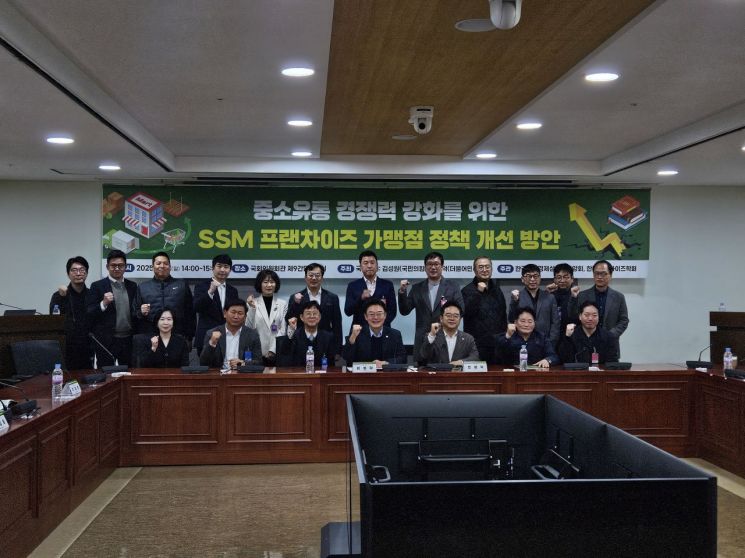 On the afternoon of the 3rd, a seminar on "Policy Improvement Measures for SSM Franchise Stores" was held at the National Assembly Members' Office Building in Yeongdeungpo-gu, Seoul, where participants are taking a commemorative photo. Photo by Jae-Hyun Park
Analysis of Credit Card User Data Before and After SSM Openings
Professor Cho stated, "The opening of SSMs has a dual structure: it has a limited competitive effect on businesses of the same type, but it revitalizes local commercial districts in the lifestyle service sector." He added, "In the case of restaurants and convenience stores, SSMs increase the floating population and dwell time in the commercial area, expanding demand for dining out at restaurants and supplementary consumption at convenience stores, thereby forming a complementary relationship with SSMs."
He continued, "SSMs are located within a 300-500 meter radius of neighborhood commercial districts and have the second highest customer attraction power after large discount stores. Over 90 percent of their sales come from food products, focusing on product categories that can compete with online platforms. When individually operated neighborhood supermarkets convert to SSM franchises, their average sales increase, and small business owners can improve their operational efficiency and price competitiveness by sharing the logistics and standard operating infrastructure of the headquarters."
In fact, as of last year, 47 percent (668 stores) of the 1,433 SSMs nationwide were franchise stores operated by small business owners. When the Distribution Industry Development Act was enacted in 2013, only 225 out of 1,293 SSMs were franchises. However, the number has increased as SSM franchises have emerged as a low-capital startup option for small business owners lacking experience and capital.
47% of SSM Franchises Operated by Small Business Owners...Conflict with Franchise Business Law
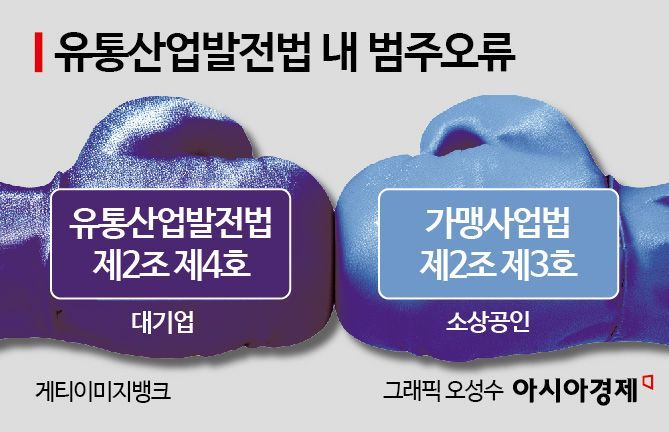
Because of this, there are claims that it is unfair for only SSM franchise stores among all franchise businesses to be subject to business restrictions. Professor Cho pointed out, "There are no business restrictions on franchises such as convenience stores, bakeries, or cafes operated by large corporations, and among franchise businesses, SSMs are the only ones subject to such regulations. Under the current distribution law, franchise stores like convenience stores, Daiso, and bakeries are classified as eligible for livelihood recovery consumer coupons, but SSM franchises are excluded, resulting in a loss of fairness."
He further emphasized, "It is necessary to apply exceptions to business restrictions for franchise stores to support the survival of neighborhood supermarkets by converting them into SSM franchises and to support the successful startup and continued operation of small business owners."
The current Distribution Industry Development Act, aimed at protecting traditional markets and small- and medium-sized retailers, imposes the following on large discount stores and quasi-large stores (including SSMs): business hours restrictions from midnight to 10 a.m. the next day, mandatory closure twice a month, and a ban on opening within traditional commercial preservation zones. However, more than a decade after these regulations were implemented, the offline distribution market has stagnated while online platforms have grown explosively since the COVID-19 pandemic, leading to criticism that these regulations are now shrinking local commercial districts.
Experts Agree: "Regulating SSM Franchises Contradicts the Original Policy Purpose"
Kim Kyungbae, President of the Korea Central Association for Revitalizing Local Economies, said, "As the market shifts online, the entire offline distribution sector is struggling, and the number of small- and medium-sized supermarkets converting to SSM franchise stores for survival is rapidly increasing, especially since their business conditions are much worse than those of large distributors. Even though owners who have converted from individual supermarkets to SSM franchises are all local small business owners, subjecting them to the same regulatory framework as large corporations is neither fair nor consistent with the original intent of the policy."
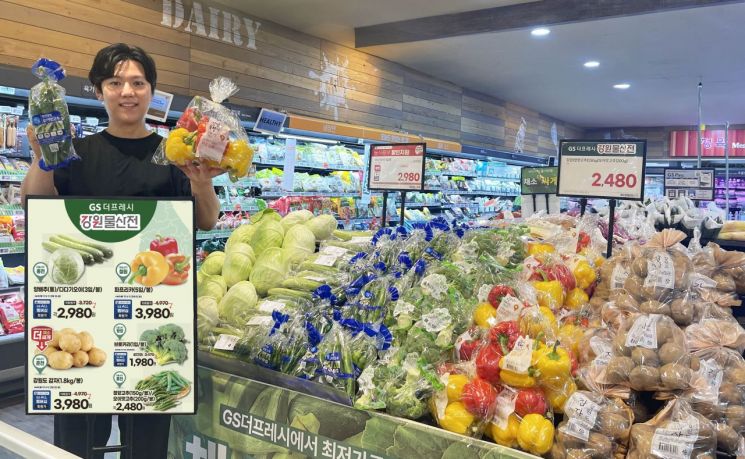
Lim Dongil, a franchise owner of Emart Everyday in Garak-dong, said, "Business restrictions have made things difficult, and being excluded from the list of stores eligible for consumer coupons has caused many existing customers to leave, resulting in a significant drop in sales. I felt very marginalized by policy." Jeong Jaehun, who operates a GS The Fresh franchise, also commented, "In the past, I struggled to procure products due to the closure of local distributors, but as a franchise owner, I can now sell a variety of products and focus on store and customer management, which has been a great help."
Experts also agreed on the need for policy support. Song Taeho, a professor at Pusan National University, suggested, "The current Distribution Industry Development Act, which discriminates against small business owners in distribution sectors operated as matching funds with small business owners, should be rationally revised." He added, "The government should develop rational strategies to promote coexistence among distributors and enhance consumer welfare based on market analysis." Park Jeongeun, a professor at Ewha Womans University and the seminar chair, also emphasized, "SSM franchises are a means to strengthen the competitiveness of small and medium-sized merchants and a win-win model where large distributors and self-employed business owners can cooperate. SSM franchises are one of the key ways for small merchants to survive against dominant players such as online distributors, food material marts that have rapidly encroached on local commercial districts by exploiting regulatory loopholes, and convenience stores that have replaced small supermarkets. Therefore, policy support from the government and the National Assembly is essential."
Meanwhile, on September 25, the National Assembly's Trade, Industry, Energy, SMEs and Startups Committee passed a bill at its plenary session to extend the current business restrictions on large discount stores and SSMs for another four years. If the bill passes the Legislation and Judiciary Committee and the National Assembly plenary session, regulations on SSMs will be extended until November 2, 2029.
© The Asia Business Daily(www.asiae.co.kr). All rights reserved.
![Clutching a Stolen Dior Bag, Saying "I Hate Being Poor but Real"... The Grotesque Con of a "Human Knockoff" [Slate]](https://cwcontent.asiae.co.kr/asiaresize/183/2026021902243444107_1771435474.jpg)


















