Another Batch of Drugs Disguised as "Tea" Found on Jeju Beach
Police: "Packaging Similar to That Found in Pohang"
Drugs were discovered on the beach in Aewol-eup, Jeju, prompting the Coast Guard to launch an investigation. As drugs continue to be found along the Jeju coastline, concerns are growing that the area may be part of a distribution route.
According to the Jeju Regional Coast Guard Headquarters on October 31, a report was received from a passerby on October 24 regarding a suspicious object believed to be drugs on the beach in Aewol-eup, Jeju City.
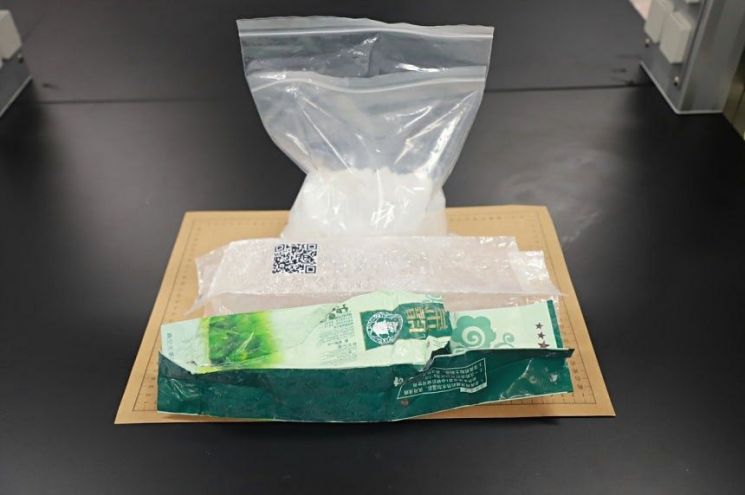
1 kg of ketamine worth approximately 250 million won confirmed
The Coast Guard collected the object and requested a detailed analysis from the National Forensic Service, which confirmed that it was ketamine. Ketamine is originally an anesthetic used for minor surgeries, childbirth, and burn treatment, but when abused, it can cause visual and auditory hallucinations and is classified as a new type of drug. This batch of drugs was packaged in a "tea" (茶) container, with about 1 kg of white crystals sealed inside. Based on a standard single dose of 0.03g, this amount could be used by 33,000 people simultaneously and is valued at approximately 250 million won.
Previously, on the 7th, drugs were also found on Gwangchigi Beach in Seongsan-eup, Seogwipo City. At that time, a marine environment protector cleaning the beach reported a suspicious object. The reported old sack contained 20 brick-shaped rectangular blocks mixed with other marine debris. Each block was wrapped in aluminum foil and transparent plastic, with the Chinese character 茶 (tea) written on the surface. The substance found in the sack was 20 kg of ketamine. Based on a single dose of 0.03g, this amount could be used by 660,000 people simultaneously and is reportedly worth about 6 billion won. The drugs found at that time were also ketamine, the same as in the recent case.
"Do not open or touch the package; report it immediately"
The Coast Guard explained that while the packaging of the drugs found on the Seongsan-eup beach was different, it was similar to the Chinese Tieguanyin (鐵觀音) oolong tea packaging found on the beach in Imgok-ri, Pohang, North Gyeongsang Province, on October 15. A representative from the Jeju Regional Coast Guard Headquarters stated, "We are investigating the possibility that the drugs, packaged similarly to those found on the beach in Imgok-ri, Pohang, may have drifted along ocean currents." As drugs continue to be discovered along the Jeju coastline, the Coast Guard has formed a dedicated investigation team to trace both maritime and land entry routes. The police urged, "If you find a white powder or block-shaped substance in a 'tea' (茶) package on the coast, do not open or touch it, and report it to the Coast Guard immediately."
© The Asia Business Daily(www.asiae.co.kr). All rights reserved.
![Clutching a Stolen Dior Bag, Saying "I Hate Being Poor but Real"... The Grotesque Con of a "Human Knockoff" [Slate]](https://cwcontent.asiae.co.kr/asiaresize/183/2026021902243444107_1771435474.jpg)















