Deposit Facility Rate Held at 2%
The European Central Bank (ECB) decided to keep all its key policy rates unchanged on the 30th (local time), including the deposit facility rate (2.00%), the main refinancing rate (2.15%), and the marginal lending facility rate (2.40%).
The ECB made this decision during a monetary policy meeting held in Florence, Italy, on the same day.
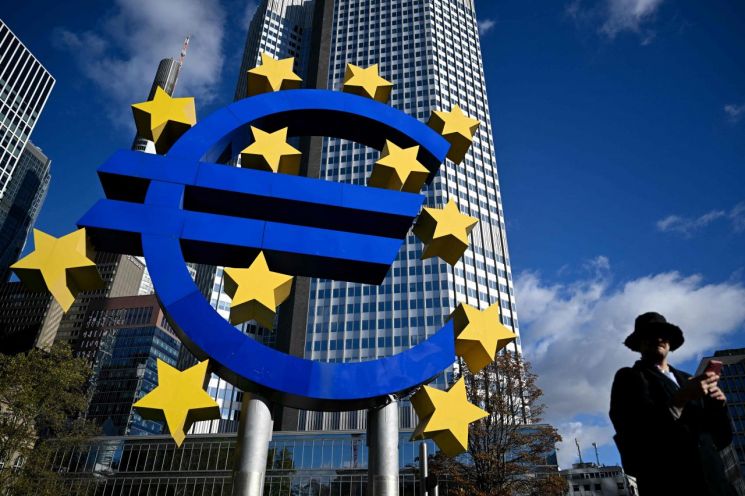
The ECB stated, "Inflation remains close to the medium-term target of 2%, and the Governing Council's inflation outlook is largely unchanged," adding, "The economy continues to grow despite a challenging global environment."
This rate freeze is in line with market experts' predictions, as reported by Bloomberg News and others.
With this decision, the gap between the deposit facility rate, which serves as the benchmark for Eurozone monetary policy, and South Korea's base rate (2.50%) remains at 0.50 percentage points. The U.S. Federal Reserve lowered its benchmark rate to 3.75-4.00% the previous day, narrowing the interest rate gap between the Eurozone and the United States to 1.75-2.00 percentage points.
From June of last year to June of this year, the ECB cut its policy rates by a total of 2.00 percentage points over eight occasions, and has since held rates steady at three subsequent meetings, including the latest one.
The Eurozone's consumer price inflation rate fell to 1.9% in May this year and has hovered around 2.0% since then. Last month, it was 2.2%. The ECB forecasts inflation at 2.1% for this year and 1.7% for next year.
Christine Lagarde, President of the ECB, commented, "The U.S.-EU trade agreement, the recently announced Middle East ceasefire, and today's progress in U.S.-China trade negotiations have all helped to partially ease downside risks to the economy." However, she cautioned, "The global trade policy environment remains unstable, making the inflation outlook uncertain," and added, "A stronger euro could lower inflation more than expected."
Experts believe that, as the Eurozone's third-quarter economic growth rate announced today exceeded expectations at 0.2%, downside risks to the economy have diminished, and the ECB is likely to remain on hold for the time being.
David Powell, Senior Economist at Bloomberg Economics, said, "The ECB is taking comfort in the resilience of the Eurozone economy and is hesitant to cut rates further," adding, "If the impact of U.S. tariff hikes on the Eurozone becomes more apparent next year, it will become increasingly difficult for the ECB to maintain its current stance."
Opinions remain divided on whether the rate-cutting cycle has ended. Some analysts expect that the stronger euro this year, ongoing trade uncertainties, and the need for France to reduce its fiscal deficit will increase downside risks to inflation, leaving open the possibility of further rate cuts. On the other hand, there are also concerns about rising inflation, particularly due to food prices.
In a Bloomberg News survey of experts, 17% of respondents predicted that there would be at least one rate hike by the end of next year.
© The Asia Business Daily(www.asiae.co.kr). All rights reserved.
![Clutching a Stolen Dior Bag, Saying "I Hate Being Poor but Real"... The Grotesque Con of a "Human Knockoff" [Slate]](https://cwcontent.asiae.co.kr/asiaresize/183/2026021902243444107_1771435474.jpg)















