Real-time Sharing of Funding Plans with the Ministry of Land, Infrastructure and Transport
Separate "Real Estate Tax Evasion Reporting Center" to Be Established
The National Tax Service plans to focus all its resources on preventing real estate tax evasion. The agency will thoroughly verify funding plans by sharing them in real time with the Ministry of Land, Infrastructure and Transport, and will also establish a separate "Real Estate Tax Evasion Reporting Center."
On the 30th, the National Tax Service announced that it is pursuing a plan to share the entire set of funding plans and supporting documents with the Ministry of Land, Infrastructure and Transport in real time. The funding plan serves as a foundational document for verifying the legitimacy of funds used to acquire real estate, as it details the sources of acquisition funds.
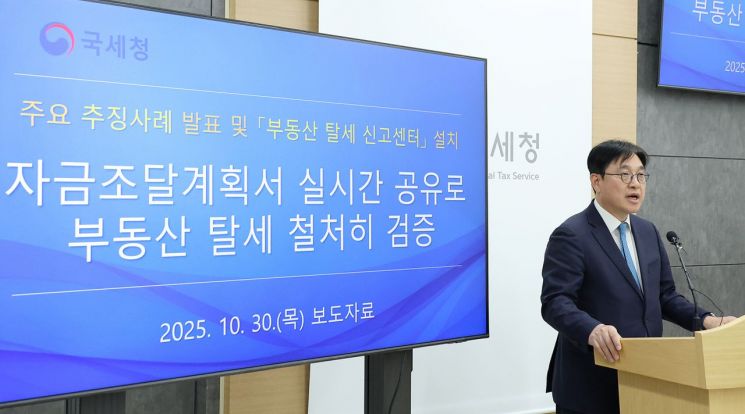 Sanghoon Oh, Director of the Asset Taxation Bureau at the National Tax Service, is giving a briefing at the Government Sejong Complex on the 30th. National Tax Service
Sanghoon Oh, Director of the Asset Taxation Bureau at the National Tax Service, stated, "The National Tax Service will focus all its efforts on blocking speculation and tax evasion in the real estate market to restore market order and tax justice." He emphasized, "We will significantly strengthen the verification of funding sources for high-priced apartment transactions, and thoroughly examine whether gift tax has been properly reported in cases of property transfers by donation."
The National Tax Service has observed an increase in gap investment transactions as lending regulations have tightened recently. The agency also analyzed that transactions suspected of using "parental support," such as private loans between individuals, are on the rise. This indicates an increase in speculative transactions aimed at asset accumulation or wealth transfer, rather than genuine demand for housing.
The National Tax Service is closely analyzing funding plans collected from the Ministry of Land, Infrastructure and Transport by linking them with various taxation data it holds, such as property and income records, to detect possible tax evasion. If the information in the funding plan is found to be inaccurate or if the source of funds is unclear-raising suspicions of disguised gifts or other forms of tax evasion-the case is selected for a funding source investigation. The agency then traces the actual flow of funds and collects any evaded taxes.
For example, according to the National Tax Service, an individual in their 30s who had just started their career acquired a high-priced apartment in Seoul for several billion won and submitted a funding plan citing the proceeds from selling a previously owned apartment, Apartment B, as the source of funds. The agency found that when the individual acquired Apartment B in their 20s, they had no income or assets, making the source of funds unclear and prompting an investigation. The investigation revealed that the individual had received the full amount for Apartment B from their mother as a cash gift but failed to report the gift tax. As a result, the National Tax Service collected several hundred million won in unpaid gift taxes from the mother.
Additionally, starting from October 31, the National Tax Service will open the Real Estate Tax Evasion Reporting Center to collect tips from the public regarding tax evasion, and any information received will be processed promptly.
Director Oh stated, "Tax audits have frequently uncovered cases where individuals acquired property using funds improperly gifted from their parents or using unreported income from underreported sales." He added, "By sharing information in real time, we will promptly identify suspicious real estate transactions, further advance our funding source analysis system to more precisely select suspected tax evaders, and respond strongly to tax evasion while minimizing inconvenience for taxpayers who file honestly."
© The Asia Business Daily(www.asiae.co.kr). All rights reserved.
![Clutching a Stolen Dior Bag, Saying "I Hate Being Poor but Real"... The Grotesque Con of a "Human Knockoff" [Slate]](https://cwcontent.asiae.co.kr/asiaresize/183/2026021902243444107_1771435474.jpg)















