Annual U.S. Combat Ship Procurement Reaches 50 Trillion Won
Korean Firms Link U.S. Local Plants with Domestic Shipyards
Nuclear Submarine Approval Could Unlock Multi-Trillion Won Market
At the 2025 Asia-Pacific Economic Cooperation (APEC) Summit on October 29, South Korea and the United States reached a dramatic agreement on tariff negotiations. The MASGA (Make America Shipbuilding Great Again) project for the shipbuilding industry will be supported primarily through ship finance, including refund guarantees (RG) and long-term loans, alongside direct investments by Korean shipbuilders in the United States. Kim Yongbeom, Chief Presidential Secretary for Policy, stated, "MASGA will be driven by our companies."
On October 30, Meritz Securities analyzed in its report, "Shipbuilding: The American Dream," that direct investment by Korean shipbuilders in the United States could serve as a catalyst for trickle-down effects originating from the U.S. market.
Korea-U.S. Naval Ship Cooperation to Begin in 2028
The U.S. shipbuilding industry’s value chain is nearly collapsed. Even if allied countries such as South Korea and Japan manufacture and deliver ship blocks, it is difficult to assemble them at U.S. yards. This could disrupt the Korea-U.S. naval ship cooperation schedule, which is set to begin in 2028 and proceed in earnest from 2030. Direct investment by Korean shipbuilders in the United States has become an unavoidable choice to enter the vast American market.
According to the Annual Long-Range Plan for Construction of Naval Vessels, the U.S. Navy’s average annual procurement plan for combat ships over the next five years stands at 36.3 billion dollars, which is close to 50 trillion won. Meritz Securities estimated that the outsourcing volume that South Korea and Japan could secure would be about 6.7 billion dollars (9.2 trillion won) annually, assuming this accounts for approximately 19% of the total procurement plan.
Expanding Order Opportunities from Naval Ships to Merchant Ships
Bae Kiyoun, an analyst at Meritz Securities, stated, "Direct investment by Korean shipbuilders could provide an opportunity to secure an irreplaceable position not only in the U.S. combat ship market but also in the merchant ship and naval ship sectors." In this context, the three major Korean shipbuilders are already preparing for entry into the U.S. market in various ways.
HD Hyundai Group has signed memoranda of understanding (MOUs) with U.S. companies such as Huntington Ingalls Industries (HII) and Fairbanks Morse Defense (FMD) in relation to naval ships. The group also entered a strategic partnership with Edison Chouest Offshore (ECO) for the joint construction of LNG-DF container ships by 2028.
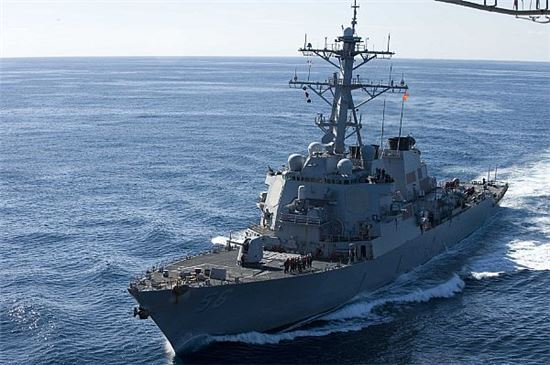
Hanwha Group, after acquiring Hanwha Philly Shipyard, is also pursuing the acquisition of Austal USA. In September last year, Austal USA signed a contract with a U.S. nuclear-powered submarine builder to establish a submarine module production facility, with completion scheduled for next year. If Hanwha succeeds in acquiring Austal USA, it will directly participate in the value chain for building nuclear-powered submarines, which is the top priority for U.S. naval expansion. Unlike China, which has completed a system to build six nuclear-powered submarines per year, the United States has struggled to meet its annual production targets of one Columbia-class submarine for nuclear deterrence and two Virginia-class submarines for multipurpose attack roles.
Samsung Heavy Industries has formed a strategic partnership with Vigor Marine Group. The collaboration will begin with maintenance, repair, and overhaul (MRO) services for non-combat naval vessels, with plans to expand into various shipbuilding projects in the future.
Nuclear-Powered Submarines to Reshape the Shipbuilding Landscape
During the joint statement at the Korea-U.S. summit on October 29, President Lee Jaemyung publicly requested approval for nuclear fuel supply for nuclear-powered submarines. South Korea has faced obstacles in building nuclear-powered submarines due to a clause in the Korea-U.S. nuclear agreement restricting the use of nuclear fuel for military purposes. In a briefing after the summit, Wi Sunglak, National Security Advisor to the President, announced, "President Trump expressed his understanding of our need for nuclear-powered submarine capabilities and agreed to hold follow-up discussions." On October 30, President Trump stated on the social media platform Truth Social, "I have approved the construction of nuclear-powered submarines for Korea. They will be built at the Philadelphia Shipyard acquired by Hanwha," effectively confirming South Korea's construction of nuclear-powered submarines.
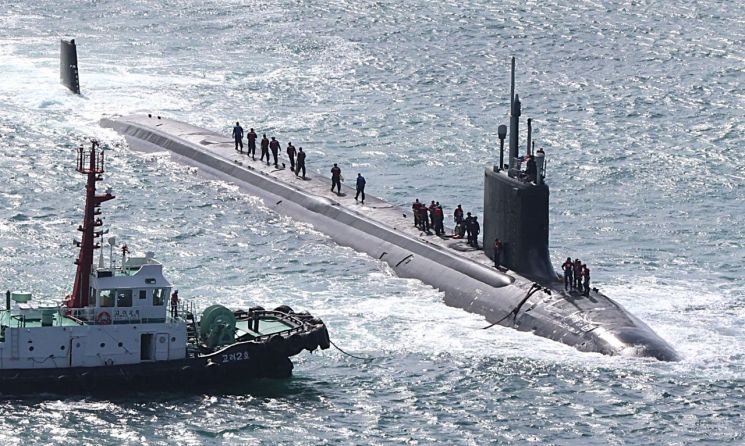
How much will it cost for a Korean shipbuilder to construct a nuclear-powered submarine for the Korean Navy? The contract amount for the third Jangbogo III Batch II submarine, the latest model ordered from Hanwha Ocean, is 1.102 trillion won. Among U.S. nuclear-powered submarines, the Virginia-class costs 5.1 billion dollars (about 7 trillion won) per unit, while the Columbia-class costs 9.4 billion dollars (about 13 trillion won) each. In Korea’s case, since only conventional weapons can be installed, unlike in the United States, the price will be much lower. Nevertheless, a multi-trillion-won market per submarine will open up.
Bae Kiyoun, the analyst, commented, "Although the value may not reach that of U.S.-made nuclear-powered submarines, there is significant upside compared to current diesel-powered submarines. If Korea secures a reference for building nuclear-powered submarines, it could also consider participating in the value chain for expanding the U.S. Navy’s nuclear-powered submarine fleet, which is a top priority for the United States."
© The Asia Business Daily(www.asiae.co.kr). All rights reserved.
![Clutching a Stolen Dior Bag, Saying "I Hate Being Poor but Real"... The Grotesque Con of a "Human Knockoff" [Slate]](https://cwcontent.asiae.co.kr/asiaresize/183/2026021902243444107_1771435474.jpg)















