US Fed Lowers Benchmark Rate to 3.75~4.0% Annually
Two Dissenting Votes: "0.5% Cut" and "Hold"
Quantitative Tightening to End Starting December
Powell: "December Rate Cut Not a Foregone Conclusion"
Hawkish Remarks Lead to Stock Market
The U.S. Federal Reserve (Fed) lowered its benchmark interest rate by 0.25 percentage points on the 29th (local time), as expected, marking its second consecutive rate cut in two months. The Fed also announced it would end its balance sheet reduction policy, known as quantitative tightening (QT), starting in December. However, Fed Chairman Jerome Powell drew a line against expectations for further rate cuts within the year, stating, "It should not be taken for granted that there will be a rate cut in December."
The market reacted immediately to Powell’s hawkish (monetary tightening-oriented) remarks. As expectations for additional rate cuts quickly faded, major indices on the New York Stock Exchange turned downward, and U.S. Treasury yields surged, with the 10-year yield surpassing 4%.
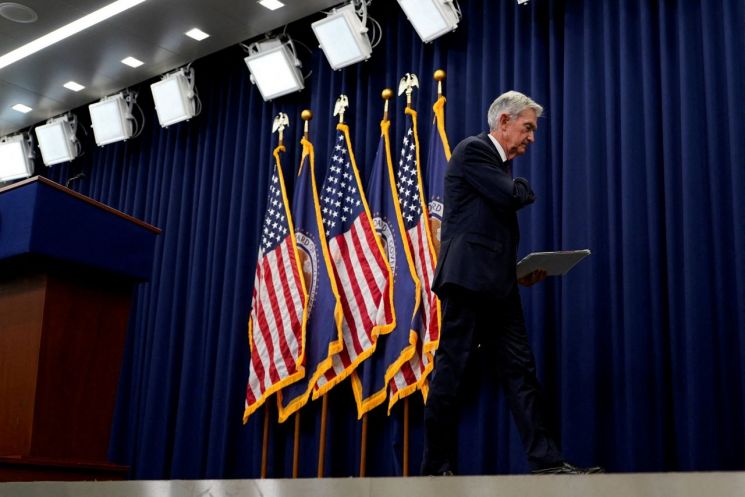
U.S. Fed Cuts Benchmark Rate to 3.75-4.0% Annually... Two Dissenting Votes for "0.5%P Cut" and "Hold"
In a statement released after the Federal Open Market Committee (FOMC) regular meeting, the Fed announced it would lower the federal funds rate by 0.25 percentage points to an annual range of 3.75-4.0%. This marks the second consecutive rate cut, following the first cut of the year last month. As a result, the interest rate gap between South Korea and the United States has narrowed to 1.5 percentage points at the upper end.
This decision was not unanimous. Of the 12 FOMC members with voting rights, two cast dissenting votes. Steve Myron, a Fed governor known as President Donald Trump’s "economic advisor," advocated for a 0.5 percentage point cut, while Jeffrey Schmidt, President of the Federal Reserve Bank of Kansas City, argued for holding rates steady, reflecting divergent views. This highlights the Fed’s growing dilemma between its dual mandates of price stability and full employment, as job growth slows and inflation remains above the Fed’s target of 2%.
In its statement, the Fed assessed, "Available indicators suggest that economic activity has been expanding at a moderate pace," and added, "Although job gains have slowed and the unemployment rate has edged up, it remained low through August." Regarding inflation, the Fed noted, "Inflation has risen since the beginning of the year and remains somewhat elevated."
Additionally, the Fed decided to end quantitative tightening, which began in June 2022, on December 1. Quantitative tightening is a policy in which the Fed absorbs market liquidity by selling its holdings of bonds or ceasing reinvestment after maturity, the opposite of quantitative easing (QE), which supplies liquidity.
Powell: "December Cut Not a Foregone Conclusion"... Market Expectations Cool Rapidly, Stocks Fall, Treasury Yields Surge
This rate cut had been widely anticipated by the market, given the gradual cooling of the labor market and lower-than-expected inflation. While the market was focused on whether there would be a signal for further cuts within the year, Powell took a cautious stance and tempered such expectations.
At a press conference immediately following the FOMC meeting, Powell said, "It should not be taken for granted that there will be a rate cut in December. In fact, we are far from that," adding, "There are strong differences of opinion among policymakers regarding the direction for December." He also noted that among Fed members, there is a growing sentiment that "at least one cycle (meeting) should be waited out before any further cut."
The fact that the dissenting votes on this day were for both a "big cut" and a "hold" suggests that internal differences within the Fed over future monetary policy are likely to intensify. In reality, the Fed faces a policy dilemma: it needs to raise rates to control inflation, but lower them to support employment. Powell also pointed out that if the release of economic data continues to be delayed due to the federal government shutdown (temporary suspension of government work), it could further support the argument for caution regarding additional cuts.
Powell stated, "The current rate level is less restrictive than before, which will help prevent further deterioration in the labor market." He also mentioned that this cut, following last month’s, is a risk management step to move closer to the neutral rate. Additionally, he explained, "If the effects of tariff increases are excluded, the inflation rate would be close to the 2% target."
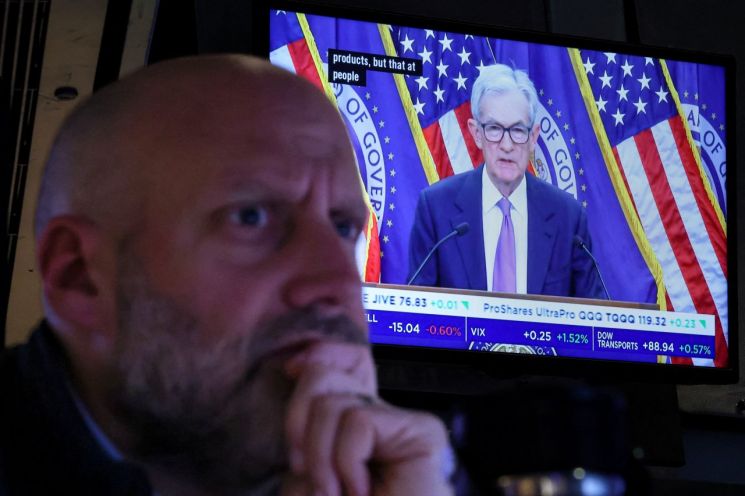 On the 29th (local time) at the New York Stock Exchange (NYSE) trading floor in the United States, a trader is working while in the background, a screen shows Jerome Powell, Chairman of the U.S. Federal Reserve, holding a press conference after announcing a base interest rate cut. Photo by Reuters Yonhap News
As Powell’s remarks were more hawkish than expected, the market sharply lowered its expectations for additional rate cuts within the year. According to CME FedWatch, the probability that the Fed will cut rates by another 0.25 percentage points in December, adjusting the annual rate to 3.5-3.75%, dropped from 90% the previous day to the 60% range after Powell’s remarks. As the outlook for further monetary easing weakened, the three major New York stock indices, which had hit record intraday highs, gave up their gains. The Dow Jones Industrial Average and S&P 500 Index each closed down by less than 0.16% and 0.1%, respectively, while the Nasdaq Index closed up 0.55% thanks to gains in Nvidia. U.S. Treasury yields surged, with the 10-year yield-considered the global benchmark-jumping 9 basis points (1bp = 0.01 percentage points) from the previous day to 4.08%, surpassing the 4% mark. The yield on the 2-year Treasury note, which is sensitive to monetary policy, also soared by 10 basis points to around 3.6%.
On Wall Street, opinions are divided over whether the Fed will proceed with another rate cut in December.
Michael Rosen, Chief Investment Officer (CIO) at Angeles Investment, commented, "Chairman Powell’s remarks reflect the tension within the Fed between those favoring more aggressive easing and those still concerned about elevated inflation," adding, "The market has been pricing in the pace and scale of future rate cuts (into stock prices) too aggressively."
On the other hand, Vincent Reinhart, Chief Economist at BNY Investment, pointed to the lack of key economic data due to the shutdown, predicting, "It will be more difficult not to cut rates in December. It is easier to keep going than to stop."
© The Asia Business Daily(www.asiae.co.kr). All rights reserved.
![Clutching a Stolen Dior Bag, Saying "I Hate Being Poor but Real"... The Grotesque Con of a "Human Knockoff" [Slate]](https://cwcontent.asiae.co.kr/asiaresize/183/2026021902243444107_1771435474.jpg)
















