Rural Development Administration: "Overall Growth Performance and Meat Quality of Hanwoo Have Improved"
Marbling Increased by 33% from the 1990s to the 2020s
The marbling, growth rate, and meat quality of Hanwoo cattle have shown remarkable improvement over the past 30 years. Intramuscular fat, or marbling, which greatly influences domestic consumer preferences, has increased by more than 30%.
The Rural Development Administration announced on October 29 that, after a comprehensive analysis of data accumulated from the 1990s to the 2020s, the overall growth performance and meat quality of Hanwoo cattle have significantly improved.
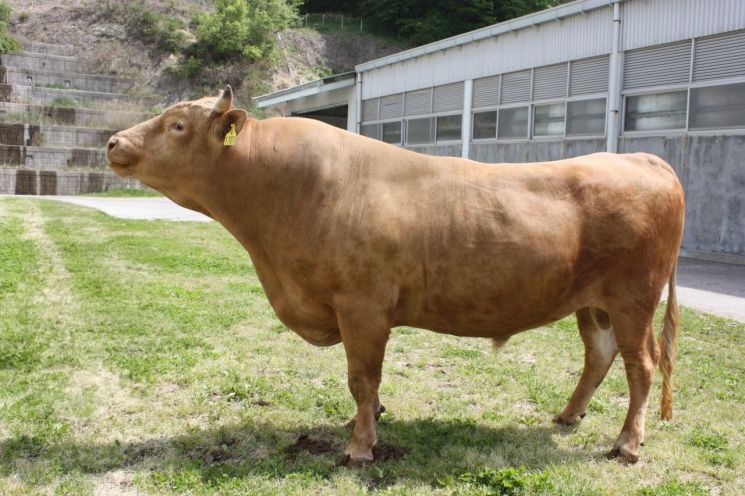
First, the weight at six months of age increased from 144.7 kg to 157.7 kg, and the live weight-meaning the total weight of Hanwoo cattle before slaughter-rose from 575.5 kg to 756.3 kg, marking a 31.4% increase. In particular, intramuscular fat (marbling) improved from 3.62 to 5.10. Marbling rapidly increased after 16 months of age and peaked at 30 months.
Kim Jinhyung, Director of the National Institute of Animal Science at the Rural Development Administration, stated, "The dramatic improvement in Hanwoo quality is a direct result of precise nutritional management at each growth stage and advancements in feeding technology," adding, "The Rural Development Administration has driven Hanwoo quality innovation by focusing research and development on three pillars: genetic capability improvement, advanced customized feeding technology, and systematic quality management."
Since 1993, a genetic capability evaluation system has been established to scientifically analyze the traits of individual Hanwoo cattle, and in the late 1990s, the improvement system was shifted to enhance Hanwoo beef quality. In 2017, a sire selection technique utilizing genomic information was introduced, increasing evaluation accuracy by 5 to 11 percentage points.
Since 2020, the National Institute of Animal Science has commercialized a "genomic genetic capability analysis service" for breeding cows, raising the prediction accuracy of genetic capability for cows owned by farms from 40% (when based on pedigree information) to around 60% by using genomic data, an improvement of 20 percentage points. As a result, both cow selection efficiency and shipment profits have increased, and the Rural Development Administration estimates the annual economic effect to be about 113 billion won.
A customized feeding management system that segments nutritional levels according to Hanwoo growth stages has also been established. High-quality hay is provided during the growing phase, while rice straw is mainly fed during the fattening phase, improving both nutritional balance and feed efficiency. These management standards were reflected in the "Livestock Feeding Standards" revised in 2022, contributing to improved feeding design and feed mixing efficiency for farms.
Additionally, the Rural Development Administration has developed and distributed technology that allows farms to directly produce and feed total mixed rations (TMR) using agricultural by-products such as rice bran and brewers' grains, tailored to the nutritional requirements of Hanwoo. When farms produce TMR themselves, feed costs can be reduced by as little as 10% and up to 40% compared to conventional compound feed. The nationwide TMR adoption rate increased from less than 5% in the early 2000s to over 29% in the 2020s.
Distinct changes in Hanwoo characteristics have also become evident. The actual edible meat yield ratio increased from 36.4% to 38.8%. The fat content (marbling) in sirloin rose by more than 33.6%, from 10.7g to 14.3g per 100g. The water-holding capacity, which helps retain meat juices, also improved by about 21%, enabling Hanwoo beef to maintain a juicier and more tender texture.
The Rural Development Administration is also preparing for the future by developing sustainable Hanwoo production technologies. The National Institute of Animal Science is conducting research to shorten the fattening period alongside quality improvement. If the shipment age is reduced from 30 months to within 28 months, greenhouse gas emissions generated during intestinal fermentation and manure treatment processes can be reduced by about 180,000 tons of CO₂ equivalent per year. This is significant as a carbon-reducing livestock model that also lowers feed usage and environmental impact.
Director Kim said, "The premiumization of Hanwoo is a representative example showing that technological research and data accumulated in the livestock field over the past 30 years have led to actual improvements in Hanwoo quality," adding, "Going forward, we will continue to focus on practical research that can be applied in the field, not only for premiumization of livestock products but also for shortening the fattening period, achieving carbon neutrality, and establishing a sustainable livestock industry foundation."
© The Asia Business Daily(www.asiae.co.kr). All rights reserved.
![Clutching a Stolen Dior Bag, Saying "I Hate Being Poor but Real"... The Grotesque Con of a "Human Knockoff" [Slate]](https://cwcontent.asiae.co.kr/asiaresize/183/2026021902243444107_1771435474.jpg)















