$550 Billion Japanese Investment Secures 15% U.S. Tariff Rate
Korea-U.S. Summit on the 29th to Decide the Course of Tariff Negotiations
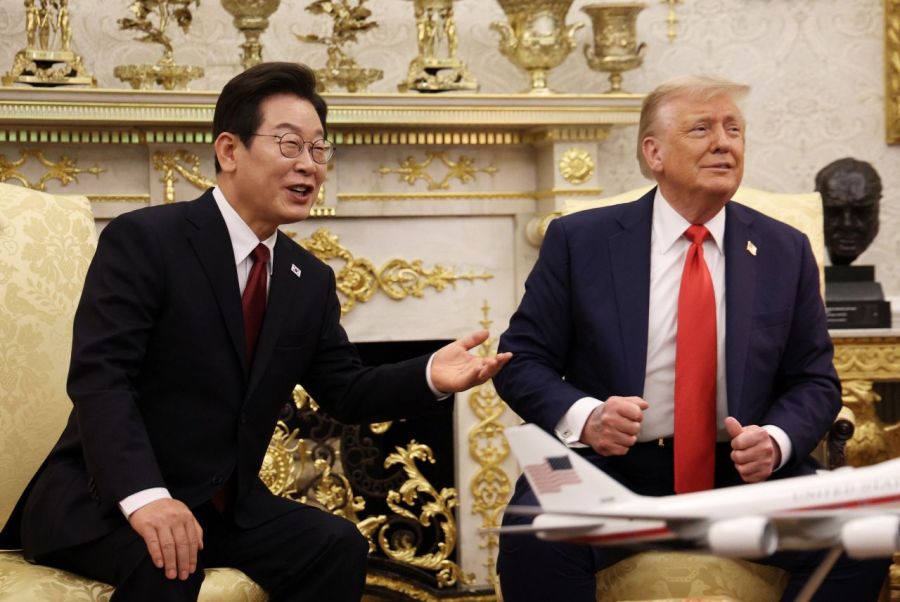
As the United States formalizes a $550 billion investment agreement with Japan, the Trump administration's trade strategy is solidifying into a full-fledged "exploitative alliance model." While the stated purpose is to strengthen U.S.-Japan cooperation, many assess that it effectively means Japan is ceding its industrial and technological sovereignty to the United States. The U.S. vision of restoring its manufacturing sector using allied nations' capital and technology is thus becoming a reality. South Korea is also facing similar pressure regarding tariff negotiations and investment conditions, making the U.S.-Korea summit to be held in Gyeongju on October 29 a matter of keen interest for Seoul.
On the previous day in Tokyo, U.S. President Donald Trump signed the "U.S.-Japan Framework Agreement" with Japanese Prime Minister Sanae Takaichi. Under this agreement, the Japanese government and major corporations have pledged a total of $550 billion in investments in the United States, covering nuclear power plants, power grids, artificial intelligence (AI) infrastructure, semiconductor components, and critical mineral facilities. In return, the United States will apply a basic tariff rate of 15%, but will implement a "conditional reduction" system where the extent of tariff relief varies according to the level of investment.
Although the deal is outwardly packaged as "strengthening the economic security alliance," in reality, it is a structure in which Japan shoulders the financial burden of restoring the U.S. industrial base. The fact sheet released by the White House repeatedly uses the phrase "Japan commits to investment" instead of "co-development." While Japanese companies provide the capital and build the factories, all tax benefits and employment effects accrue to the United States. Notably, in the nuclear power (AP1000, SMR) and energy infrastructure sectors, the agreement explicitly states that Japanese companies such as Westinghouse, GE Vernova, Hitachi, and Toshiba will participate as subcontractors for construction projects within the United States. The goal is not to strengthen Japan's domestic industrial base, but to restore U.S. manufacturing.
The technology cooperation section is also structured as a U.S.-led subordinate system under the guise of "sharing and standardization." Provisions for cooperation in advanced technologies such as AI, 6G, quantum, and nuclear fusion are interpreted as requiring Japanese technology to conform to U.S. standards. The agreement states that "the two countries will deepen mutual understanding on technology standards and security requirements," but in practice, it means Japan will be incorporated into U.S. technology verification processes.
The issue is that the United States is demanding a similar bilateral trade model from South Korea. Currently, South Korea and the United States have yet to conclude their tariff negotiations. The Trump administration is pushing for a plan in which tariff reductions are granted if a certain level of investment or procurement ratio within the United States is met. This is a structure similar to the one in which Japan secured a basic tariff rate of 15% in exchange for a $550 billion investment.
South Korea's position differs from that of Japan. While Japan has positioned itself as an "investment-type ally" by presenting specific investment amounts and industrial value chain plans through this agreement, South Korea remains in a cautious negotiation phase regarding the scale and conditions of U.S. investments. Currently, the U.S. side is seeking to strengthen control over $350 billion in investments and procurement conditions (including advance payments), leading to difficult negotiations.
This "invest first, reduce tariffs later" structure also poses a significant burden on the Korean economy. If, as the United States demands, tens of trillions of won are rapidly sent overseas, there is a high likelihood of both foreign exchange market instability and a contraction in domestic investment. In fact, the financial sector is concerned that by making "investment fulfillment" a prerequisite for tariff reductions, the Trump administration is forcing Korean companies to secure dollar funding in advance.
The Korean industrial sector also sees this negotiation as a matter of defending industrial sovereignty, not just a simple tariff reduction issue. They warn that agreeing to a structure in which tariff benefits are granted solely based on investment commitments, as with Japan, could result in the transfer of key production bases to the United States. An industry official commented, "The Trump-style trade model signed with Japan demands the position of a 'customer,' not an 'ally.' What is needed now is not an investment list, but the establishment of principles for technology and supply chain negotiations."
The government is adjusting its negotiation strategy for the U.S.-Korea tariff talks to focus not just on the scale of investment, but also on "mutual market opening" and "joint technology development." The rationale is that fully accepting U.S. conditions may bring short-term tariff benefits, but in the long term, it could erode Korea's domestic production base.
The APEC U.S.-Korea summit to be held in Gyeongju today is expected to be a watershed moment in Korea's trade diplomacy. Since the summit takes place immediately after President Trump announced the $550 billion U.S.-Japan investment agreement, it is expected that U.S. demands on Korea will be even higher. Diplomatic sources suggest that the summit may serve as a de facto "final review" of the scale and timing of Korea's investments in the United States, as well as the road map for tariff negotiations.
© The Asia Business Daily(www.asiae.co.kr). All rights reserved.
![Clutching a Stolen Dior Bag, Saying "I Hate Being Poor but Real"... The Grotesque Con of a "Human Knockoff" [Slate]](https://cwcontent.asiae.co.kr/asiaresize/183/2026021902243444107_1771435474.jpg)















