Ray Dalio in CNBC Interview
"AI Investment Resembles Pre-Dot-Com Bubble"
Although the artificial intelligence (AI) investment boom, led by major technology stocks, is showing signs of a bubble, there are projections that stock prices will not easily collapse as long as the U.S. central bank maintains its monetary easing stance.
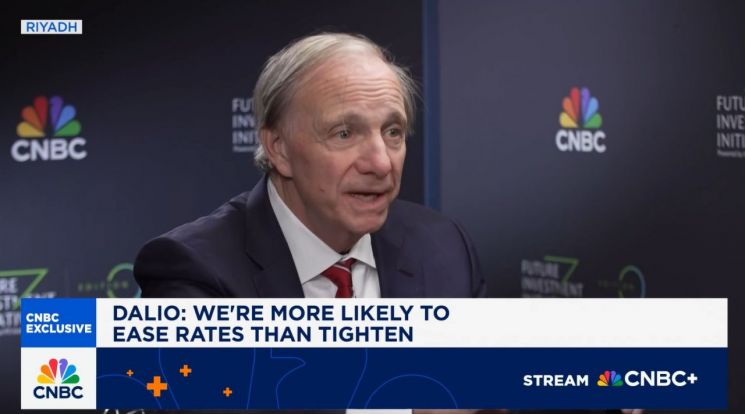 Ray Dalio, founder of Bridgewater Associates, is being interviewed by CNBC on the 28th (local time) in Riyadh, the capital of Saudi Arabia. Photo by CNBC.
Ray Dalio, founder of Bridgewater Associates and known as the 'godfather of hedge funds,' said in a CNBC interview in Riyadh, the capital of Saudi Arabia, on the 28th (local time), "There are significant bubble elements in the current market," adding, "Bubbles typically do not burst until monetary policy shifts to tightening."
He went on to say, "At the moment, it is much more likely that policy will tilt toward easing rather than tightening when it comes to interest rates," predicting that the current interest rate cut stance of the U.S. Federal Reserve (Fed) could fuel overheating in the asset market for some time.
Dalio revealed that his personal 'bubble indicator' has now reached a relatively high level. He also pointed out that, excluding AI-related stocks, overall market performance remains relatively weak, and that 80% of market returns are concentrated in a handful of big tech companies.
He further diagnosed that the current U.S. economy is divided into vulnerable sectors being eased by rate cuts and, conversely, sectors where bubbles are forming, noting that such an imbalance is difficult to resolve simultaneously through monetary policy.
Dalio believes the current situation is similar to the period just before the burst of the dot-com bubble in 1998-1999 or the Great Depression in 1927-1928.
He warned, "It is impossible to know for certain whether this is a bubble or when it might burst," but added, "What can be said is that the risks are very high."
As Dalio forecasts, the Fed is expected to maintain its monetary easing stance for the time being. Last month, the Fed lowered its benchmark interest rate by 0.25 percentage points for the first time this year, adjusting it to an annual range of 4.0-4.25%. Another 0.25 percentage point cut is highly likely at the regular Federal Open Market Committee (FOMC) meeting scheduled for the 30th.
© The Asia Business Daily(www.asiae.co.kr). All rights reserved.
![Clutching a Stolen Dior Bag, Saying "I Hate Being Poor but Real"... The Grotesque Con of a "Human Knockoff" [Slate]](https://cwcontent.asiae.co.kr/asiaresize/183/2026021902243444107_1771435474.jpg)















