Prevailing View Within the Judiciary: Move Deemed Inappropriate
"Ruling Party Fueling Legislative vs. Judicial Conflict"
On the Mention of Abolishing the National Court Administration
"Judicial Autonomy Must Be Respected and Court Opinions
As the Democratic Party of Korea has revived the so-called "trial suspension law," which would halt criminal trials for a sitting president, the legal community has voiced strong criticism, calling the move "inappropriate."
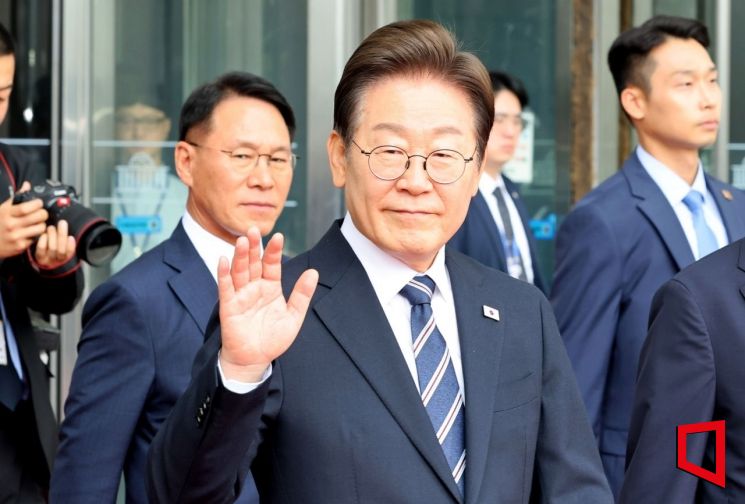 President Lee Jae-myung is greeting as he leaves the National Assembly after delivering the supplementary budget address at the National Assembly in Yeouido, Seoul on June 26, 2026. Photo by National Assembly Press Photographers Group
Recently, Kim Dae-woong, Chief Judge of the Seoul High Court, appeared before the Legislation and Judiciary Committee during a parliamentary audit and commented that, in theory, President Lee Jae-myung's election law trial-currently in a "date to be set later" status-could proceed even during his presidential term. In response, some members of the Democratic Party are increasingly calling for the swift passage of the trial suspension law.
Within the judiciary, there is a prevailing view that, given the practical impossibility of resuming the trial, the Democratic Party is instead fueling a conflict between the legislative and judicial branches. A chief judge in the Seoul metropolitan area stated, "Pushing forward with such a 'tailor-made law' in a situation where the resumption of the trial seems highly unlikely infringes on the principle of equality and appears inappropriate. The trial has already been suspended and faded from public attention, so creating a trial suspension law at this point is essentially dragging themselves back into a political quagmire."
An attorney who previously served as a judge pointed out, "Chief Judge Kim's response simply meant that, due to the absence of explicit legal provisions, there is room for theoretical debate; it was not an indication that the trial could actually be resumed. If the judiciary continues to face pressure, it could provoke a response that the courts should counter with judicial measures of their own."
Some have also suggested that the judiciary itself needs to reflect on how to handle trials involving the president. Han Sang-hee, a professor at Konkuk University Law School, said, "The courts also need to consider whether they have the authority to remove a sitting president from office through their own judgments."
Furthermore, judges have expressed strong opposition to the Democratic Party's mention of abolishing the National Court Administration. A judge in Seoul commented, "This would effectively dismantle the independence of the judiciary and appears to be an attempt to control lower court judges at will. In an environment where judges are attacked unless they take sides, the prevailing sentiment within the courts is that there is little motivation to work diligently."
An attorney who previously served as a research judge at the Supreme Court noted, "While it is true that the National Court Administration has often been criticized as functioning merely as the Supreme Court Chief Justice's secretariat, the judiciary's autonomy and self-regulatory functions should be respected. Regardless of whether abolition is right or wrong, it is important to reflect the opinions of the courts as much as possible."
© The Asia Business Daily(www.asiae.co.kr). All rights reserved.
![Clutching a Stolen Dior Bag, Saying "I Hate Being Poor but Real"... The Grotesque Con of a "Human Knockoff" [Slate]](https://cwcontent.asiae.co.kr/asiaresize/183/2026021902243444107_1771435474.jpg)















