President Lee's Interview with Bloomberg
"Investment method, scale, and timeline all remain points of contention"
President Lee: "A delay in reaching an agreement does not mean failure... We will achieve a reasonable outcome"
"Hoping for North Korea-U.S. dialogue to resume soon... There is no need for us to take the first step"
On the Bank of Korea's rate freeze: "The right decision"... "Excessive real estate investment puts us on a path similar to Japan"
President Lee Jaemyung stated that discussions between South Korea and the United States regarding the details of the $350 billion (approximately 500 trillion won) U.S. investment package are still facing significant difficulties.
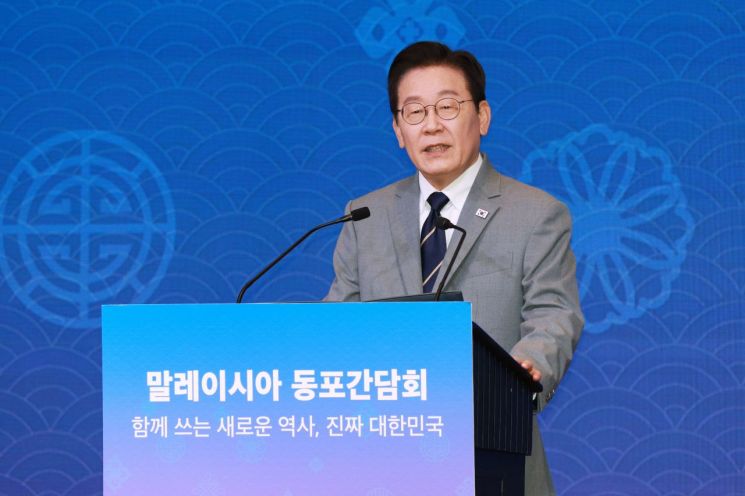
In an interview with Bloomberg released on the 27th, President Lee said, "Everything is still a point of contention, including the investment method, investment scale, timeline, loss-sharing mechanism, and dividend distribution." This interview took place on the 24th, immediately after Kim Yongbeom, Chief Policy Officer at the Presidential Office, and Kim Jeonggwan, Minister of Trade, Industry and Energy, held consultations in the United States with U.S. Secretary of Commerce Howard Lutnick (Korea time, 23rd).
While the two countries reached a broad agreement on reciprocal tariffs at the end of July, they have continued to negotiate over the specifics of the $350 billion U.S. investment package, which is a core issue of the tariff talks. In early October, negotiations gained momentum as the U.S. side accepted South Korea's demands, but the outlook remains uncertain. As a result, it is unclear whether the second South Korea-U.S. summit, scheduled for the 29th, will produce a final outcome.
President Lee reiterated that the South Korea-U.S. tariff negotiations should not result in catastrophic consequences for South Korea. He has consistently instructed the negotiation team to prioritize "economic rationality" and conduct talks centered on the national interest. President Lee emphasized, "The United States will try to maximize its own interests, but it should not be to the extent that it causes catastrophic consequences for South Korea."
He added, "Dialogue is ongoing, and while there are some differences in opinion, a delay in reaching an agreement does not necessarily mean failure. As an ally and friend of the United States, I believe South Korea can and must reach a reasonable outcome that is acceptable to all."
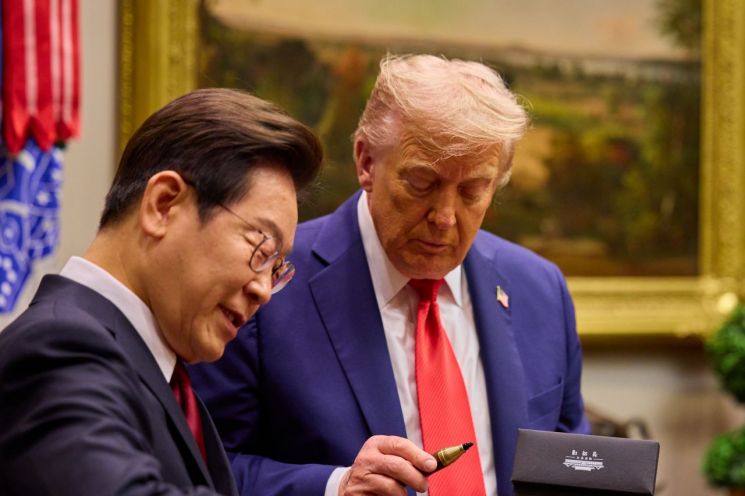
President Lee's remarks differ significantly from those of U.S. President Donald Trump, who made comments while embarking on his tour of Asia. On the 24th (local time), during a brief press conference aboard Air Force One, President Trump was asked whether he expected to conclude the tariff negotiations with South Korea during this meeting. He replied, "We are very close to being finalized," and added, "If they (South Korea) are ready, I am ready."
Additionally, President Lee addressed the incident in September in Georgia, United States, where more than 300 Korean workers were detained by immigration authorities and later released. He warned that unless reasonable treatment is guaranteed in the future, construction of factories could be delayed. These workers had been dispatched to support the expansion of the Hyundai Motor-LG Energy Solution battery plant.
President Lee said, "This caused serious trauma for the workers, and I heard that some do not want to return to the United States." He continued, "If safety and reasonable treatment for the workers are not guaranteed, there is a high likelihood that factory construction in the U.S. will be significantly delayed." President Lee also noted, "In fact, visa issues are a bigger problem for the U.S. than for South Korea," and regarding ongoing discussions to improve the visa system to prevent a recurrence, he stated, "I expect a solution will be found in the near future."
President Lee stated that there has been progress on security issues, including the modernization of the South Korea-U.S. alliance. He said, "It is clear that the U.S. Forces Korea are essential for maintaining peace and security on the Korean Peninsula," but added, "Given the realities of the international community, we cannot decide the fate of U.S. Forces Korea." He further explained that South Korea must be prepared to deter North Korea regardless of external factors, and that the plan to increase the defense budget from the current 2.3% to 3.5% of GDP reflects the government's basic stance to strengthen self-reliant defense, rather than being a response to U.S. demands.
Regarding the first face-to-face meeting in six years between President Trump and Chinese President Xi Jinping at the Asia-Pacific Economic Cooperation (APEC) summit in Gyeongju, President Lee expressed hope that tensions between the world's two largest economies-and South Korea's largest trading partners-would ease.
President Lee cited China's sanctions against Hanwha Ocean's business division as an example, describing South Korea as "a country caught between two grinding stones." He said, "It is very regrettable and difficult to understand. This is likely a way for China to send a signal that such incidents could continue in the future."
He continued, "The world order is moving into a very complex and dangerous phase, but through bilateral talks between South Korea and the U.S., we can deepen mutual understanding, coexist, and find sufficiently mutually beneficial paths. I believe it is South Korea's role as the APEC chair to facilitate such outcomes."
Regarding the possibility of North Korea-U.S. dialogue, President Lee said, "I hope it will resume in the near future." He added, "We will strive to create an environment where people in both Koreas do not feel threatened and to promote the resumption of dialogue. For peace and cooperation on the Korean Peninsula, direct dialogue with North Korea is desirable, but in the current situation, where direct communication channels are cut off and hostility has deepened, North Korea-U.S. dialogue could play a decisive role in improving inter-Korean relations."
President Lee further stated, "There is no reason to insist that we must take the first step. I am a practical and results-oriented person. If we can achieve genuine peace on the Korean Peninsula, I am willing to compromise on logic, methods, and procedures."
Meanwhile, President Lee assessed that the recent decision by the Bank of Korea to freeze the base interest rate was the right move to stabilize real estate prices. He said, "If we lower interest rates, it could stimulate real estate prices," and remarked that the Bank of Korea made "the right decision." He also pointed out that South Korea is sitting on a time bomb due to excessive real estate investment and is following a path similar to Japan, which is still struggling with the aftermath of the real estate bubble collapse over 30 years ago. President Lee warned, "If this trend continues, the bubble will inevitably burst, and we will face a serious crisis not only in the economy but in all areas."
© The Asia Business Daily(www.asiae.co.kr). All rights reserved.
![Clutching a Stolen Dior Bag, Saying "I Hate Being Poor but Real"... The Grotesque Con of a "Human Knockoff" [Slate]](https://cwcontent.asiae.co.kr/asiaresize/183/2026021902243444107_1771435474.jpg)
















