President Lee and Trump Expected to Announce 'Trade-Security Package' at Summit on the 29th
Wi Sunglak: "Striving for Tariff Agreement... Outcome Uncertain" ? Security Issues Finalized
Possibility Remains for Security-Only Announcement
"National
National Security Advisor Wi Sunglak stated that, in connection with the Asia-Pacific Economic Cooperation (APEC) Summit in Gyeongju, he is leaving open the possibility of announcing a so-called "joint fact sheet" covering both trade and security issues during the upcoming South Korea-U.S. summit. He added that while agreements were reached on security issues such as the nuclear energy agreement and increased defense spending during the first summit, a comprehensive joint document has not been finalized due to the unresolved tariff negotiations.
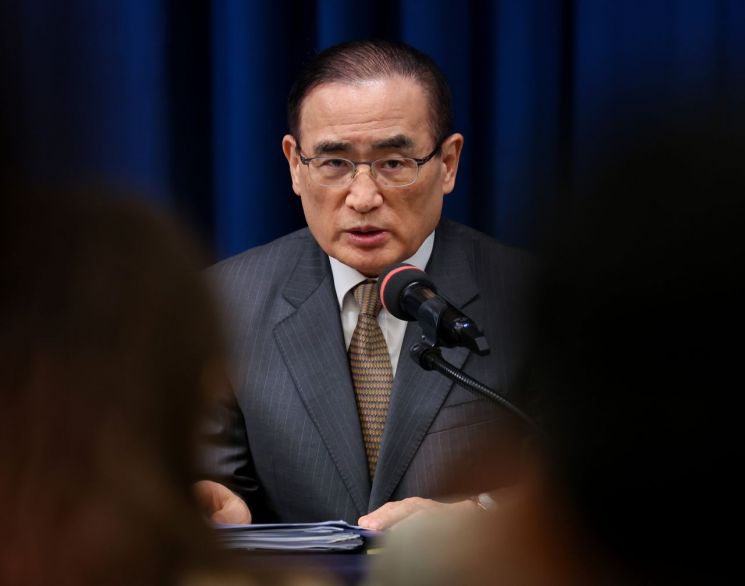
On the 26th, appearing on KBS Sunday Diagnosis, Advisor Wi was asked whether the tariff negotiations might be concluded at the South Korea-U.S. summit coinciding with APEC. He responded, "Negotiations in the tariff area have narrowed differences through intensive coordination, but significant issues remain." He continued, "President Lee has issued strong instructions emphasizing 'economic rationality' and 'national interest-centered negotiations.' The negotiation team is making a final effort in accordance with these instructions, but I cannot be certain whether an agreement will be reached during this summit." The second South Korea-U.S. summit between President Lee Jaemyung and U.S. President Donald Trump is scheduled for the 29th.
Regarding the possibility of a dramatic "top-down" resolution at this summit, Advisor Wi took a cautious stance. He said, "Summits are usually carefully prepared in advance, making the summit itself a kind of finishing touch. President Trump has a unique negotiating style, and our president is also a skilled negotiator, but he prefers to finalize matters through prior coordination. Let us see if the summit itself becomes the finishing touch."
Nevertheless, he stated that all possibilities are being considered in the negotiations, including the announcement of a trade and security package deal in the form of a "joint fact sheet," a security package deal, or even no announcement at all. Advisor Wi explained, "A fact sheet can be a unilateral document, or a joint fact sheet, which is essentially a common agreement. We have been working on the documentation, and in the security area, most of the language has been mutually agreed upon."
He further stated, "We have not yet reached a common document in the tariff area, but if that is achieved, everything else will fall into place. We are working on documentation, but I am not sure whether the tariff documentation will be completed. As for the security area, where the documentation is ready, we will have to wait and see whether it will be made public."
On the issue of revising the nuclear energy agreement, which includes uranium enrichment and nuclear fuel reprocessing-one of the core security topics-he reported that a compromise has been found. "At the first South Korea-U.S. summit, the security package was generally accepted," he said. Regarding the expansion of uranium enrichment rights, he noted, "We are receiving positive feedback. We are using Japan, which possesses both rights, as a model and are asking the U.S. to allow us the same, just as it does for Japan."
He also expressed no concerns about the issue of increasing South Korea's share of U.S. Forces Korea defense costs. Advisor Wi stated that coordination between South Korea and the U.S. on defense cost-sharing is ahead of that between South Korea and Japan, and since South Korea is taking a proactive approach to increasing defense spending and its role, he does not foresee any new burdens.
When asked whether defense policy decisions made at the U.S.-Japan summit could pressure South Korea, he replied, "That is possible, but I am not particularly concerned. We have already addressed this issue with the U.S., and our discussions are ahead of those between the U.S. and Japan." He added, "President Lee, under the directive that South Korea must play an independent role in defending the Korean Peninsula, has ordered increases in defense and military spending. We used this as leverage in negotiations with the U.S., and this also enabled us to reach an agreement on revising the nuclear energy agreement."
At the South Korea-China Summit: "The Goal Is to Find Space for Korean Peninsula Denuclearization and Economic Cooperation... Anti-China and Hate-China Protests Should Be Refrained From"
Regarding the South Korea-China summit scheduled for November 1, Advisor Wi predicted it would be the first meeting to seek opportunities for cooperation on Korean Peninsula denuclearization and economic partnership. He emphasized that, with Chinese President Xi Jinping's state visit to South Korea-the first in 11 years-anti-China and hate-China protests taking place domestically should be refrained from.
On the summit's objectives, Advisor Wi said, "The first issue is to establish good personal and communication relations during this meeting. Second, in this era of intense U.S.-China rivalry, we must elicit China's cooperation for denuclearization, peace, and stability on the Korean Peninsula, and find room to maneuver in practical areas of cooperation such as the economy." He appealed, "Anti-China and hate-China protests do not align with the spirit of a state visit and are impolite to our guest, so I ask for restraint."
He anticipated that the South Korea-Japan summit with newly appointed Japanese Prime Minister Sanae Takaichi would be held on the 30th. Advisor Wi, who recently visited Japan for two days, assessed that although Prime Minister Takaichi is conservative, many do not see her as a right-wing figure, and she is particularly attentive to South Korea-Japan relations.
"During my visit to Japan, I met with officials from the new administration. While she is conservative, many do not regard her as right-wing," he said. "She also recognizes the particular importance of South Korea-Japan relations." He added, "If the two leaders establish a good first relationship at the APEC summit, I expect there will be no obstacles to developing a partnership between South Korea and Japan."
Regarding the possibility of President Trump meeting North Korean leader Kim Jong Un during his Asia tour, Advisor Wi said information is limited. On the 24th (local time), President Trump, during an onboard press briefing on Air Force One, responded to North Korea's demand to be recognized as a "nuclear power" as a precondition for talks with the U.S. by saying, "They think of themselves as a kind of 'nuclear power.' As for meeting Chairman Kim, I would like to do so. He knows we are moving in that direction."
Advisor Wi commented on Trump's remarks, "I hope the meeting happens, and if it does, I will support it," but added, "We are communicating with the U.S. side, but we do not have any special information." Regarding speculation that the departure of Joseph Yun, acting U.S. ambassador to South Korea, signals a possible U.S.-North Korea summit, he said, "It should not be interpreted as related to a U.S.-North Korea summit."
On the U.S.-China summit to be held in Busan, he noted that it is unusual for such a meeting to take place in a third country (South Korea) on a multilateral stage, and he does not expect lengthy discussions. Advisor Wi said, "Because it is being held at the APEC venue, the summit will likely be shorter than if it were held in Beijing or Washington. While it is unclear how far discussions will go, I believe we can expect some progress on certain trade issues."
Plan to Announce the 'Gyeongju Joint Declaration' at the APEC Summit
He also revealed that efforts are underway to coordinate the text for the adoption of the "Gyeongju Declaration" at this APEC summit. He explained that, given the precedent of the 2018 Papua New Guinea summit where the joint declaration failed due to U.S.-China conflict, South Korea is playing a mediating role to ensure the Gyeongju Declaration is adopted.
As the chair, South Korea is expected to incorporate the main theme and sub-theme, "Building a Sustainable Tomorrow Together-Connectivity, Innovation, Prosperity," into the declaration, summarizing joint agendas such as supply chain stability, digital and artificial intelligence (AI) cooperation, and responses to demographic changes. The summit's joint declaration will be finalized in ministerial and senior official consultations before being adopted by the leaders.
Advisor Wi stated, "If the U.S.-China summit held during APEC goes well, it could have a positive impact on subsequent APEC meetings. It could create a virtuous cycle. We are also working to produce a declaration at APEC, and if the U.S. and China cooperate, it should be much easier."
© The Asia Business Daily(www.asiae.co.kr). All rights reserved.
![Clutching a Stolen Dior Bag, Saying "I Hate Being Poor but Real"... The Grotesque Con of a "Human Knockoff" [Slate]](https://cwcontent.asiae.co.kr/asiaresize/183/2026021902243444107_1771435474.jpg)















