On-site Meeting Presided Over by Second Vice Minister of Health and Welfare Lee Hyun
The Ministry of Health and Welfare announced on the 23rd that it held an on-site meeting for research and development (R&D) in the field of health security in the conference room of the Korean Advanced Research Projects Agency for Health (ARPA-H) Promotion Team in Jung-gu, Seoul.
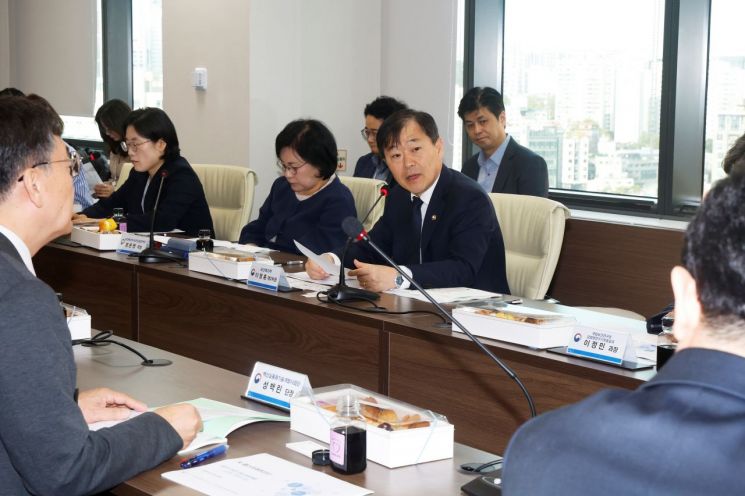 On the 23rd, Lee Hyun, the Second Vice Minister of Health and Welfare, is speaking at the on-site meeting for research and development (R&D) in the field of health security held in the conference room of the Korean Advanced Research Projects Agency for Health (ARPA-H) Promotion Team in Jung-gu, Seoul. Ministry of Health and Welfare
R&D in the field of health security aims to develop vaccines and treatments to prepare for pandemics and to establish disaster response systems.
At the meeting, held during the "K-Defense Week" (the week of October 20), participants reviewed the progress and discussed future directions for five major R&D projects in health security: the Korean ARPA-H project, the development of vaccine self-sufficiency technology, the advancement of the pan-ministerial infectious disease response system, the development of advanced infection response capabilities in medical settings, and the development of telemedicine technologies.
The "Korean ARPA-H Project" is a mission-oriented R&D initiative that supports high-cost, high-difficulty projects with significant ripple effects, aiming to solve national challenges such as the next pandemic and essential healthcare crises. The project is currently pursuing the development of decentralized production systems, ultra-long-term vaccine storage technologies, and therapeutics to suppress severe illness in response to pandemics. By 2032, approximately 18 billion won will be invested in each project, totaling 1.1628 trillion won.
The "Vaccine Self-Sufficiency Technology Development" project, which began in 2020, supports the localization of essential vaccines for the National Immunization Program and the development of vaccines for potential future infectious diseases. To date, clinical phase 2 trials have been approved for two Tdap (tetanus, diphtheria, pertussis) combination vaccines (by Boryung Biopharma and GC Green Cross) and one pediatric hexavalent DTaP-IPV-Hib-HepB combination vaccine (diphtheria, tetanus, pertussis, polio, Haemophilus influenzae type b, hepatitis B) by LG Chem. The total project budget is 215.1 billion won through 2029.
The "Advancement of the Pan-Ministerial Infectious Disease Response System" project (2023-2027, 42 billion won) involves eight ministries collaborating to support 11 tasks aimed at advancing the national infectious disease response system, including early surveillance, prediction, rapid on-site diagnostics, and ensuring the reliability of daily quarantine supplies. Achievements include the development of a One Health pathogen surveillance system, the establishment of infectious disease spread prediction systems, and the development of rapid on-site diagnostic technologies, all of which are making substantial contributions to infectious disease response.
The "Development of Advanced Infection Response Capabilities in Medical Settings" project (2025-2029, 37.3 billion won) aims to establish preparedness and response systems for infectious diseases in healthcare settings to proactively address future outbreaks. A representative research task is the "Establishment and Demonstration of an Intelligent Bed Allocation Network for Infectious Disease Response," which uses artificial intelligence (AI) to classify patient symptom stages and enables real-time tracking and allocation of hospital beds, thereby facilitating the efficient distribution of medical resources and rapid treatment of patients during large-scale outbreaks.
The "Development of Telemedicine Technologies" project (2023-2027, 27.3 billion won) supports the development of telemedicine monitoring devices, patient prediction and emergency response technologies, and clinical decision support systems (CDSS) to ensure uninterrupted access to medical services during pandemics. The project also aims to establish an integrated telemedicine platform to connect the developed telemedicine technologies.
Lee Hyun, Second Vice Minister of Health and Welfare, who presided over the meeting, stated, "R&D in the field of health security is not just a health issue but a matter of national security that protects the lives and safety of the people. We will listen to the voices from the research field and ensure that research outcomes lead to tangible improvements in response capabilities."
© The Asia Business Daily(www.asiae.co.kr). All rights reserved.
![Clutching a Stolen Dior Bag, Saying "I Hate Being Poor but Real"... The Grotesque Con of a "Human Knockoff" [Slate]](https://cwcontent.asiae.co.kr/asiaresize/183/2026021902243444107_1771435474.jpg)















