One in Three Wage Earners Is a Non-Regular Worker
Regular Workers: 3,896,000 Won, Non-Regular Workers: 2,088,000 Won
 Illustration of non-regular employment (photo to aid understanding of the article). Photo by The Asia Business Daily Database
This year, the number of non-regular workers reached an all-time high, and the wage gap with regular workers exceeded 1.8 million won, the largest difference since statistics have been compiled. In particular, the number of non-regular workers among the elderly surpassed 3 million, highlighting the urgent need for countermeasures.
On the 22nd, the National Data Office released the "August 2025 Supplementary Survey on Employment Status by Work Type," which included these findings.
According to the survey, as of August, there were 8,568,000 non-regular workers, an increase of 110,000 compared to the same month last year. This is the highest figure since statistics began in 2003 and marks the second consecutive year of growth since 2023.
The number of regular workers increased by 160,000 to 13,845,000. As both regular and non-regular workers increased, the proportion of non-regular workers among all wage earners (22,413,000) remained at 38.2%, the same as last year. This is the second highest figure since 2019, with the previous peak being August 2021 (38.4%).
By age group, non-regular workers aged 60 and over increased by 233,000 to 3,044,000, surpassing 3 million for the first time since statistics began in 2003. This is also the largest increase in four years, since the 270,000 rise in 2021. The proportion of non-regular workers aged 60 and over among all non-regular workers rose to 35.5%, up 2.3 percentage points from the previous year.
This survey also broke down the over-60 group into "60-69" and "70 and over." The number of non-regular workers aged 70 and over was 1,205,000, similar to those in their 40s (1,204,000).
Song Junhaeng, Director of Employment Statistics at the National Data Office, explained, "The increase in the 60s age group is due not only to population growth but also to a higher employment rate. In particular, there has been significant growth in the health and social welfare sectors. The proportion of elderly participants in government direct job creation programs is high, and most of these positions are non-regular jobs."
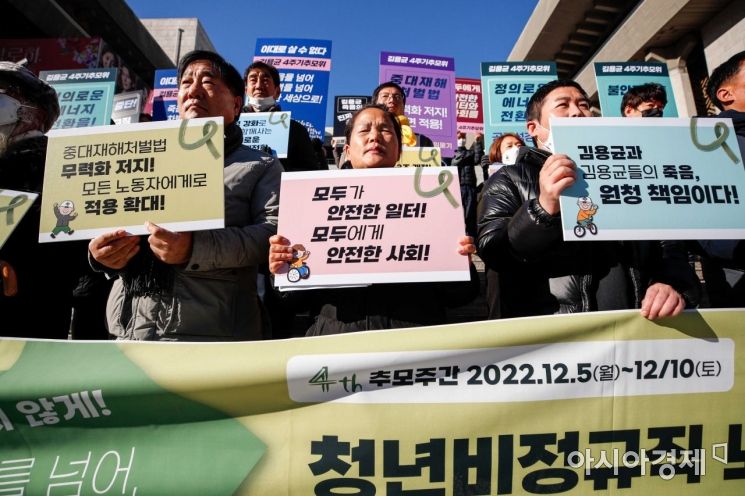 A press conference announcing the Youth Non-Regular Workers Late Kim Yonggyun 4th Anniversary Memorial Week held in front of Sejong Center for the Performing Arts. Photo by The Asia Business Daily
Wage Gap Between Non-Regular and Regular Workers: 1.8 Million Won... About Half the Level of Regular Workers
The wage gap between non-regular and regular workers has widened further. The average monthly wage of non-regular workers over the past three months was 2,088,000 won, an increase of 40,000 won compared to the previous year. In contrast, regular workers earned 3,896,000 won, up by 100,000 won.
While both groups reached their highest levels since statistics began in 2004, the wage gap is also at its largest ever. The wage disparity has continued to widen since 2004, when it was 616,000 won.
The ratio of non-regular to regular worker wages was 53.6%, a slight decrease from last year's 54.0%. The average monthly wage for non-regular workers, excluding part-time workers, was 3,037,000 won, surpassing 3 million won for the first time.
In this case, the wage gap with regular workers was 859,000 won, meaning non-regular workers earned 78% of regular workers' wages, the same as last year, according to the National Data Office.
Director Song added, "A significant portion of non-regular workers are part-time employees. Since they work fewer hours than regular employees, their wages are relatively lower, which greatly affects the overall average wage for non-regular workers. This point needs to be considered comprehensively."
© The Asia Business Daily(www.asiae.co.kr). All rights reserved.
![Clutching a Stolen Dior Bag, Saying "I Hate Being Poor but Real"... The Grotesque Con of a "Human Knockoff" [Slate]](https://cwcontent.asiae.co.kr/asiaresize/183/2026021902243444107_1771435474.jpg)
















