
An increasing number of local governments are providing "livelihood recovery support funds" in addition to government-issued consumer coupons. These measures are being promoted under the justification of revitalizing the local economy. However, there are ongoing concerns about disregarding fiscal self-sufficiency, accusations of pre-election populism and excessive spending, and complaints about fairness, as some regions receive the funds while others do not.
Some Local Governments Provide Livelihood Support Funds to Residents, Citing Local Economic Revitalization
According to each city and province on October 22, 14 out of 22 cities and counties in South Jeolla Province have independently provided livelihood recovery support funds this year. Most local governments distributed between 100,000 and 300,000 won, while Yeonggwang County provided a total of 1 million won per person, split into 500,000 won each for the first and second halves of the year. Eight regions-Mokpo, Yeosu, Gwangyang, Damyang, Yeongam, Hampyeong, Jangseong, and Sinan-did not distribute the funds. The decision by Suncheon, the most populous city in South Jeolla Province, to provide the funds reignited debates over fairness among the cities and counties. Suncheon decided to give 200,000 won in livelihood recovery support funds to all 275,144 residents. The estimated budget for this is 58 billion won. Residents in neighboring Yeosu (264,724 people) and Gwangyang (155,261 people) have expressed a sense of relative deprivation.
In North Jeolla Province, Buan County distributed 300,000 won in livelihood stabilization support funds to all residents last month. County officials visited villages to hand out prepaid cards loaded with 300,000 won to residents. The county had previously prepared a supplementary budget to provide 300,000 won in livelihood stabilization support funds to all residents and marriage immigrants before Chuseok, aiming to revitalize the local economy.
 A notice about consumer coupons is displayed at a market in downtown Seoul. Unrelated to the article content. Yonhap News Agency
Amounts Vary from 100,000 to 500,000 Won... Some Call for "2 Million Won" in Integration Talks
Iksan City executed 79 billion won in fiscal funds before Chuseok, including public benefit payments for farmers. Major expenditures included 8.4 billion won for farmers' allowances, 16.4 billion won for facility costs such as construction and service supplies, and 37 billion won for social welfare. Of these, the farmers' allowances were provided to over 17,000 local farmers who applied between March and June and were selected after verification. Single-operator farms received 600,000 won each, while farms with two or more operators received 300,000 won per farmer.
In North Jeolla Province, controversy has arisen over support funds ahead of the launch of the integrated city. On September 15, the Wanju-Jeonju Integration Promotion Committee and the Wanju-Jeonju Win-Win Development Network, both supporting the integration of Wanju County and Jeonju City, held a press conference at Jeonju City Hall, demanding, "Provide 2 million won in integration support funds per Wanju County resident in the integrated city." They argued, "The integration support funds will stimulate consumption in the economically struggling Jeonju and Wanju areas and help achieve the ultimate goal of integration, which is economic revitalization. We expect wise decisions from Jeonju Mayor Woo Beomgi and Jeonju City Council Chairman Nam Gwanwoo." However, the general consensus is that it would be difficult to realize this proposal, as it would require as much as 200 billion won and considering Jeonju City's poor fiscal self-sufficiency.
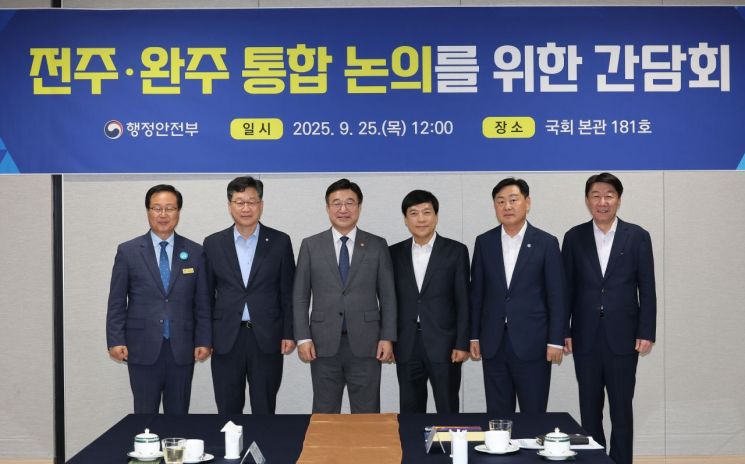 On September 25, at the National Assembly in Yeouido, Seoul, participants including Yoon Hojung, Minister of the Ministry of the Interior and Safety, are taking a commemorative photo at a meeting for the discussion of the Jeonju-Wanju integration. Photo by Yonhap News Agency
Disregarding Fiscal Self-Sufficiency? vs. Clear Local Economic Impact
Eumseong County in North Chungcheong Province also provided 100,000 won in "livelihood support funds" to each of its approximately 84,200 residents in the first half of this year. According to an analysis commissioned by the county to a specialized institution, the livelihood support funds generated an economic effect 2.8 times greater than the amount invested. In July, Jeungpyeong County also distributed 100,000 won in livelihood support funds per resident. Jecheon City provided about 200,000 won in livelihood support funds to citizens with local addresses, marriage immigrants, and Koryoin immigrants.
Geoje City in South Gyeongsang Province submitted a supplementary budget plan worth 25 billion won to the city council on October 16 for the "Geoje City Livelihood Recovery Support Fund," aiming to help small business owners recover sales and to revitalize the local economy amid the economic downturn. The city plans to use approximately 25 billion won from the city's integrated fiscal stabilization fund to provide 100,000 won in local currency to each citizen, and 200,000 won to vulnerable groups such as basic livelihood security recipients, the near-poor, and single-parent families.
© The Asia Business Daily(www.asiae.co.kr). All rights reserved.
![Clutching a Stolen Dior Bag, Saying "I Hate Being Poor but Real"... The Grotesque Con of a "Human Knockoff" [Slate]](https://cwcontent.asiae.co.kr/asiaresize/183/2026021902243444107_1771435474.jpg)

















