Announcement of Mid- to Long-Term Growth Strategy and Global Business Vision
Expansion of Independently Developed Immuno-Adjuvant Platform Business
Overseas Expansion Focused on Low- and Middle-Income Countries such as South America
Cha Vaccine Research Institute, a subsidiary of Cha Biotech, has unveiled its mid- to long-term growth strategy, focusing on core pipelines, expanding its immuno-adjuvant platform business, and entering global markets with a focus on low- and middle-income countries (LMICs).
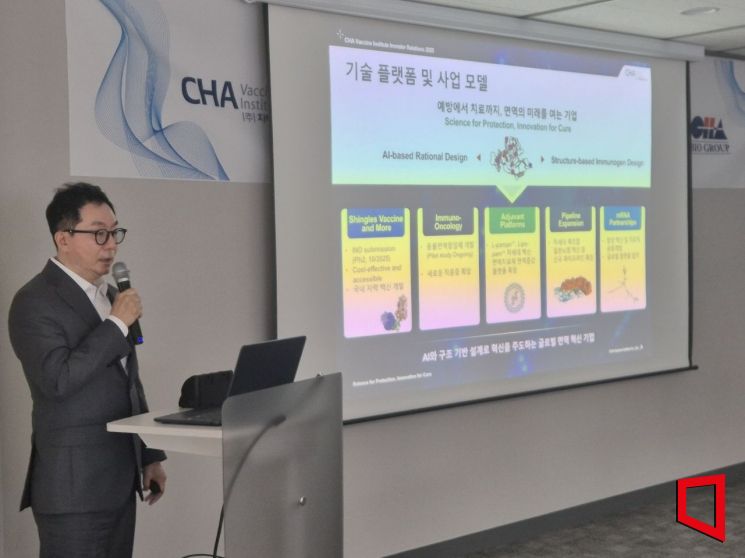 Hansungil, CEO of Cha Vaccine Research Institute, held his first press conference since taking office in August on the 22nd at the HJ Business Center in Jongno-gu, Seoul, and announced the mid- to long-term growth strategy. Photo by Choi Taewon
Hansungil, CEO of Cha Vaccine Research Institute, held his first press conference since taking office on the 22nd at the HJ Business Center in Jongno-gu, Seoul, and stated, "For our shingles prevention vaccine candidate, we plan to pursue both technology transfer and global partnerships starting from Phase 2 clinical trials in 2026. For our immuno-oncology drug for companion animals, we aim to complete Phase 3 clinical trials and launch the product by 2027."
Cha Vaccine Research Institute plans to concentrate its resources on three existing pipelines with high commercialization potential. The first is 'CVI-VZV-001', a shingles prevention vaccine candidate whose efficacy was confirmed in Phase 1 clinical trials. The currently available recombinant protein vaccine, 'Shingrix', is highly effective but is entirely imported and expensive. If the development of CVI-VZV-001 succeeds, it is expected to overcome issues of unstable supply and high cost. The company plans to pursue technology transfer and global partnerships in parallel, starting from Phase 2 clinical trials in 2026.
CEO Hansungil said, "We plan to focus our resources on pipelines that address unmet medical needs and have high commercialization potential among our existing pipelines. The pipeline we are most dedicated to is the shingles vaccine, which has demonstrated safety and 100% seroprotection efficacy in Phase 1 clinical trials."
Keeping pace with the growth of the companion animal market, the company is also accelerating the development of its immuno-oncology drug for companion animals, 'CVI-CT-002', targeting canine mammary gland tumors. These tumors in dogs have a high risk of recurrence and metastasis, leading to significant treatment demand. However, currently, there are no appropriate treatment options other than surgery. Recently, anti-cancer drugs for companion animals have been released, but they require daily intravenous administration and have a response rate of only about 30%. Initially, this candidate was being developed as an immuno-oncology drug for humans, but due to outstanding results in animal studies, the target was shifted to companion animals.
CEO Hansungil stated, "In the pilot study (Phase 1/2 clinical trial), we observed a 100% response rate with just three weekly intratumoral injections. We are pursuing both indication expansion and a license-out strategy, and we expect that CVI-CT-002 will be able to meet the unmet medical needs for canine mammary gland tumors."
The final candidate is the Japanese encephalitis vaccine 'CVI-JEV-001'. There is currently no treatment for Japanese encephalitis, and it can only be prevented by vaccination. However, existing vaccines, both inactivated and live, carry significant risks of side effects. Safety concerns have also been raised due to allergenic substances and mercury-based compounds. Notably, CVI-JEV-001 has been selected as a project for the Ministry of Health and Welfare's 'Vaccine Commercialization Technology Development Project' and is under development.
CEO Hansungil said, "We will actively leverage the network built over more than 20 years at Pfizer to grow global partnerships. If good opportunities arise, we are open to various possibilities such as partnerships, joint development, and technology transfer."
The company will also expand its independently developed immuno-adjuvant platform business. A representative example is the selection for CEPI's (Coalition for Epidemic Preparedness Innovations) 'Adjuvant Library' project. The goal is to diversify vaccine platform development by applying the immuno-adjuvant platform to various modalities such as messenger RNA (mRNA), in addition to existing recombinant protein vaccines.
For overseas markets, the company plans to focus on low- and middle-income countries, such as those in South America. By collaborating with local development and production companies, the company aims to secure revenue through local clinical trials, production, and public vaccine tenders. In other regions, such as Europe, the company intends to enter advanced markets by negotiating joint pipeline development and technology transfer with global pharmaceutical companies.
The company also expressed its ambition to secure revenue and achieve a turnaround in the near future. CEO Hansungil said, "Since taking office, my top priority has been to turn around the undervalued corporate value. Through clinical performance and global partnerships, we will secure revenue and operating profit as quickly as possible and solidify the market's trust in Cha Vaccine Research Institute."
Kim Sangki, Vice President of Cha Vaccine Research Institute, who also attended the press conference, said, "Although we have not yet recorded any revenue, we are considering various strategies to meet the requirements for special listing. Taking into account both internal strategies and external factors, we will strive to achieve a turnaround by 2027."
© The Asia Business Daily(www.asiae.co.kr). All rights reserved.
![Clutching a Stolen Dior Bag, Saying "I Hate Being Poor but Real"... The Grotesque Con of a "Human Knockoff" [Slate]](https://cwcontent.asiae.co.kr/asiaresize/183/2026021902243444107_1771435474.jpg)















