Financial Industry Employers’ Council and Financial Labor Union Reach Agreement
The Financial Industry Employers’ Council and the National Financial Industry Labor Union held the 5th industry-wide negotiation meeting on the 22nd and signed a wage agreement.
Since the initial industry-wide negotiation meeting in April, labor and management in the financial sector have reached an agreement after extended negotiations, deciding that the wage increase rate will be based on a total wage increase of 3.1%, with each institution’s labor and management determining the specifics according to their circumstances. The union had initially demanded a 7.1% wage increase, considering this year’s economic growth rate and consumer price inflation. However, despite the recent rise in profits within the financial sector, both parties decided on a lower wage increase rate than last year’s average wage increase rate for all industries (3.6%), taking into account the growing domestic and international economic uncertainty, as well as the difficulties faced by small business owners and vulnerable groups. For low-wage groups, whose wage levels are relatively lower than those of regular employees, it was agreed that the wage increase rate should be set above the standard rate depending on each institution’s situation.
Regarding the agenda of the Central Labor-Management Committee, employers agreed to comply with relevant laws on ordinary wages and to follow the intent of last year’s Supreme Court en banc decision. However, the specific details regarding ordinary wages will be determined by each branch’s labor and management.
Labor and management in the financial sector also agreed to continue discussions on wage-related matters such as the retirement age and the wage peak system in next year’s collective bargaining, considering government policies and legislative trends. They also pledged to expand new hiring in order to address youth unemployment and maintain and increase high-quality jobs. Furthermore, they recognized the public nature and social influence of the financial industry and agreed to make efforts to fulfill their corresponding social responsibilities.
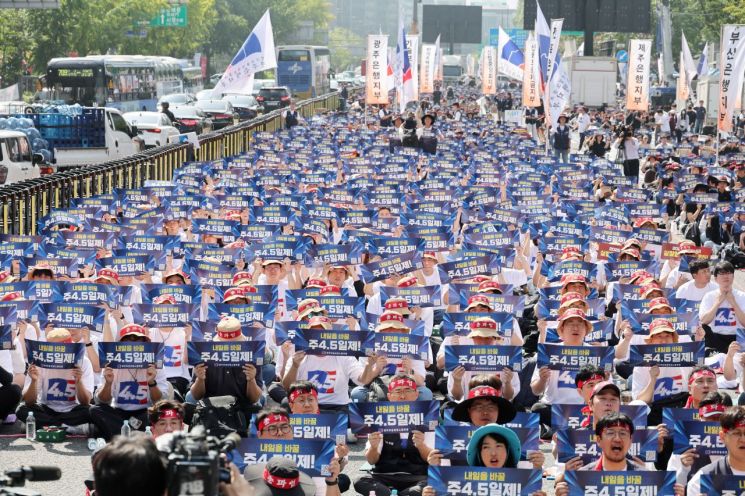
In addition, to improve work efficiency, labor and management at each institution will autonomously implement a “one-hour early leave on Fridays” system, according to their respective circumstances. This one-hour early leave on Fridays is a separate agreement unrelated to the 4.5-day workweek, and was agreed upon on the condition that it should not cause customer inconvenience or increase labor costs. Even after the implementation of the early leave system, bank branch operating hours will remain unchanged, and working beyond the early leave time will not result in additional allowances for work performed within the prescribed working hours, in line with the intent of the agreement. The early leave system will be implemented based on mutual agreement between labor and management at each institution, and the timing of its implementation will also be determined according to each institution’s circumstances.
Furthermore, labor and management in the financial sector agreed to make joint efforts to reduce working hours through the adoption of a 4.5-day workweek, aiming to enhance workers’ quality of life and time sovereignty amid challenging external conditions and sluggish domestic demand.
Choi Yongbyung, Chairman of the Financial Industry Employers’ Council, stated, “Although there were difficulties such as the threat of a general strike in the financial sector, I would like to thank Kim Hyungseon, Chairman of the Financial Industry Labor Union, for his active cooperation, which enabled us to successfully conclude the industry-wide agreement through mutual cooperation and respect.”
© The Asia Business Daily(www.asiae.co.kr). All rights reserved.
![Clutching a Stolen Dior Bag, Saying "I Hate Being Poor but Real"... The Grotesque Con of a "Human Knockoff" [Slate]](https://cwcontent.asiae.co.kr/asiaresize/183/2026021902243444107_1771435474.jpg)















