Virtual Meeting Held with Li Chenggang, China’s International Trade Negotiations Representative
Proposal for Early Removal of Sanctions and Supply Chain Stabilization
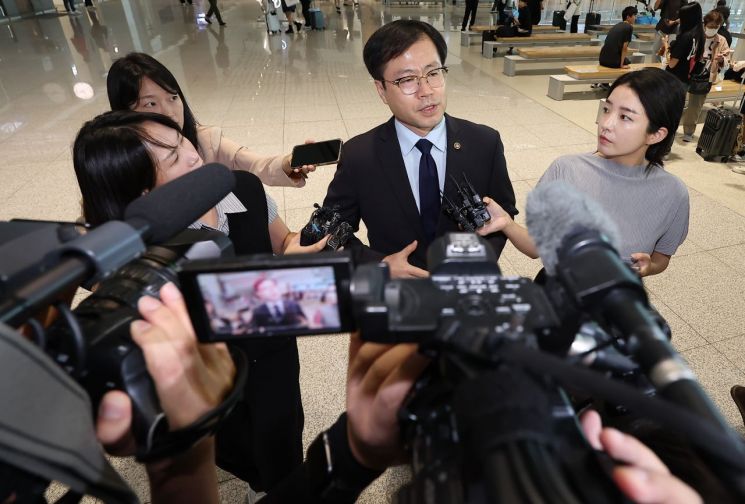
On October 22, Yeo Han-koo, Trade Minister for Trade Negotiations at the Ministry of Trade, Industry and Energy, held a virtual meeting with Li Chenggang, China’s International Trade Negotiations Representative at the Ministry of Commerce, to discuss current trade issues such as China’s recent sanctions on Hanwha Ocean’s U.S. subsidiaries and the strengthening of export controls on rare earths. As strategic competition between the United States and China intensifies, this meeting is seen as a government-level response aimed at minimizing the impact of China’s successive measures on Korean companies.
During the meeting, Minister Yeo expressed deep concern over China’s decision on October 14 to designate five of Hanwha Ocean’s U.S. subsidiaries as targets for sanctions. The Korean side conveyed its position that it is necessary to work closely with the Chinese government for the prompt removal of these sanctions. Minister Yeo reportedly requested an early easing of the sanctions, stating, “Korean companies participating in global supply chains, such as shipbuilding and shipping, should not have their normal business activities affected by unnecessary regulations.”
Hanwha Ocean is a company with experience participating in U.S. defense projects, and China’s recent sanctions are widely viewed as a check against “companies cooperating with the United States.” Industry experts believe that while direct damage may be limited, there could be growing indirect risks in the future, such as restrictions on transactions within China, financing, and procurement of parts. One shipbuilding industry official stated, “The short-term impact is limited, but there are concerns about mid- to long-term risks, given that China has started to strategically classify companies that cooperate with the United States and Korea.”
The government believes that these sanctions are not limited to a specific company but serve as a signal to the entire Korean shipbuilding and shipping industry. The Ministry of Trade, Industry and Energy has activated an emergency monitoring system with relevant industries and is working through diplomatic and trade channels to understand the specifics of the measures and the procedures for their removal. During the meeting, Minister Yeo conveyed the industry’s concerns to the Chinese side and proposed establishing a regular communication channel to discuss ways to stabilize supply chains.
The two sides also exchanged views on China’s recent strengthening of export controls on rare earths. On October 9, the Chinese Ministry of Commerce announced measures to strengthen export controls, including rare earth mining and refining technologies and equipment, as well as materials related to batteries and magnets. As China accounts for more than 70% of global rare earth production, this decision could affect Korea’s semiconductor, secondary battery, and electric vehicle industries, raising concerns within the domestic industrial sector.
Minister Yeo stated, “For Korea, supply chain stability in advanced industries is directly linked to economic security,” conveying the industry’s concerns about the expanded export controls. He also proposed, “Since rare earths are a key area of cooperation for both Korea and China in sectors such as semiconductors, electric vehicles, and defense, we should strengthen dialogue channels to minimize supply chain disruptions.” The government has set the diversification of supply chains and the securing of recycling technologies for key minerals, including rare earths, as major response tasks, and is operating a “Rare Earth Supply Chain Task Force” within the Ministry of Trade, Industry and Energy.
The two sides agreed not to end this consultation as a one-off discussion, but to continue related talks by holding a trade ministers’ meeting on the occasion of the Asia-Pacific Economic Cooperation (APEC) Summit next month. Minister Yeo proposed, “Let’s have an in-depth discussion on all mutual interests, including these current issues, at the APEC Trade Ministers’ Meeting,” and Representative Li Chenggang reportedly responded positively.
Going forward, the government plans to closely analyze the impact of China’s sanctions and strengthened export controls on domestic industries and, if necessary, mobilize all available trade diplomacy tools. In addition, the government will conduct joint assessments with major industry associations and export companies, and, should difficulties arise, will immediately consult with the Chinese side.
© The Asia Business Daily(www.asiae.co.kr). All rights reserved.
![Clutching a Stolen Dior Bag, Saying "I Hate Being Poor but Real"... The Grotesque Con of a "Human Knockoff" [Slate]](https://cwcontent.asiae.co.kr/asiaresize/183/2026021902243444107_1771435474.jpg)















