Samsung Supports 3,450 Companies Over 10 Years
Park Seunghee: "SMEs Are the Backbone of the Economy"
Announcing Support Plans for Smart Factory AI Innovation
Priority Support for Companies in Regions at Risk of Population Decline
"With the introduction of smart factories, we have automated most manual processes, resulting in a dramatic increase in productivity. By pioneering overseas markets, we are now aiming for 46 billion won in sales next year."
Kim Cheolyu, CEO of Baekje Co., Ltd., made this statement at the "Smart Factory 10th Anniversary Event" held by Samsung at COEX in Gangnam-gu, Seoul, on October 21 to mark the 10th anniversary of the Smart Factory support project. Baekje, based in Hongseong-gun, Chungnam, is a food company producing products such as rice cake soup and rice noodles. After adopting the smart factory, the company increased productivity by about 33% and developed overseas sales channels, growing into a strong small-to-medium-sized enterprise now exporting to over 20 countries.
Wijez, located in Iksan, Jeonbuk, manufactures tractor cabins for agricultural machinery and has seen productivity increase by about 52% since introducing a smart factory. Jung Byungkyu, CEO of Wijez, said, "Based on the experience of innovation through the smart factory, we are now pursuing 'family innovation,' where our partner companies grow together with us."
 Seunghee Park, President of External Cooperation (CR) at Samsung Electronics, delivered a welcoming speech at the "Smart Factory 10th Anniversary Event" hosted by Samsung at COEX in Gangnam-gu, Seoul, on the 21st to celebrate the 10th anniversary of the Smart Factory support project. Samsung Electronics.
Samsung began its smart factory support project in 2015 under the philosophy that "sharing and growing together is the path to becoming the best in the world." The smart factory project is Samsung's flagship social contribution initiative, conducted in partnership with the Ministry of SMEs and Startups and the Korea Federation of SMEs.
The 10th anniversary event brought together the government, Samsung, and small and medium-sized enterprises to reflect on the achievements of the smart factory project over the past decade and to share future visions. About 150 participants attended the event, including Vice Minister Noh Yongseok of the Ministry of SMEs and Startups, Jeonbuk Governor Kim Kwanyoung, Democratic Party lawmaker Heo Sungmoo, Oh Kiwoong, Executive Vice Chairman of the Korea Federation of SMEs, and Seunghee Park, President of External Cooperation (CR) at Samsung Electronics. Vice Minister Noh commended Samsung's achievements in the smart factory project and presented a plaque of appreciation. Lee Kwangryeol, Head of Samsung Electronics' Smart Factory Support Center, said, "The 10 years of smart factories are the result of Samsung and small and medium-sized enterprises working together in the field," adding, "We will continue to support innovation through manufacturing artificial intelligence (AI)."
At the event, Vice Minister Noh said, "Samsung has been a reliable partner in manufacturing innovation, working together with small and medium-sized enterprises to build smart factories." Governor Kim stated, "I hope that companies in Jeonbuk will open up broader growth opportunities nationwide through the establishment of smart factories."
President Park remarked, "When we first started this project, many people feared that jobs would decrease as factories became smarter. However, after 10 years, we have actually seen that investment has led to increased employment." He continued, "Small and medium-sized enterprises make up 97% of Korea's manufacturing industry and are the backbone of our economy, accounting for more than half of all employment. Based on the expertise we have accumulated over the past decade, we will continue to provide systematic support and walk together with small and medium-sized enterprises."
Coinciding with the 10th anniversary smart factory event, the "Smart Biz Expo," which supports the development of sales channels for small and medium-sized enterprises, also opened at COEX. Samsung began the "Smart Factory 1.0" project in Gyeongbuk Province and expanded support nationwide from 2016. Since 2018, with the launch of "Smart Factory 2.0," Samsung has provided not only smart factory construction support but also assistance in developing sales channels, nurturing talent, providing technical support, and aftercare services.
Since 2023, Samsung has been promoting "Smart Factory 3.0," which supports data-driven advancement. Over the past 10 years, Samsung has cumulatively supported 3,450 small and medium-sized enterprises across the country. More than 160 smart factory specialists with over 20 years of manufacturing experience have been deployed to support smart factory construction.
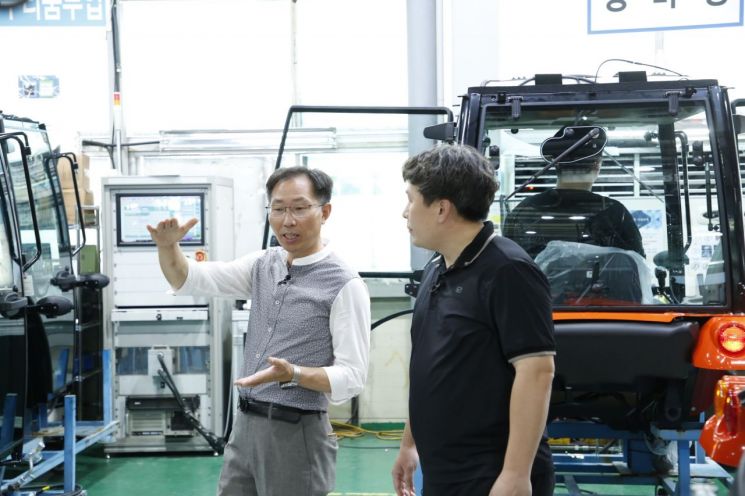 A smart factory specialist from Samsung Electronics is visiting Wijez, an agricultural machinery manufacturer located in Iksan, Jeonbuk, to conduct smart factory consulting. Samsung Electronics.
According to an analysis of the policy effects of the "Large-Small Business Win-Win Smart Factory Support Project" released by the Korea Federation of SMEs in September 2022, the introduction of smart factories resulted in a 23.7% increase in sales, a 26.0% increase in employment, and a 36.8% increase in research and development (R&D) investment. In a satisfaction survey of companies that received smart factory support, the proportion of respondents who answered "very satisfied" or "satisfied" steadily increased from 86.2% in 2019 to 93.6% in 2024.
The smart factory project has also contributed to overcoming national crises. When the supply of quarantine products was insufficient due to the spread of COVID-19, Samsung supported the construction of smart factories for small and medium-sized enterprises manufacturing self-diagnostic kits, polymerase chain reaction (PCR) diagnostic kits, low dead space (LDS) syringes, and masks, dramatically increasing production and helping to overcome the crisis.
In 2023, Samsung announced "Smart Factory 3.0," advancing from simple automation to data-driven manufacturing innovation. The core of this upgrade is to collect and analyze data generated in the manufacturing field in real time, enabling immediate response and improvement when problems arise, thereby creating a highly advanced smart factory.
At the anniversary ceremony, Samsung announced a phased support plan tailored to the level of each beneficiary company. The plan includes a basic stage of building a "data operating system" for automatic data aggregation, an advanced stage of introducing manufacturing AI to predict equipment abnormalities and enable maintenance, and ultimately, a stage of supporting autonomous factories capable of AI-based decision-making.
Through "Smart Factory 3.0," Samsung is also playing a catalytic role in revitalizing regions with declining populations by prioritizing support for companies located in those areas. In 2024, Samsung collaborated with six local governments: Gyeongnam, Gwangju, Busan, Jeonnam, Jeonbuk, and Chungbuk. Starting in 2025, Samsung will expand cooperation to four more local governments: Gangwon, Gumi, Daegu, and Pohang, strengthening partnerships with a total of 10 local governments.
Since 2015, Samsung has supported the construction of smart factories for a cumulative total of 2,312 small and medium-sized enterprises outside the Seoul metropolitan area. A new, evolved business model has emerged, in which local governments and beneficiary companies cooperate to build a "self-sustaining smart factory ecosystem." Since 2023, Jeonbuk Province has partially subsidized the costs that local small and medium-sized enterprises must bear to participate in smart factory construction. From 2024, Jeonbuk has launched its own "Jeonbuk Smart Factory" project, separate from Samsung's initiative. The smart factory project started by Samsung has thus evolved into a regionally-led "self-sustaining smart factory ecosystem," carried forward by local governments and beneficiary companies.
In the second part of the event, Vice Minister Noh gave a presentation on "Smart Manufacturing Innovation Driven by AI," and a panel discussion on "The Introduction of Manufacturing AI in Small and Medium-Sized Enterprises" was held with experts from the government, the Korea Federation of SMEs, and private companies. Through the discussion, participants built consensus on the government's and Samsung's strategies for promoting manufacturing AI and shared perspectives from various viewpoints.
Together with the government, Samsung is hosting the "2025 Smart Biz Expo" at COEX until October 24 to enhance the competitiveness of small and medium-sized enterprises and help them develop new sales channels. The exhibition, now in its ninth year since its first event in 2016, features 81 small and medium-sized enterprises from various fields such as parts and materials, machinery and equipment, home appliances, and food and beverages. These companies are operating exhibition booths, conducting purchase consultations, hosting live commerce broadcasts, and providing educational programs. A total of 124 client companies from 19 countries are attending, and a variety of programs are available to help domestic small and medium-sized enterprises pioneer new markets.
© The Asia Business Daily(www.asiae.co.kr). All rights reserved.
![Clutching a Stolen Dior Bag, Saying "I Hate Being Poor but Real"... The Grotesque Con of a "Human Knockoff" [Slate]](https://cwcontent.asiae.co.kr/asiaresize/183/2026021902243444107_1771435474.jpg)
















