[The Arctic, A New Route to Hegemony] ③
Can Arctic Multilateralism Survive?
The network among Arctic states, which had continued for decades since the establishment of the Arctic Council in 1996, was completely split in two when Russia launched its war against Ukraine. Since early 2021, Russia has not participated in multilateral discussions related to the Arctic. Naturally, an anti-Russian alliance has formed, led by European Arctic states such as Denmark and Norway. With the prolonged war further solidifying this structure, this year's Arctic Circle Assembly resembled a forum for denouncing Russia.
The opening session of the Arctic Circle Assembly, held on the 16th (local time), was titled "Trump and Putin, Can Arctic Multilateralism Survive?" The "great power unilateralism" represented by the United States and Russia is currently the hottest topic of debate in the Arctic region. Although not a single Russian government official attended, the venue was packed to the point that people were standing in the aisles, reflecting the high level of interest in the Arctic.
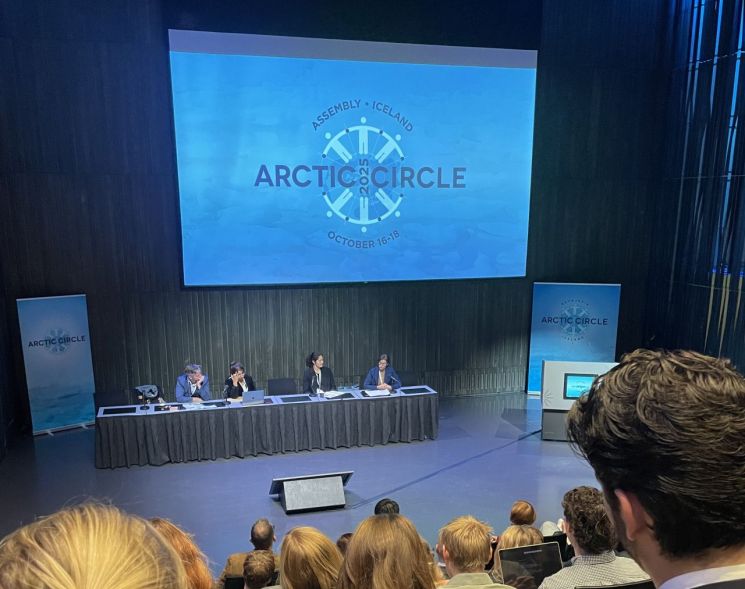 On the 16th (local time), participants are discussing "Trump and Putin, Can Arctic Multilateralism Survive?" at the 2025 Arctic Circle Assembly held in Reykjavik, Iceland. Photo by Son Sunhee
Eda Ayaydin, Professor of International Politics at the University of London Institute in Paris, who moderated the session, remarked, "For populist leaders who reject institutions and personalize power, the Arctic becomes a stage for showmanship," citing Russian President Vladimir Putin's militarization of the Arctic as a prime example.
She further pointed out, "Such actions disrupt the cooperation- and norm-based order that has maintained Arctic governance." There was even a suggestion to completely exclude Russia and restructure the Arctic Council. Celine Rodrigues, a professor at the University of Lisbon in Portugal, stated, "If we are to redefine multilateralism, we may need to restructure the Arctic Council," adding, "The new council should include discussions on security and defense, which were excluded at its founding in 1996."
Lars Lokke Rasmussen, Denmark's Minister of Foreign Affairs and chair of the Arctic Council this year, said in his opening plenary speech, "Since 1996, the Arctic Council has been the cornerstone of cooperation, but the situation has changed rapidly since Russia's full-scale invasion of Ukraine," expressing concern that "unfortunately, the Arctic is no longer a 'low tension' region." Nevertheless, he emphasized the need to restore multilateralism, stating, "The challenges we face in the Arctic test our ability to embrace collective action for the common good beyond narrow national interests."
However, despite such resentment among European Arctic states, in reality, it is not easy to completely exclude Russia from Arctic-related discussions. Russia borders 50 to 60 percent of the entire Arctic coastline and owns most of the infrastructure, including ports along the Northern Sea Route, where melting glaciers have made shipping possible. Above all, the know-how accumulated through actual navigation experience is the most valuable asset. For non-Arctic states like South Korea that aim to develop Arctic routes in the future, Russia is an indispensable partner.
Ultimately, sustainable use of the Arctic Ocean requires a joint international response through multilateral cooperation. This is equally true for South Korea, which is pursuing 'pragmatic diplomacy.'
Lee Seokbae, Ambassador-designate to Russia, said, "Russia is a country that shares both the sea and sky with us," adding, "When South Korea joined the Arctic Council as an observer in 2013, Russia, as the chair at the time, provided active support." He continued, "Russia may also be interested in cooperation with South Korea in the shipbuilding sector, but due to United Nations Security Council sanctions, such exchanges are not easy," stressing that "ultimately, the establishment of lasting peace is necessary for Arctic cooperation."
© The Asia Business Daily(www.asiae.co.kr). All rights reserved.
![Clutching a Stolen Dior Bag, Saying "I Hate Being Poor but Real"... The Grotesque Con of a "Human Knockoff" [Slate]](https://cwcontent.asiae.co.kr/asiaresize/183/2026021902243444107_1771435474.jpg)















