National Assembly Energy Sector Briefing
Legislation to Abolish Solar Panel Setback Requirements
Strengthened Financial Support for Offshore Wind Power
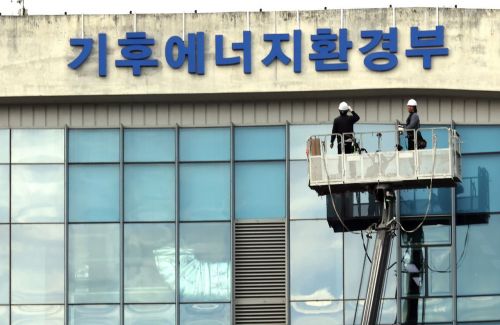 On the 30th, installation work for the Ministry of Climate, Energy and Environment signboard was in full swing on the exterior wall of the Government Sejong Complex. 2025.9.30 Yonhap News
The government is moving forward with the establishment of a tentatively named Electricity Supervisory Agency to monitor the electricity market and grid. In addition, it will raise the spent nuclear fuel surcharge, which has been frozen for 13 years. The government also plans to fully commit to expanding renewable energy by legislating the abolition of solar panel setback requirements and strengthening financial support for offshore wind power projects.
According to the National Assembly and other sources on October 19, the Ministry of Climate, Energy and Environment presented a work report on the energy sector with these details at the National Assembly's Climate, Energy, Environment and Labor Committee on October 16.
The Ministry of Climate, Energy and Environment plans to establish the 12th Basic Plan for Electricity Supply and Demand by the end of next year. The 12th plan will be finalized through a process involving an expert working group, the announcement of a draft, inter-ministerial consultations, and reporting to the National Assembly. Notably, this 12th plan will reflect the 2035 National Greenhouse Gas Reduction Target (NDC), which the government will release this year, so significant changes are expected compared to the previous 11th plan.
The roadmap for phasing out coal-fired power by 2040 will be developed by the first half of next year after gathering input from stakeholders through a government-labor consultative body. The core of the roadmap will be to decommission coal power plants while maintaining employment stability.
The ministry will strengthen the independence and expertise of the Electricity Regulatory Commission and promote the establishment of the tentatively named Electricity Supervisory Agency as a specialized body to support the monitoring of the electricity market and grid.
Currently, domestic electricity market monitoring is handled by the Electricity Market Monitoring Committee under the Electricity Regulatory Commission, which consists of nine members including government officials. Practical work is supported by the Market Monitoring Office of the Korea Power Exchange. However, as the electricity market has rapidly expanded and the number of power generators has increased due to the growth of renewable energy, there have been calls for a more specialized market monitoring body.
In May, Assemblyman Heo Seongmu of the Democratic Party of Korea sponsored an amendment to the Electricity Business Act, which aims to strengthen the authority of the Electricity Regulatory Commission and establish the Electricity Supervisory Agency.
In the area of power grids, the ministry announced plans to build the West Coast Energy Expressway, stabilize grid operations, develop next-generation power grids, and designate special zones for distributed energy. By the end of this month, the ministry will operate a national backbone grid information system to make information on grid construction public. It also plans to strengthen communication by operating a consultative body with residents and local governments, including groups opposed to grid construction.
To accelerate the deployment of renewable energy, the ministry will actively identify new solar power sites such as agrivoltaics, floating solar, industrial complexes, and idle land, and establish a policy consultative body involving all ministries, public institutions, and local governments. The government-wide Offshore Wind Power Deployment Acceleration Task Force, launched in September, will provide close support for permitting and expand ports and vessels for infrastructure installation. In addition, financial support will be strengthened through vehicles such as the National Growth Fund and the Future Energy Fund.
In the second half of this year, the ministry will legislate the relaxation and abolition of solar panel setback requirements and introduce groundbreaking incentives for local residents to minimize on-site conflicts. The ministry will also improve the system to enable the swift implementation of renewable energy projects through a customized environmental impact assessment system.
The ministry is also reviewing adjustments to post-nuclear power plant processing costs, including the spent nuclear fuel surcharge, which has been frozen since 2013. The surcharge has been reviewed every two years by a cost assessment committee, but increases have been postponed due to the absence of a special law on high-level radioactive waste management.
The spent nuclear fuel surcharge, first introduced in 2009, is paid by Korea Hydro & Nuclear Power to safely manage nuclear waste generated at power plants. The surcharge is intended to fund the construction and operation of high-level radioactive waste management facilities. Since the surcharge has been frozen for 12 years, the increase is expected to be substantial. If the surcharge rises, the unit cost of nuclear power generation will also increase.
The ministry also plans to develop key technologies for large-scale water electrolysis focused on green and pink hydrogen, and to proactively build clean hydrogen infrastructure linked to hydrogen-specialized complexes. The national heat map system will be upgraded, and policies to support the use of unused heat will be developed based on heat data.
The ministry will also enact a special law to foster the climate tech industry, establishing a government-wide collaboration system, and will pursue a comprehensive strategy for the development of the climate tech industry.
© The Asia Business Daily(www.asiae.co.kr). All rights reserved.
![Clutching a Stolen Dior Bag, Saying "I Hate Being Poor but Real"... The Grotesque Con of a "Human Knockoff" [Slate]](https://cwcontent.asiae.co.kr/asiaresize/183/2026021902243444107_1771435474.jpg)















