International Cooperation with the United States, Japan, the Czech Republic, Poland, and Others
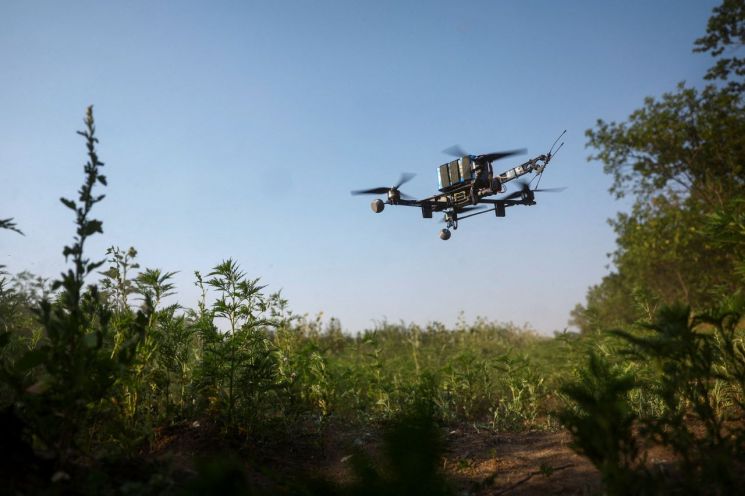 On July 8th (local time), an interceptor FPV drone belonging to the Ukrainian Army's air defense missile regiment was seen flying. Photo by Reuters-Yonhap News
Amid ongoing military tensions surrounding the Taiwan Strait, Taiwan will invest 44.2 billion New Taiwan dollars (approximately 2 trillion Korean won) over six years to foster its drone (unmanned aerial vehicle) industry.
According to Taiwanese media outlets such as Liberty Times on the 17th, the Executive Yuan announced that it had approved the Ministry of Economic Affairs' "Comprehensive Project for Drone Industry Development" at a full cabinet meeting the previous day.
The Executive Yuan plans to establish Taiwan as the "Asian Hub of the Democratic Supply Chain for Drones" by 2030. Already, countries such as the United States, China, and the European Union are pursuing the construction of independent supply chains in the drone sector.
The Ministry of Economic Affairs stated that there are about 250 domestic drone companies, with total production reaching 5.05 billion New Taiwan dollars (approximately 233.4 billion Korean won) last year. The ministry plans to increase production to more than 40 billion New Taiwan dollars (about 1.8 trillion Korean won) by 2030.
It further announced that, to advance Taiwan's drone industry and strengthen national defense, it will pursue international cooperation, including exploring domestic and overseas markets and signing memorandums of understanding (MOUs) with countries such as the United States, Japan, the Czech Republic, and Poland. Through these efforts, Taiwan aims to secure supply chain autonomy and build a robust domestic industrial ecosystem.
The ministry also explained that it is working with the Ministry of National Defense and the Ministry of Transportation to establish research and development (R&D) centers, production facilities, and testing centers within Taiwan.
Hsu Chin-Chang, Deputy Minister of Economic Affairs, stated that the project also includes the management of unmanned boats and underwater drones, both for military purposes and for future undersea data collection.
Sources interpreted the Taiwanese authorities’ move to foster the drone industry as a national strategic industry as part of a broader plan to convert civilian drones for military use in emergencies, thereby building asymmetric capabilities to counter China's overwhelming military power.
Military drones have drawn significant attention amid the Russia-Ukraine war. Ukraine's "Spider Web Operation," which sent drones deep into Russian territory to destroy fighter jets, is a representative example proving the cost-effective and highly efficient strike capabilities of swarm drones.
© The Asia Business Daily(www.asiae.co.kr). All rights reserved.
![Clutching a Stolen Dior Bag, Saying "I Hate Being Poor but Real"... The Grotesque Con of a "Human Knockoff" [Slate]](https://cwcontent.asiae.co.kr/asiaresize/183/2026021902243444107_1771435474.jpg)















