Site Briefing Held at Former Seongsu Technical High School on October 15
Project Scale and Basic Design Direction Announced
Special Design Features to Include Safety and Barrier-Free Accessibility
Construction to Begin After Detailed Design... Sc
Seongjin School, which will serve students with physical disabilities in the northeastern area of Seoul, is set to begin full-scale design work. Although the establishment of the school faced significant challenges due to opposition from local residents and administrative delays, once the detailed design is completed, construction is expected to begin in the first half of 2027.
According to the maintenance industry on October 17, the Seoul Metropolitan Office of Education held an on-site briefing session for the "Seongjin School New Construction Project Design Competition" at the former Seongsu Technical High School site in Seongdong-gu on October 15. The event was organized to recruit architectural firms to participate in the design process, and the overall project scale and basic design direction were presented.
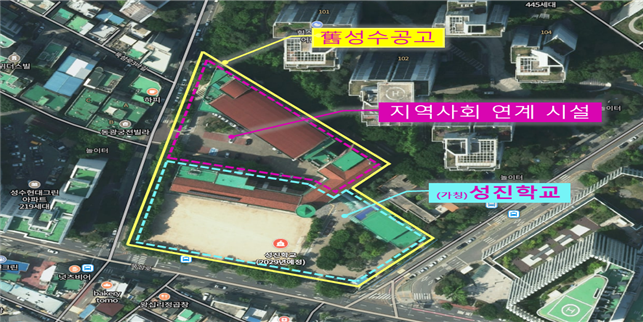 Seongjin School for students with physical disabilities in the northeastern area of Seoul will be built on the former Seongsu Technical High School site in Seongdong-gu. Seoul City
Seongjin School is an institution for students with physical disabilities residing in the northeastern area of Seoul. Although the establishment was promoted since 2022, persistent opposition from local residents delayed the process until last month, when the Seoul City Council finally approved the construction plan. At that time, parents, fearing the project might be scrapped, knelt in front of the City Council and pleaded for the ordinance to pass.
The newly released design guidelines include plans to demolish and completely rebuild part of the former Seongsu Technical High School site (8,000 square meters).
The school will be built as a four-story building above ground with one basement level, with a total floor area of 16,178 square meters, accommodating up to 136 students. The plan includes 22 classes in total: two kindergarten classes, six each for elementary, middle, and high school, and two for specialized courses. The remaining 5,800 square meters of the site are expected to be used for a general school. Initially, the Office of Education considered establishing an artificial intelligence (AI) vocational training center on the site, but in response to local residents' requests, it is now considering creating community-friendly facilities such as a general school.
The design must incorporate four key strategies: safety, accessibility, smart technology, and green features. Requirements also include barrier-free design that exceeds legal standards and BF (Barrier Free) certification, generous spatial arrangements to accommodate wheelchair users, and ensuring convenience for both staff and students.
In particular, the school is intended to serve as a space that leads the way in changing perceptions of disabilities within the local community. Spaces for direct and indirect interaction between students with physical disabilities and local residents will be created, and the school will be visible from the adjacent large residential complexes. The design must also allow for flexible adjustment of class numbers in response to changes in student enrollment. Additionally, the school will be equipped with sensory-motor training rooms, communication training rooms, rehabilitation exercise rooms, and aquatic therapy rooms for students with physical disabilities.
However, it is expected that it will take another three to four years before the school opens. Architectural firms will submit their proposals by the end of this year, and after a review process, the final design will be selected in the first half of next year. Detailed designs for facilities and civil engineering must then be completed before construction can begin, which is scheduled for 2027. Furthermore, since the currently planned total construction cost of 40 billion won may increase, ongoing administrative and financial cooperation between the City Council and the Office of Education is essential. In the case of Dongjin School in Jungnang-gu, even after the establishment was confirmed, the site was relocated eight times over 12 years, resulting in a 10-year delay in opening.
An official from the Office of Education stated, "Seongjin School is a future-oriented special school that supports students to quickly adapt to the digital society and grow together within a mature community. From the design stage, we will balance educational vision with spatial needs to meet the expectations of the local community."
As of last year, only 4,531 out of a total of 14,546 students eligible for special education in Seoul (31.1%) were attending special schools. Out of Seoul's 25 districts, eight have no special schools. Until the establishment of Seongjin School was confirmed, there were no special schools in the northeastern area (Seongdong, Gwangjin, Dongdaemun, Jungnang, Seongbuk, Gangbuk, Dobong, and Nowon districts).
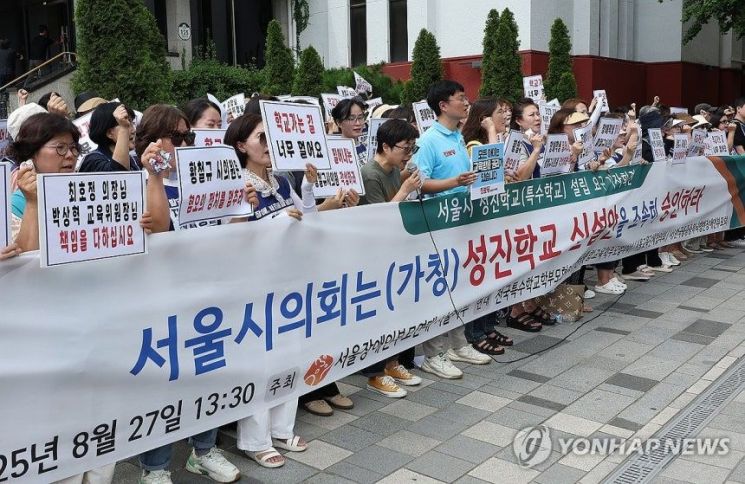 The National Parents' Association of Persons with Disabilities and others held a "Call for the Establishment of Seongjin School" meeting near the Seoul City Council in Jung-gu, Seoul, ahead of the Seoul City Council's review of the Seongjin School establishment plan last month. Yonhap News.
© The Asia Business Daily(www.asiae.co.kr). All rights reserved.
![Clutching a Stolen Dior Bag, Saying "I Hate Being Poor but Real"... The Grotesque Con of a "Human Knockoff" [Slate]](https://cwcontent.asiae.co.kr/asiaresize/183/2026021902243444107_1771435474.jpg)
















