SK Bioscience's “Skycellflu Trivalent” and Other Vaccines
The influenza (flu) season is now in full swing. The Korea Disease Control and Prevention Agency (KDCA) announced that the national influenza vaccination program for the 2025-2026 season is underway from September 22, 2025, to April 30, 2026. Free vaccinations are available to children aged 6 months to 13 years, pregnant women, and seniors aged 65 and older. Eligible individuals can receive the vaccine at any designated hospital, clinic, or public health center nationwide, regardless of their place of residence.
This season’s vaccinations began in earnest at the end of September. Children who require two doses have been able to receive their first shot since September 22, while children who need only one dose and pregnant women became eligible for vaccination starting September 29. Seniors aged 75 and older began receiving vaccinations on October 15, those aged 70 to 74 will start on October 20, and those aged 65 to 69 will follow on October 22, with vaccinations being administered sequentially.
According to the KDCA, influenza vaccination is the most effective way to reduce the risk of hospitalization and death. This year, with the possibility of earlier and more active virus circulation compared to previous years, the agency recommends completing vaccination within October for optimal protection.
Starting this year, the domestic vaccine system has shifted from the previous quadrivalent (four-strain) to a trivalent (three-strain) vaccine in accordance with World Health Organization (WHO) recommendations. This change reflects the international guideline that, as the B/Yamagata lineage virus is disappearing, it is sufficient to include only two A strains and one B/Victoria strain in the vaccine.
Vaccine production technology has already reached an advanced stage. In addition to the traditional egg-based cultivation method, cell-based production has been commercialized, offering stable quality and improved production efficiency. Cell-based vaccines are gaining global traction due to their higher antigen purity, lower allergy risk, and faster production speed. In Korea, SK Bioscience’s “Skycellflu Trivalent” is a representative cell-based flu vaccine, meeting global quality standards with approvals from the WHO and the European Medicines Agency (EMA).
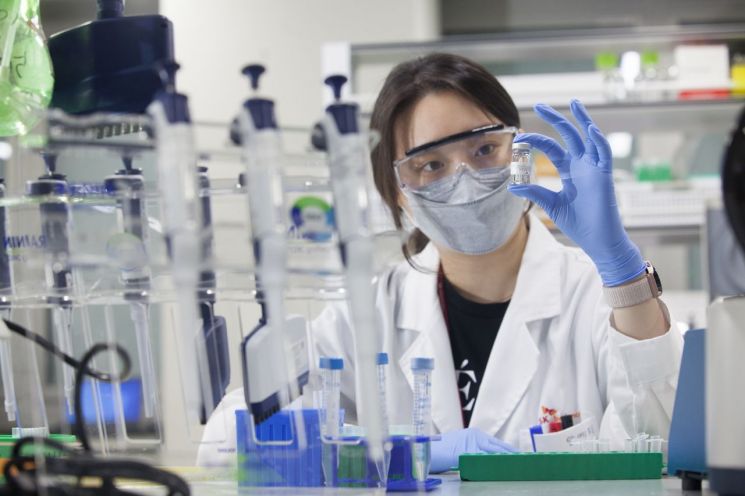 A researcher at SK Bioscience is conducting analytical experiments for vaccine development. SK Bioscience
Influenza remains a deadly infectious disease. The World Health Organization (WHO) reports that each year, there are about 3 to 5 million severe cases worldwide, with 290,000 to 650,000 deaths. According to the U.S. Centers for Disease Control and Prevention (CDC), during the 2023-2024 season, approximately 40 million Americans were infected, 470,000 were hospitalized, and 28,000 died. In Korea, the proportion of suspected flu cases (73.9 per 1,000 outpatients) reached its highest level since 2016 last year.
Warning signs are already emerging abroad. According to Thailand’s Department of Disease Control (DDC), more than 700,000 flu cases and 61 deaths were recorded from January to early October 2025. Dr. Taweechai Visanuyothin of the Thai DDC warned, “Climate change and the humid environment following the rainy season are accelerating the spread of the virus,” adding, “The current influenza incidence is increasing faster and more broadly than in previous years.” Early flu outbreaks have also been reported in Japan and Singapore, with some regions experiencing hospital bed occupancy rates temporarily exceeding 90%.
Experts warn that this surge in Asia could impact Korea as well. With active travel between Asian countries, the domestic flu season could begin earlier if imported cases increase. Professor Lee Jieun of Seoul National University Hospital’s Infectious Diseases Department advised, “Mid-October is the last window for effective immune response,” emphasizing, “Infants, the elderly, and pregnant women should complete their vaccinations by the end of October at the latest.”
It takes about two weeks for immunity to develop after vaccination. On the day of vaccination, strenuous exercise and alcohol consumption should be avoided, and it is recommended to remain at the medical facility for 20 to 30 minutes to monitor for adverse reactions. Mild fever or muscle aches are common and usually resolve within one to two days. The KDCA’s official stance is that the influenza vaccine can be administered simultaneously with other vaccines, including the COVID-19 vaccine.
Experts stress that flu prevention is not just a matter of personal health but a public health measure that helps reduce the burden on the healthcare system and strengthens the safety net for society as a whole. Every individual action to prevent infection is the most effective way to protect families and local communities.
Influenza is never “just a bad cold.” With outbreaks already underway in neighboring countries, the optimal time for vaccination is “now.” To ensure a safe winter, vaccinations should be completed no later than the end of October.
© The Asia Business Daily(www.asiae.co.kr). All rights reserved.
![Clutching a Stolen Dior Bag, Saying "I Hate Being Poor but Real"... The Grotesque Con of a "Human Knockoff" [Slate]](https://cwcontent.asiae.co.kr/asiaresize/183/2026021902243444107_1771435474.jpg)















