74% of Busan Workers Now Use AI
Usage Rate Rises by 18.1 Percentage Points in Two Years
How much are workers at Busan-based companies utilizing generative AI? A recent survey revealed somewhat unexpected results: while younger employees expressed "concern," middle-aged and older managers viewed AI as a "partner."
Two years after the launch of ChatGPT, generative AI has rapidly become an everyday work tool, and workers in Busan showed a clear generational divide in their perceptions of AI. Younger employees are worried about job losses, whereas managers are embracing AI as a "work partner."
The Busan Chamber of Commerce and Industry (Chairman Yang Jaesaeng) announced on the 16th the results of a "Survey on the Use of Generative AI by Workers at Busan-based Companies," which was conducted with 320 workers in the Busan region.
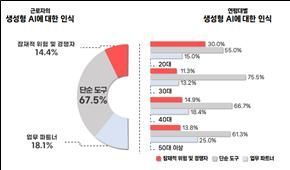
According to the survey, 67.5% of respondents perceived generative AI as a "simple tool," followed by "work partner" (18.1%) and "potential risk" (14.4%). Notably, 25.0% of workers aged 50 and above viewed AI as a work partner, a higher proportion than any other age group. In contrast, 30.0% of workers in their 20s considered AI a "threat to jobs," showing a much higher level of concern compared to other age groups.
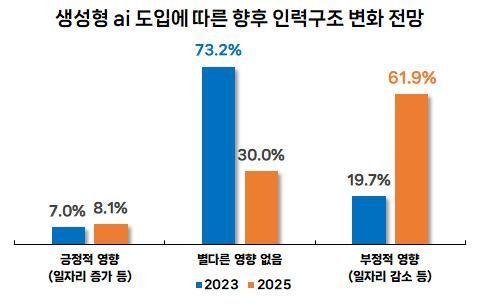
Regarding the impact of AI proliferation on workforce structure, 61.9% of respondents said it would have a "negative effect." This figure increased by 42.2 percentage points in two years, from 19.7% in 2023. The Busan Chamber of Commerce and Industry explained, "As AI performance rapidly improves and is integrated into workplaces, anxiety about job replacement is growing."
The generative AI utilization rate among local workers in 2025 was 74.4%, an 18.1 percentage point increase from 56.3% in 2023. By age group, those in their 20s, who most actively used AI voluntarily to enhance their personal skills, had the highest rate at 85.0%. By industry, the highest rates were in information and communications (90.7%), education and research (80.4%), and finance and insurance (78.1%).
Among workers using AI, 74.8% reported using generative AI in their actual work. The main areas of use were information and data searches (62.6%), document writing (36.6%), data analysis (29.0%), and image generation (28.2%). While 50.9% of respondents said work efficiency had improved, most (72.5%) reported "no change" in their workload. The Busan Chamber of Commerce and Industry analyzed, "Although the efficiency of AI use has increased, improvements to work structures at the organizational level are still insufficient."
Regarding AI learning methods, "self-learning via social media" (40.0%) was most common, while official training, such as in-house education (12.8%) and public institution education (8.8%), accounted for only 21.6%. However, demand for AI education was high at 77.5%, indicating a strong need for official training to enhance workers' professional AI skills.
A member of the Busan Chamber of Commerce and Industry's research team said, "The rapid evolution of generative AI is accelerating changes across all job functions," adding, "As the gap in AI utilization skills could quickly turn into a gap in opportunities, it is essential for companies to provide AI training and establish clear guidelines."
© The Asia Business Daily(www.asiae.co.kr). All rights reserved.
![Clutching a Stolen Dior Bag, Saying "I Hate Being Poor but Real"... The Grotesque Con of a "Human Knockoff" [Slate]](https://cwcontent.asiae.co.kr/asiaresize/183/2026021902243444107_1771435474.jpg)
















