Kim Yongbum, Chief Presidential Secretary for Policy, and Kim Jeonggwan, Minister of Trade, Industry and Energy, Visit the U.S.
Kim: "The U.S. Side Has Recently Shown Very Close Communication"
Minister Kim: "The Gap on Foreign Exchange Issues Has Narrowed Significantly"
Targeting the APEC and Korea-U.S. Summit as the Timing for a Deal
Kim Yongbum, Chief Presidential Secretary for Policy, stated on the 16th, "Our ministers have gone to Washington, D.C., and since various discussions are taking place, it was suggested that accelerating the negotiations would be beneficial, which is why I am heading to the United States." He added, "I view the follow-up consultations on the Korea-U.S. tariff negotiations positively."
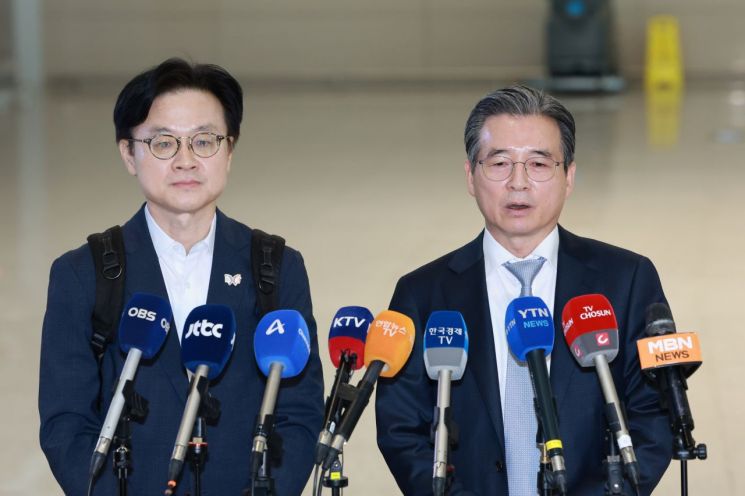
Speaking to reporters en route to the United States for follow-up consultations on the Korea-U.S. tariff negotiations, Kim addressed U.S. Treasury Secretary Scott Besant's comment that the negotiations are in their final stage. He said, "Previously, relevant U.S. departments did not appear to be communicating closely, but recently, the U.S. Department of Commerce has shown a very close level of communication."
Kim plans to hold face-to-face working-level consultations in Washington, D.C. with key counterparts, including Minister of Trade, Industry and Energy Kim Jeonggwan and U.S. Secretary of Commerce Howard Lutnick. On the previous day (October 15), Deputy Prime Minister and Minister of Economy and Finance Koo Yooncheol traveled to the United States, and Trade Minister Yeo Hangoo began his U.S. trip by scheduling a meeting with Jamieson Greer, a representative of the U.S. Trade Representative (USTR).
He explained, "During this trip, Minister Kim will negotiate with Secretary Lutnick, and Deputy Prime Minister Koo will negotiate with Secretary Besant. Since it is the period of the International Monetary Fund (IMF) and World Bank (WB) annual meetings, and the Asia-Pacific Economic Cooperation (APEC) summit and Korea-U.S. summit are timely opportunities for us, we decided to visit the United States."
Regarding speculation that a plan is being considered to use won-denominated accounts instead of dollars for U.S.-bound investment funds, Kim declined to comment on specifics but said that the gap between Korea and the U.S. has been significantly narrowed. He stated, "It is difficult to answer regarding specific details," but added, "I can say that the two sides have significantly closed the gap in various areas related to the foreign exchange market."
When asked about U.S. President Donald Trump's remarks that an agreement had been reached to provide $350 billion in U.S.-bound investment funds up front, Kim responded, "It is not appropriate to comment on the statements of a foreign head of state," adding, "However, since various matters are being discussed at the negotiating table, please consider it as part of the process." Regarding the timing of a deal, Kim said, "Since APEC is an opportunity for the leaders to meet, there is a consensus among the negotiation teams to utilize this chance. However, I believe that our national interest and the interests of our people are far more important issues."
Recently, the negotiations, which had been deadlocked for more than two months, have gained significant momentum as the U.S. side showed a notably meaningful response to Korea's revised proposal regarding the U.S.-bound investment fund. The negotiation team plans to conclude the tariff negotiations by the Korea-U.S. summit, which will take place during the APEC summit at the end of this month. Secretary Besant also stated at a press conference on the 15th (local time) regarding the Korea-U.S. tariff negotiations, "I am confident that the differences can be resolved," adding, "We are currently in talks, and I expect something within the next 10 days." This suggests that a dramatic agreement may be possible, as a significant portion of the differences has already been narrowed.
Korea and the United States reached a broad agreement on tariff negotiations at the end of July, but differences arose over the specific operation of the $350 billion U.S.-bound investment package, leading to a deadlock. The United States demanded that most of the investments be made as equity, that is, in cash. In response, Korea emphasized "commercial rationality" and sent a revised proposal arguing that, considering foreign exchange market stability and the size of gross domestic product (GDP), it would be reasonable to fulfill the investment quota through loans and guarantees, among other methods.
Previously, in an interview released by SamproTV the day before, Kim said, "By the time APEC is held, it will have been three months since the Korea-U.S. tariff negotiation agreement on July 31, and we are continuing working-level negotiations to ensure that the leaders' agreement on tariffs is finalized." He added, "There is no separate deadline for the conclusion of the tariff negotiations, but since opportunities for the two leaders to meet are not frequent, APEC is in effect a major target." Kim also said, "The United States showed a very meaningful response to our revised proposal, and a new alternative has been presented. Our negotiation team will have substantial talks this week."
© The Asia Business Daily(www.asiae.co.kr). All rights reserved.
![Clutching a Stolen Dior Bag, Saying "I Hate Being Poor but Real"... The Grotesque Con of a "Human Knockoff" [Slate]](https://cwcontent.asiae.co.kr/asiaresize/183/2026021902243444107_1771435474.jpg)















