Rising Faster Than Overall Inflation Rate
Housing Costs Surge by 5.5%, Leading the Increase
Dining Out Becomes Pricier as Ingredient Costs Climb
"Sector-Specific Measures Needed for Food, Clothing, and Housing"
Over the past five years, the cost of living-covering electricity bills, grocery baskets, and apartment maintenance fees-has surged, resulting in a perceived inflation rate that exceeds the actual inflation rate.
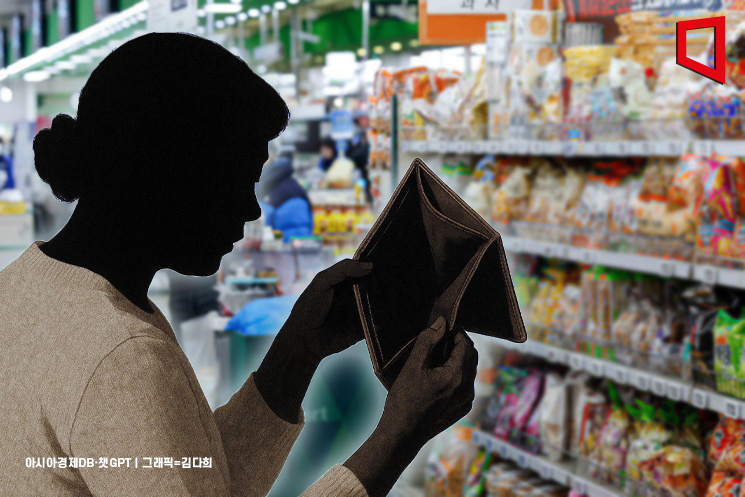
On October 16, the Federation of Korean Industries announced, via a report titled "Analysis of Factors Driving Increases in the Cost of Living and Countermeasures" commissioned to Professor Kim Sangbong of Hansung University's Department of Economics, that the average annual increase in the cost of living (covering food, clothing, and housing) from 2019 to 2024 was 4.6%. This is 1.8 percentage points higher than the overall inflation rate of 2.8%. The Federation emphasized, "The sharp rise in the cost of living, which is directly tied to daily life, likely led to a significant burden on ordinary citizens," and stressed the need for fundamental measures to stabilize these prices.
Among the essential categories, housing costs experienced the steepest rise. Over the past five years, housing costs increased by an average of 5.5% per year, far outpacing the overall inflation rate. Breaking it down further: electricity, gas, and other fuels rose by 7.0%; water and housing-related services by 4.3%; and maintenance and repair of housing facilities by 4.0%. The report analyzed that this was due to a significant increase in electricity and gas rates-heavily dependent on imported raw materials-as well as a surge in natural gas prices and exchange rates following the COVID-19 pandemic and the Russia-Ukraine war.
In particular, maintenance fees for multi-unit housing soared by 33.1% over five years, driven by rising labor costs and electricity bills. The maintenance fee per square meter rose from 2,245 won in 2019 to 2,988 won this year. For a standard apartment size of 84 square meters, the monthly fee increased from 188,580 won to 250,992 won. Additionally, the report noted that the rising prices of raw materials such as lumber and cement have increased the costs of maintaining and repairing housing facilities, further adding to the overall housing burden.
Food-related prices also saw a sharp increase, with an average annual rise of 4.6%. Most categories experienced rapid price hikes: food products (5.2%), food service (4.0%), and non-alcoholic beverages (3.9%). The report pointed out that food-related prices have a high weighting in the consumer price index, thus having a significant impact on perceived inflation. The main factors cited were increased distribution costs for agricultural products and rising international prices for agricultural and food products.
According to the Korea Agro-Fisheries & Food Trade Corporation (aT), the share of distribution costs in consumer prices rose from 47.5% in 2019 to 49.2% in 2023. Furthermore, production instability due to climate change has pushed the United Nations Food and Agriculture Organization (FAO) Global Food Price Index above 120.0 since 2021.
The upward trend in dining-out prices also continued. The report stated, "Over the past four years (2019-2023), the biggest cost burden for the restaurant industry was ingredient costs, which rose by an average of 9.8% per year." It also noted that labor costs (up 5.8% per year), rent (up 4.6% per year), and other costs such as delivery fees (up 11.3% per year) have all contributed to upward pressure on dining-out prices.
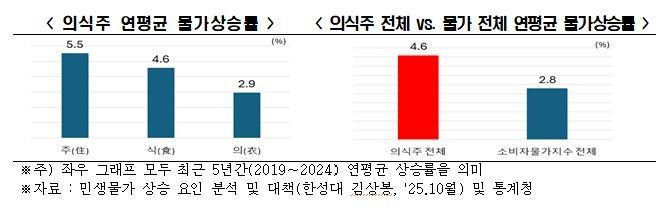
Clothing prices have also shown a steady upward trend. According to the report, prices for clothing and accessories have risen by an average of 2.9% per year over the past five years. The report attributed this to a combination of factors, including the structure of producing a wide variety of products in small quantities, consumers' preference for branded goods, inventory costs, rising labor costs, and higher international shipping rates.
The report identified several structural factors behind the faster rise in the cost of living compared to overall inflation: increases in international energy and agricultural product prices, high distribution costs, and the burden of labor costs. The surge in natural gas prices, increased dependence on imported agricultural products, and cost pass-through due to overlapping distribution stages have all contributed to the rise in perceived inflation.
The Federation of Korean Industries suggested in the report that measures tailored to each sector-clothing, food, and housing-should be implemented in parallel to stabilize the cost of living.
For the clothing sector, the report recommended inventory management and cost reduction through artificial intelligence (AI)-based demand forecasting, as well as improving efficiency through automation such as robotics. The goal is to enhance productivity and cost efficiency through the digital transformation of the clothing industry.
For the food sector, the report proposed introducing price-buffering mechanisms to offset increases in import prices, particularly for grains with high market openness. For example, when international wheat prices remained high in 2022, the government partially compensated flour milling companies for higher import costs to help stabilize prices. The report also suggested reducing distribution stages by revitalizing online wholesale markets to address the high-cost distribution structure that affects final consumer prices. In addition, it emphasized the need to boost productivity through the development of smart farms and to broaden consumer choices by diversifying import sources for fruits and vegetables with high price volatility.
For the housing sector, the report proposed installing energy-saving facilities in common areas such as parking lots and elevators to replace fluorescent and incandescent lights, and reducing labor costs through joint management among neighboring apartment complexes.
© The Asia Business Daily(www.asiae.co.kr). All rights reserved.
![Clutching a Stolen Dior Bag, Saying "I Hate Being Poor but Real"... The Grotesque Con of a "Human Knockoff" [Slate]](https://cwcontent.asiae.co.kr/asiaresize/183/2026021902243444107_1771435474.jpg)

















