Focusing on Export Items Such as Long-Range Multi-Function Radars
According to the "World Defense Market Yearbook" published by the British military intelligence company Janes, the total size of the global radar market is expected to reach 616.8 trillion won over the ten-year period from this year through 2034. The maintenance, repair, and overhaul (MRO) market is also projected to reach 17 trillion won during the same period, broken down into 11.3 trillion won for ground, 2.9 trillion won for naval, and 2.8 trillion won for aviation sectors. The expansion of the radar market is attributed to the fact that countries around the world are engaging in the development of sixth-generation fighter jets. In Europe, under the leadership of Germany, France and Spain are already jointly developing the sixth-generation fighter jet known as the Future Combat Air System (FCAS), with the first test flight scheduled for 2029. The United Kingdom, Italy, and Japan have signed the Global Combat Air Programme (GCAP) treaty to jointly develop a sixth-generation fighter jet.
Hanwha Systems achieved its highest-ever defense sector performance last year. On a consolidated basis, its operating profit in 2024 reached 219.3 billion won, a 78.9% increase compared to the previous year (122.6 billion won). Revenue rose by 14.3% to 2.8037 trillion won from 2.4525 trillion won the previous year, and net profit increased by 29.8% to 445.2 billion won from 343.1 billion won. Hanwha Systems attributes this growth in sales to the export of the Cheongung-II Multi-Function Radar (MFR) to the United Arab Emirates. Looking ahead, the company plans to position itself at the center of not only the ground radar market but also the naval and aviation radar markets. This confidence is based on over 30 years of expertise, including the development of Cheonma Detection and Tracking Radar, Cheolmae-II Multi-Function Radar, and shipborne tracking radars since the late 1980s.
Hanwha Systems signed export contracts for the Cheongung-II Multi-Function Radar with the United Arab Emirates in 2022 and with Saudi Arabia in 2024. For the 2022 UAE export, Hanwha Systems' contract was valued at approximately 1.3 trillion won, accounting for 30% of the total deal. In the Saudi export, the company secured a contract worth 1.2 trillion won, representing 28% of the total. The Multi-Function Radar for the "Medium-Range Surface-to-Air Missile System-II (Cheongung-II)" is capable of simultaneously detecting and tracking enemy fighter jets and ballistic missiles approaching from all directions. It performs a range of complex engagement missions with a single 3D phased array radar, including detection and tracking, friend-or-foe identification, jamming (electronic countermeasures) response, and missile acquisition, tracking, and communication.
Following the Cheongung-II radar, the Long-Range Multi-Function Radar (Long-Range MFR) is also included among subsequent export items. Additionally, the company expects to join the export market by developing the "Anti-MLRS MFR," a multi-target simultaneous engagement radar capable of detecting multiple Multiple Launch Rocket System (MLRS) threats at once.
The company is also developing a multi-function radar for the long-range artillery interception system, a core component of the Korean Iron Dome, known as the Long-range Artillery Interception System (LAMD). One LAMD battery consists of a radar, engagement control center, six launchers, and interceptor missiles. The multi-function radar for the long-range artillery interception system can simultaneously detect and track multiple threats. In particular, it can detect and track long-range artillery shells flying in salvos in real time, providing dense protection for key domestic facilities. Hanwha Systems' multi-function radar for the long-range artillery interception system boasts superior detection and tracking performance compared to similar overseas systems such as the Iron Dome.
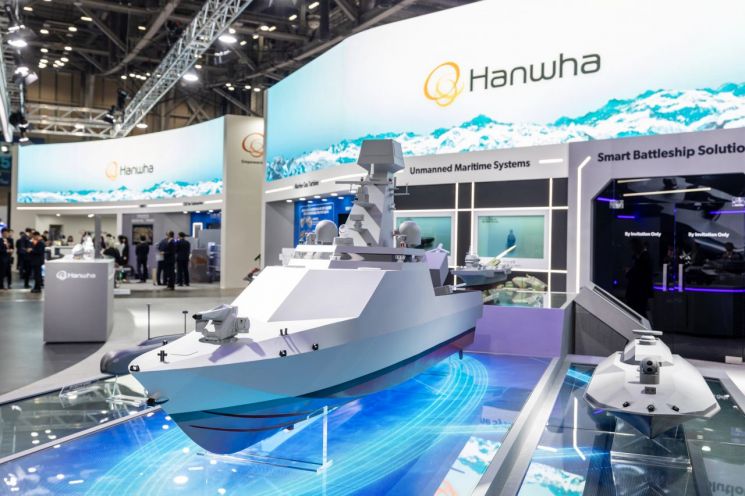
The company is also engaged in the development of combat systems for the next-generation frigate (Ulsan-class Batch-III), as well as the combat system and multi-function radar for the next-generation destroyer (KDDX). The radar alone enables multi-mission capabilities, including 360-degree all-around detection and tracking of aerial and naval targets and gunfire support. In addition, last year, Hanwha Systems became the first in Asia to receive certification from the American Bureau of Shipping (ABS) for its self-developed "cybersecurity solution for ships." This is the first case among the three leading shipbuilding nations-South Korea, China, and Japan-to obtain certification for a cybersecurity solution for ships. The company also developed a Condition-Based Monitoring System (CBMS) for naval propulsion systems, which diagnoses the operational status of ship propulsion systems in real time. Since this technology is owned only by a few advanced countries such as the United States, Norway, and Italy, it is expected to have a significant import substitution effect. In addition, Hanwha Systems is taking on the challenge of developing advanced radars for ground, naval, aviation, and satellite applications, including the SAR for the 425 satellite.
© The Asia Business Daily(www.asiae.co.kr). All rights reserved.
![Clutching a Stolen Dior Bag, Saying "I Hate Being Poor but Real"... The Grotesque Con of a "Human Knockoff" [Slate]](https://cwcontent.asiae.co.kr/asiaresize/183/2026021902243444107_1771435474.jpg)















