Royal Academy of Cambodia Policy Analyst Contributes to Phnom Penh Post
"Cambodians Love K-pop and Korean Dramas, Admire the 'Miracle on the Han River'"
"Foreign Cybercrime Threatens Korea-Cambodia Friendship...Korea's Role Is Crucial"
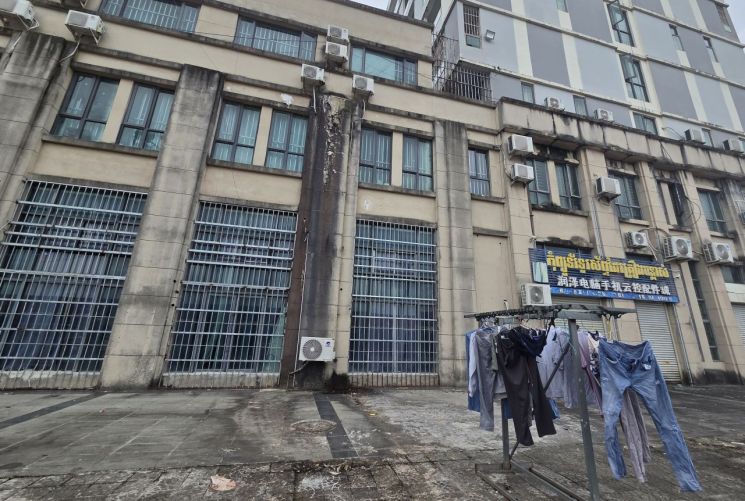 Afternoon of the 14th (local time), a building suspected to be a crime complex in Sihanoukville, Cambodia. 2025.10.14 Yonhap News Photo by Yonhap
In Cambodia, where employment scams, abductions, and illegal detentions targeting Koreans occur frequently, voices are being raised that the friendship between Korea and Cambodia is under threat due to Chinese criminal organizations, and that cooperation between the two countries should be strengthened in times like this.
Cambodian Think Tank Policy Analyst: "Korea Should Increase Support for Cambodia"
On the 14th (local time), the Phnom Penh Post published an opinion piece titled "Why Korea Should Strengthen Support for Cambodia Against Foreign-Led Cybercrime." The article was written by Sun Sam, a policy analyst at the Royal Academy of Cambodia, a local think tank. In the opening of his piece, he wrote, "Cambodia, the heart of Southeast Asia, has long been regarded as a symbol of resilience and hospitality. Underlying this is a deep affection for Korean culture." He continued, "Cambodians love K-pop and Korean dramas, and they admire Korea's entrepreneurial spirit, epitomized by the 'Miracle on the Han River.'" He added, "Such cultural ties between the two countries have expanded into economic cooperation, tourism, and people-to-people exchanges. However, the recent spread of cybercrime led by foreign criminal organizations threatens these relations. These crimes target victims worldwide, shaking Cambodia's international reputation and social stability."
According to the article, Cambodia has "unintentionally become a hub for international scam organizations." In recent years, "scam compounds" disguised as legitimate businesses have proliferated throughout Sihanoukville and Kampot Province. These organizations are linked to Chinese criminal networks and lure job seekers from Asia and abroad with promises of hospitality and technology-related jobs. Victims are kidnapped and detained, then forced to participate in complex online crimes such as romance scams, investment fraud, and cryptocurrency scams. The resulting global losses amount to billions of dollars.
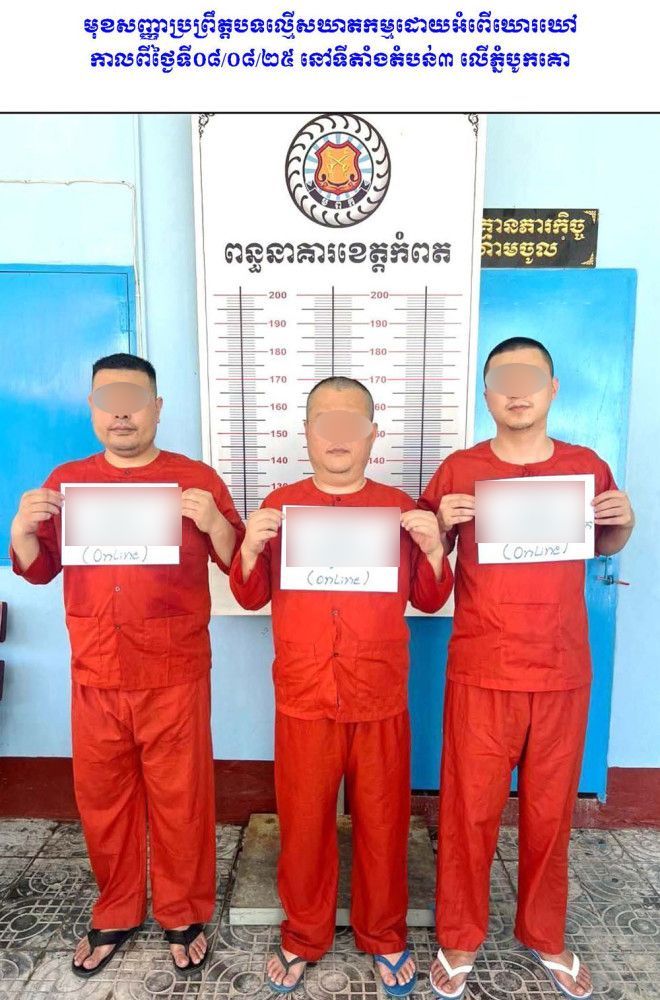 Cambodian authorities' joint task force fighting against 'online scam' criminal organizations revealed the Chinese nationals arrested during a crackdown operation in Kampot Province last August, reported Cambodia's state-run AKP News Agency. Yonhap News
"Cambodia Has Unintentionally Become a Hub for International Scam Organizations"
The Cambodian government has acknowledged this situation. Foreigners, particularly Chinese businesspeople and organized crime groups, are operating scam bases by exploiting lax laws and corruption. They have entered Cambodia through China's Belt and Road infrastructure initiative, and the international watchdog Global Anti-Scam Organization (GASO) has reported that their investments are concentrated in Special Economic Zones (SEZs). These "shadow compounds" disrupt local communities, trigger everyday crimes such as theft and assault by those attempting to escape, and ultimately deal a significant blow to Cambodia's international image and tourism industry.
In 2024 alone, Cambodian police conducted raids on 20 scam compounds and rescued hundreds of victims of human trafficking. However, due to a lack of substantial external support, some describe the situation as "like mopping a floor that keeps leaking water." Koreans have not been exempt from falling victim to these crimes. In August 2025, the body of a Korean university student in his twenties was found in Kampot Province. He was the second Korean victim at a scam facility operated by a Chinese criminal organization.
The Korean Ministry of Foreign Affairs officially protested to the Cambodian government over this incident, requesting a thorough investigation and support for the bereaved family. However, in reality, Korea has only one police officer (police attach?) stationed at its embassy in Phnom Penh, limiting its ability to investigate and respond. Issues with local jurisdiction and suspicions of corruption have also hindered investigative cooperation. Policy analyst Sun Sam noted, "This case exposes the structural problem of foreign-led criminal organizations exploiting Cambodian territory without direct intervention by Cambodian authorities."

"Most Cambodians Love and Respect Korea...Bilateral Cooperation Needed to Prevent Further Tragedy"
He continued, "Most Cambodians still hold genuine affection and respect for Korea. According to a survey by the Korea International Cooperation Agency (KOICA), more than 70% of respondents said Korea is their favorite foreign country. This is because we share common values such as diligence, family orientation, and rapid development." He also noted that K-dramas like "Crash Landing on You" enjoy high viewership and that BTS concerts sell out instantly. He stated, "This 'Hallyu' wave is more than a cultural phenomenon; it has provided tangible benefits to Cambodia's economic development, including Korean corporate investment and technology transfer. However, the current wave of foreign-led cybercrime threatens the trust and exchanges between the two countries."
Analyst Sun Sam said, "The tragic death of the Korean university student demonstrates that Chinese scam organizations are exploiting Korean culture to commit transnational crimes." He added, "What is needed now is Korea-Cambodia cooperation that combines technological collaboration, diplomatic influence, and economic support." He emphasized, "If Korea takes the initiative, the two countries can protect their people from crime and set a model for development in Asia based on mutual trust." He concluded, "Now, respect must evolve into an alliance. Only then can we prevent further tragedies, such as finding the body of a Korean in a trash bin."
© The Asia Business Daily(www.asiae.co.kr). All rights reserved.
![Clutching a Stolen Dior Bag, Saying "I Hate Being Poor but Real"... The Grotesque Con of a "Human Knockoff" [Slate]](https://cwcontent.asiae.co.kr/asiaresize/183/2026021902243444107_1771435474.jpg)

















