Madagascar Regime Collapses Amid Generation Z-Led Protests
Per Capita GDP Stagnant at $500 for 45 Years
Severe Economic Crisis Since 2009 Coup
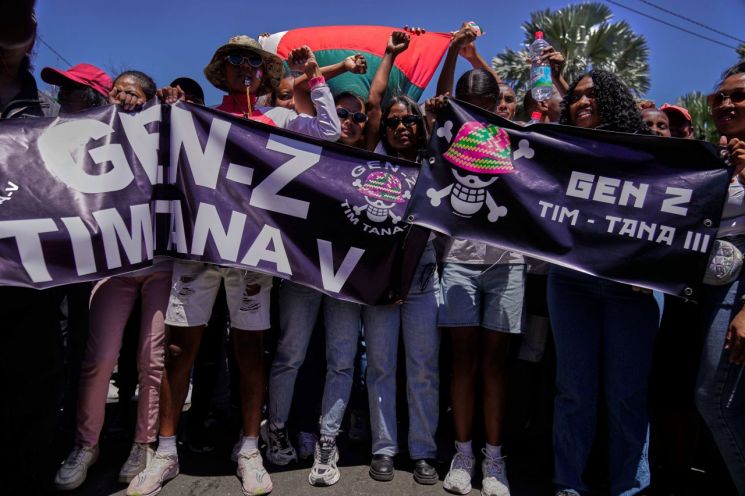 On the 14th (local time), anti-government protesters cheer as the Madagascar military and parliament pass an impeachment motion against President Andry Rajoelina, who fled abroad. Photo by AP Yonhap News
The government of Madagascar, an African island nation, has collapsed due to anti-government protests led by Generation Z (those born in the mid-to-late 1990s to early 2000s). Analysts attribute the sudden eruption of discontent among young people to a combination of stagnant national income-stuck at around 500 dollars since 1980-and a youth unemployment rate exceeding 40 percent. Following Nepal last month, the fall of the government in Madagascar due to Generation Z-led protests is heightening concerns in Southeast Asian and African countries with large youth populations.
Per Capita GDP Drops Below 1980 Levels... Economic Crisis Triggers Generation Z Uprising
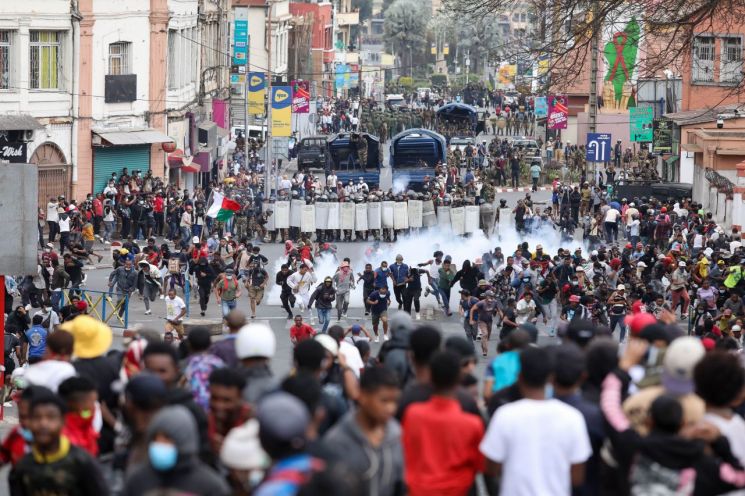 On the 30th of last month (local time), a large-scale anti-government protest led by young people took place in Antananarivo, the capital of Madagascar. Photo by AP Yonhap News
On the 17th (local time), Colonel Michael Randrianirina, who had served as the head of Madagascar's military and interim national leader, was inaugurated as president. Previously, on the 14th, Madagascar’s parliament passed an impeachment motion against President Andry Rajoelina, who had fled abroad, with 130 out of 163 members voting in favor, making his ousting all but certain. As anti-government protests led by Generation Z continued for more than two weeks, political instability deepened, and the military joined forces with the protesters to remove President Rajoelina, ultimately resulting in the collapse of the regime.
The main cause of the protests is cited as the severe economic crisis. According to the World Bank, Madagascar’s annual per capita GDP last year was 545 dollars, ranking 186th in the world. This figure is not only lower than the 577 dollars recorded in 1980, but also falls short of the average of 571 dollars since the country gained independence from France in 1960. It is less than half the per capita GDP of North Korea (about 1,200 dollars), which is classified as an extremely poor country.
Madagascar, whose main industries are tourism and agriculture, has faced a sharp decline in tourist arrivals due to the COVID-19 pandemic. Recently, severe climate change has led to frequent droughts and typhoons, significantly reducing agricultural productivity and worsening the economic crisis. Last year, the poverty rate reached 75 percent, youth unemployment exceeded 40 percent, and frequent power and water outages further fueled the discontent among young people.
Economic Crisis Worsened Under Rajoelina... Corruption and Polarization Turned the Military
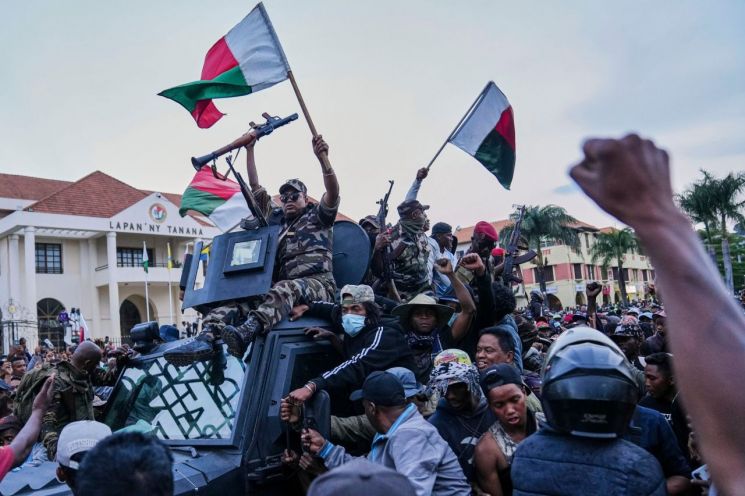 On the 12th (local time), the military, joined by anti-government protesters, entered the city center of Antananarivo, the capital of Madagascar. Photo by AP Yonhap News
Corruption by President Rajoelina, who came to power in a 2009 military coup, and his associates also emerged as major factors behind the anti-government protests. Critics argue that during his prolonged rule, Madagascar’s economic crisis deepened and corruption became even more rampant.
Born into a wealthy family in Madagascar, President Rajoelina was the CEO of Viva TV, a Malagasy broadcaster, before entering politics in 2007. He seized power in 2009, being appointed as the head of the High Transitional Authority, the interim government formed after the military coup. He was then elected president in 2018 and secured a second term in 2023, paving the way for long-term rule.
However, the situation changed dramatically after a small protest broke out on the 19th of last month and quickly escalated. When the police used force to suppress youth protests demanding solutions to water and electricity shortages and arrested two protesters, more young people joined the demonstrations in defiance.
As anti-government protests spread nationwide, even the military, which had supported President Rajoelina, turned against him. The elite CAPSATS unit, which had helped him seize power, switched sides to support the protesters, and both the military and police declared they would not open fire on the demonstrators, leading to the collapse of the regime. President Rajoelina reportedly fled to the United Arab Emirates on a French military aircraft on the 12th. Although the French government has refrained from making an official statement, it is believed to have assisted Rajoelina, who holds French citizenship, in his escape.
Generation Z-Led Revolution Succeeds After Nepal... Protests Spread Across Southeast Asia and Africa
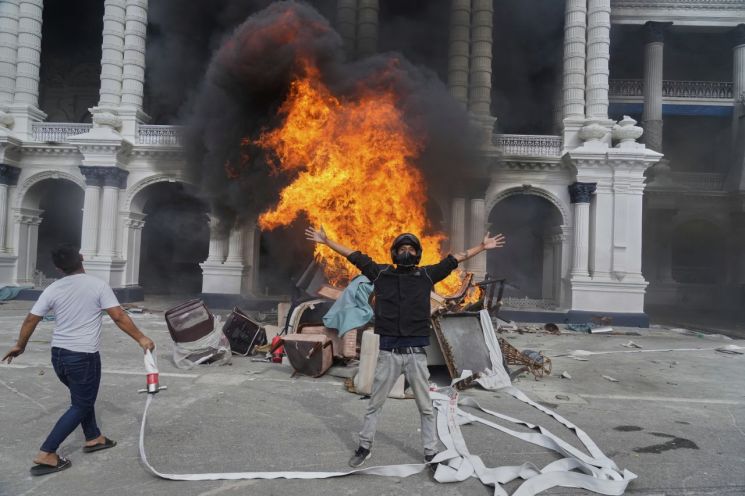
Following Nepal last month, the collapse of the government in Madagascar due to Generation Z-led protests signals the potential for youth-led movements to spread rapidly, especially in the poorest countries of Southeast Asia and Africa.
According to The Guardian, Madagascar’s Generation Z protesters were highly motivated by the success of the Nepal protests, which they observed through social media, and adopted many of the same protest and resistance tactics. Current Generation Z-led anti-government protests in Morocco, Kenya, Indonesia, the Philippines, Peru, and Paraguay have also been influenced by the Nepal movement.
Most of these countries are low-income nations heavily dependent on tourism and agriculture, and they share the common challenge of prolonged economic stagnation following the sharp downturn in tourism after the COVID-19 pandemic.
However, some observers caution that with the military ultimately taking power after the collapse of the government in Madagascar, it may be difficult for the voices of Generation Z to be directly reflected in politics. Luke Freeman, a professor at the University of London and an expert on Madagascar, said in an interview with France 24, "Generation Z protesters acted as the catalyst for political change in Madagascar, but in the end, the military regained power. Even if a new civilian government is established, there is a risk that Generation Z protesters will be marginalized in the process of political reform."
© The Asia Business Daily(www.asiae.co.kr). All rights reserved.
![Clutching a Stolen Dior Bag, Saying "I Hate Being Poor but Real"... The Grotesque Con of a "Human Knockoff" [Slate]](https://cwcontent.asiae.co.kr/asiaresize/183/2026021902243444107_1771435474.jpg)

















