KCCI Holds '2035 NDC Industrial Sector Forum'
At the site discussing the government's 2035 Nationally Determined Contribution (NDC) greenhouse gas reduction targets, the steel industry voiced concerns about practical limitations. The industry suggested that, since the commercialization of hydrogen-based steelmaking is expected by 2037, the timeline for the NDC targets should be adjusted to reflect the commercialization schedule of these core carbon-neutral technologies.
The Korea Chamber of Commerce and Industry held the '2035 NDC Industrial Sector Forum' at 2 p.m. on the 13th in the Members' Meeting Room of the Korea Chamber of Commerce and Industry in Jung-gu, Seoul. The event was organized to gather opinions from various stakeholders, including the industrial sector, on the government's draft 2035 NDC. Participants included Nam Jeongim, Director of Climate, Environment, and Safety at the Korea Iron & Steel Association; Lee Sangjun, Professor at Seoul National University of Science and Technology; and Oh Ilyoung, Director of Climate, Energy, and Environment Policy at the Ministry of Climate, Energy, and Environment.
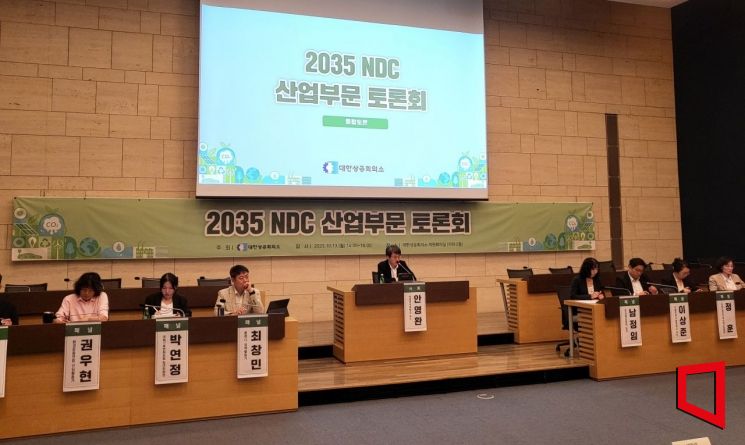 The scene of the '2035 NDC Industrial Sector Forum' held at 2 p.m. on the 13th in the Members' Meeting Room of the Korea Chamber of Commerce and Industry in Jung-gu, Seoul. Photo by Shim Sunga
Director Nam Jeongim stated, "Achieving carbon neutrality requires the cooperation of all sectors of the nation, but at forums, the industry is often criticized for being passive, which is very frustrating for those of us in the sector." She emphasized, "To transition to a decarbonized industry, five foundations must be established: core technologies, investment, market demand, energy infrastructure, and raw material supply chains."
She continued, "Hydrogen-based steelmaking, the core reduction technology for achieving carbon neutrality by 2050, is included in the draft 2035 NDC at a minimum scale of 1.5 million tons. However, the industry expects that commercial facilities will only be introduced by 2037." She argued, "The government must take into account the commercialization timeline of core carbon-neutral technologies, such as hydrogen-based steelmaking, when setting the NDC targets."
Nam Jeongim added, "Although an electric arc furnace, which cost over 1 trillion won, will begin operation next year, the market is not accepting the increased costs, resulting in a structure where the more we produce, the more losses we incur." She explained, "When I mentioned that hydrogen-based steelmaking would be possible as early as 2037, the response was that the industry was lukewarm about decarbonization. Considering that it took 11 years to expand a 600,000-ton facility to 2 million tons, and that hydrogen-based steelmaking involves changing the reducing agent itself, saying we will expand a 300,000-ton facility to 2.5 million tons in seven years demonstrates our determination to compress the timeline as much as possible."
Professor Lee Sangjun commented, "Companies have experienced situations where only the government's targets remained while its promises disappeared. The government must provide assurances, whether in the form of agreements or contracts, so that companies can trust and follow." He further stated, "Eco-friendly competitiveness is not the source of all competitiveness. If companies cannot make profits from their current main businesses, they cannot invest in eco-friendly initiatives at all."
Jeong Hoon, head of the Future Industry Team at the National Assembly Future Research Institute, explained, "Although there is an obligation to submit NDC targets to the United Nations, there is no binding force to achieve them. From this perspective, it may not seem like a regulation, but domestically, the 2050 carbon neutrality target is stipulated in the Basic Act on Carbon Neutrality, and the 2030 NDC target is also specified in law as an interim target, so it is inevitably perceived as a regulation."
He added, "There is a need to redefine the roles of the government and the industrial sector. The government should establish strategies necessary to achieve national targets and design incentive systems and policies so that the industrial sector can participate and implement these strategies together."
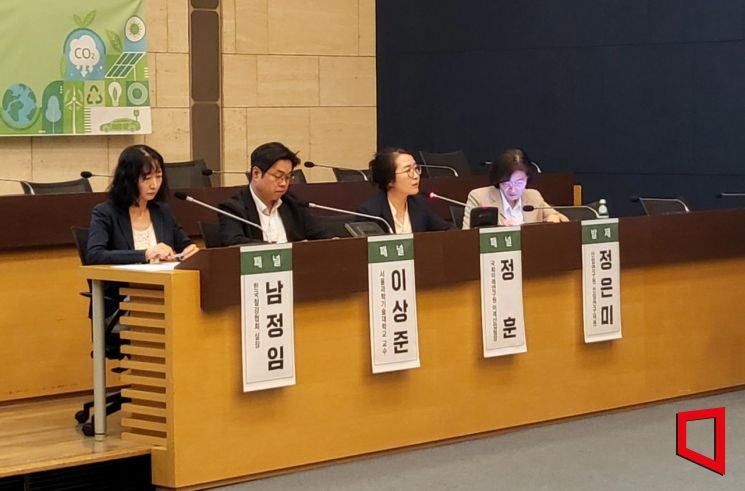 At 2 p.m. on the 13th, Jeong Hoon, head of the Future Industry Team at the National Assembly Future Research Institute, is speaking in the Members' Meeting Room of the Korea Chamber of Commerce and Industry in Jung-gu, Seoul. Photo by Shim Sunga
In response, Choi Changmin, a policy activist at Plan 1.5, criticized, "Despite anticipated global demand stagnation and supply surplus, the industrial sector forecasts an increase in production, which has led to projections of increased emissions and a shift toward rising total national emissions. There is also an excessive reliance on ESG reports created by companies or associations when applying reduction measures." He further argued, "Indicators such as the world's lowest emissions trading prices and the Organization for Economic Cooperation and Development's (OECD) lowest share of renewable energy generation prove the failure of the current decarbonization transition. In this situation, adjusting the pace until 2035 means voluntarily giving up the last chance to catch up in the decarbonization race."
Director Oh Ilyoung stated, "We are considering both the economic and normative aspects in setting greenhouse gas reduction targets. We are preparing not just numerical targets but also proposals on what the government and society should do together."
NDC (Nationally Determined Contribution) refers to the greenhouse gas reduction targets that each country sets for itself under the Paris Agreement framework. The government plans to submit the 2035 NDC, which sets the reduction target for 2035, to the United Nations Framework Convention on Climate Change (UNFCCC) next month. Regarding the 2035 NDC, the government has proposed four options to reduce emissions by between 48% and up to 65% compared to 2018. The four options are: 48% (reflecting industrial sector demands), 53% (average annual linear path from 2018 to 2050), 61% (international community recommendation), and 65% (civil society recommendation). South Korea's 2030 national reduction target (2030 NDC) is a 40% reduction compared to 2018.
© The Asia Business Daily(www.asiae.co.kr). All rights reserved.
![Clutching a Stolen Dior Bag, Saying "I Hate Being Poor but Real"... The Grotesque Con of a "Human Knockoff" [Slate]](https://cwcontent.asiae.co.kr/asiaresize/183/2026021902243444107_1771435474.jpg)
















