Priority Given to Sites with High Power Demand and Generation Capacity of at Least 1MW
Monitoring of Actual Farming Activities and Crop Yields
Solar Power Profits to Be Shared with Local Communities
The government has decided to launch a pilot project for “agricultural solar power” in the Seoul metropolitan area, where electricity demand is high. The project sites will be located in Gyeonggi Province, an area with high electricity demand and no current power grid issues, including industrial complexes. The plan is to first establish two large-scale agricultural solar power models, each with a generation capacity of at least 1MW.
The Ministry of Agriculture, Food and Rural Affairs announced on October 13 that it plans to select two pilot sites for agricultural solar power by December this year.
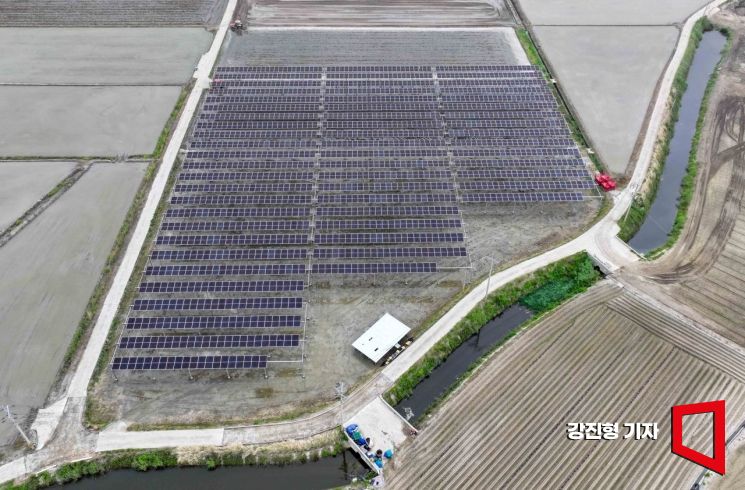 Agricultural solar power plant installed in farmland in Wolpyeong-eup, Yeomsan-myeon, Yeonggwang-gun, Jeollanam-do. Photo by Kang Jin-hyung
An official from the Ministry of Agriculture, Food and Rural Affairs stated, “The government is preparing to institutionalize agricultural solar power and solar income villages, aiming to simultaneously increase farmers’ income and strengthen food security. This pilot project will serve as a precursor to the institutionalization of solar power in agriculture and rural areas, integrating models that focus on scaling up and clustering, as well as returning profits to local communities.”
There are various perspectives regarding the institutional framework for agricultural solar power and solar income villages, including issues related to project operators, the permissible scope of farmland, facility regulations, power grid connections, and local acceptance. To address these, the Ministry plans to use this pilot project to identify and improve areas that need refinement.
The targeted sites will involve leasing reserved farmland owned by the Korea Rural Community Corporation and farmland contributed by local residents. After the facilities are established, the government will designate a dedicated agency to ensure that agricultural activities are actually being carried out and to monitor crop yields, in line with the purpose of the agricultural solar power system, which includes mandatory farming.
Profits from the solar power generation business will be returned to the local community so that village residents can share in the benefits. The pilot villages will be selected in December following an open call for applications. The government and local authorities will actively support all necessary aspects from the project preparation stage.
The Ministry of Agriculture, Food and Rural Affairs will not only lease land but also provide consulting and management support throughout the entire project, including the power generation business. In addition, the ministry plans to quickly proceed with the pilot project for solar income villages, which is currently being prepared.
Park Haecheong, Director of the Rural Carbon Neutral Policy Division at the Ministry of Agriculture, Food and Rural Affairs, said, “Since agricultural solar power and solar income villages are being introduced for the first time, the government is working to ensure that the system is established in an orderly and stable manner, utilizing a variety of pilot models during the institutionalization process. We will thoroughly prepare for implementation by reflecting any issues identified through the pilot projects in the relevant systems and policies.”
© The Asia Business Daily(www.asiae.co.kr). All rights reserved.
![Clutching a Stolen Dior Bag, Saying "I Hate Being Poor but Real"... The Grotesque Con of a "Human Knockoff" [Slate]](https://cwcontent.asiae.co.kr/asiaresize/183/2026021902243444107_1771435474.jpg)















